






About this show:
Habit-making / Habit breaking got you down?
This week’s new show is for everyone who’s ever made or broken a habit – or felt like they’re a constant failure at doing so.
You are not the failure!
One curve ball moment, day or week where you don’t stick to your plan doesn’t mean “you have failed and it’s over”.
The cookie-cutter approach to habits is the failure
I’m genuinely excited to bring you this conversation and the insights that will help any type of person move the needle in the ways you seek to in your life.
Dr Gina Cleo has a PhD in Habits, and her work, her book and this show help everyone find success regarding habits.
She is passionate about translating scientific evidence into simple, actionable strategies to help improve health, wellness, mindset, and lifestyle-related habits – long-term.
Gina has a PhD in habit change, is an Adjunct Professor at Bond University and is an Accredited Dietitian who has recently published a book, The Habit Revolution.
Enjoy the show + tag me @lowtoxlife on Instastories with your shares and highlights from it. Are you a fellow tooth-brushing overthinker like us? This was possibly my favourite revelation. It’s not just me!
Alexx Stuart
Founder of Low Tox Life and the Low Tox movement
Join me on Insta @lowtoxlife
Questions we explore in the show:
- Driving something from the conscious to the subconscious: What’s happening in the brain for this to happen?
- CHARACTERISTICS OF A HABIT – you can read lots of habit books and see so many different takes, but researchers seem to agree on a habit’s 3 central characteristics:
1. a history of repetition
2. a high degree of automaticity
3. being triggered in stable contexts - Understanding these characteristics allows us to identify whether the
actions we are taking are habits or behaviours. Can you explain that difference between habits and behaviours? - How important is feeling the real need to adopt a habit, when it comes to successful adoption vs “I should/that’s probably a good idea” thoughts around a habit.
- Mass externalisation of health ‘answers out there’—how do you think this impacts us in terms of positive life changes? There are so many options and variations as to what it could look like/who to follow, etc. Is this sabotaging our ability to stick to things?
- Is one of the most important things then, really connecting to what certain habits will mean for us in our lives, if we choose to adopt them and do the work to make it so?
- How much does a healthy sense of self “Kind inside talk” have to do with adoption of good habits/letting go of the not-so-good ones?
- Like, someone who has one day where their new habit isn’t sticky and so they let that morning 20 minute walk commitment slide, then the next morning it’s a busy day so they also don’t do that one, but next day, good to go and back into it… whereas another person will miss one day and think ‘well, it’s all over, I failed’ and let it go entirely – is there work to do psychologically to be better at habit building in the first place?
- We’ve talked a fair bit about wanted habits… what about the unwanted ones – is there a difference between ‘adopting’ and ‘breaking up with’ in our brains? Does it take them longer to build habits or stop doing something we know is not great for us?
***
Thank you to this month’s show sponsors for helping you make your low tox swaps easier:
@ausclimate gives you 10% off their range for the whole of 2024, with brilliant Winix Air Purifiers, the best Dehumidifiers I’ve ever used and their new energy-efficient heating range. code LOWTOXLIFE https://bit.ly/ShopAusclimate
@koalaeco gives you 25% off all of July CODE: LOWTOXLIFE. It’s a delicious range of home and personal care products using no new plastic, fake fragrances, dyes, harmful preservatives or phosphates. I’m a bit obsessed with their clothes-washing liquid, stain spray and doggy wash are all on repeat order at our house! https://bit.ly/KoalaEco
Be sure to join me on Instagram @lowtoxlife and tag me with your shares and AHAs of this week’s episode.
***
About Gina Cleo:

Dr. Gina Cleo is one of the world’s leading experts in habits. She is passionate about translating scientific evidence into simple, actionable strategies to help improve health, wellness, mindset, and lifestyle-related habits – long-term.
Gina has a PhD in habit change, is an Adjunct Professor at Bond University and is an Accredited Dietitian. When she’s not geeking out on new habit research, Gina runs courses
through her Habit Change Institute and obsesses over chai lattes. She has also recently published a book, The Habit Revolution.
Connect with Gina on Instagram @drginacleo
Website: www.drginacleo.com
Her amazing book, The Habit Revolution is available via Amazon AU and US in paperback and eBook formats.
Join her Free Habit Course here: habitchangeinstitute.mykajabi.com/masterclass
More about this month’s sponsors:
Thank you to this month’s sponsors for partnering with our show and helping you make your swaps with their special offer:

Ausclimate’s highly recommended range of WINIX Air Purifiers is the ideal solution for cleaner, healthier indoor air. Easy to use, reactive features and settings with a truly comprehensive 4-5 stages of purification, including Hospital Grade True HEPA Filtration and Winix’s unique PlasmaWave® technology. Perfect for smoke, dust, pets, viruses, bacteria, household odours, and allergies (covering a variety of allergens). Breathe easier, sleep better, and feel better. Winix; is the most complete air purifier on the market!

Offer: Ausclimate is now giving all Low Tox Life followers an EXTRA 10% OFF their already discounted prices. Simply enter the discount code of LOWTOXLIFE on check out via: https://www.ausclimate.com.au/
This discount can also be redeemed for over-the-phone orders verbally.
Website: www.ausclimate.com.au
Facebook: www.facebook.com/Ausclimate
Instagram: www.instagram.com/ausclimate

Koala Eco is a purpose-led family business founded by Jessica Bragdon and Paul Davidson. We have created a range of safe, powerful, plant-based products for a clean home, body and mind. Made locally in the USA with high concentrations of Australian essential oils, the range of natural and eco-friendly cleaning and hand & body products are certified non-toxic, vegan and allergy-safe.
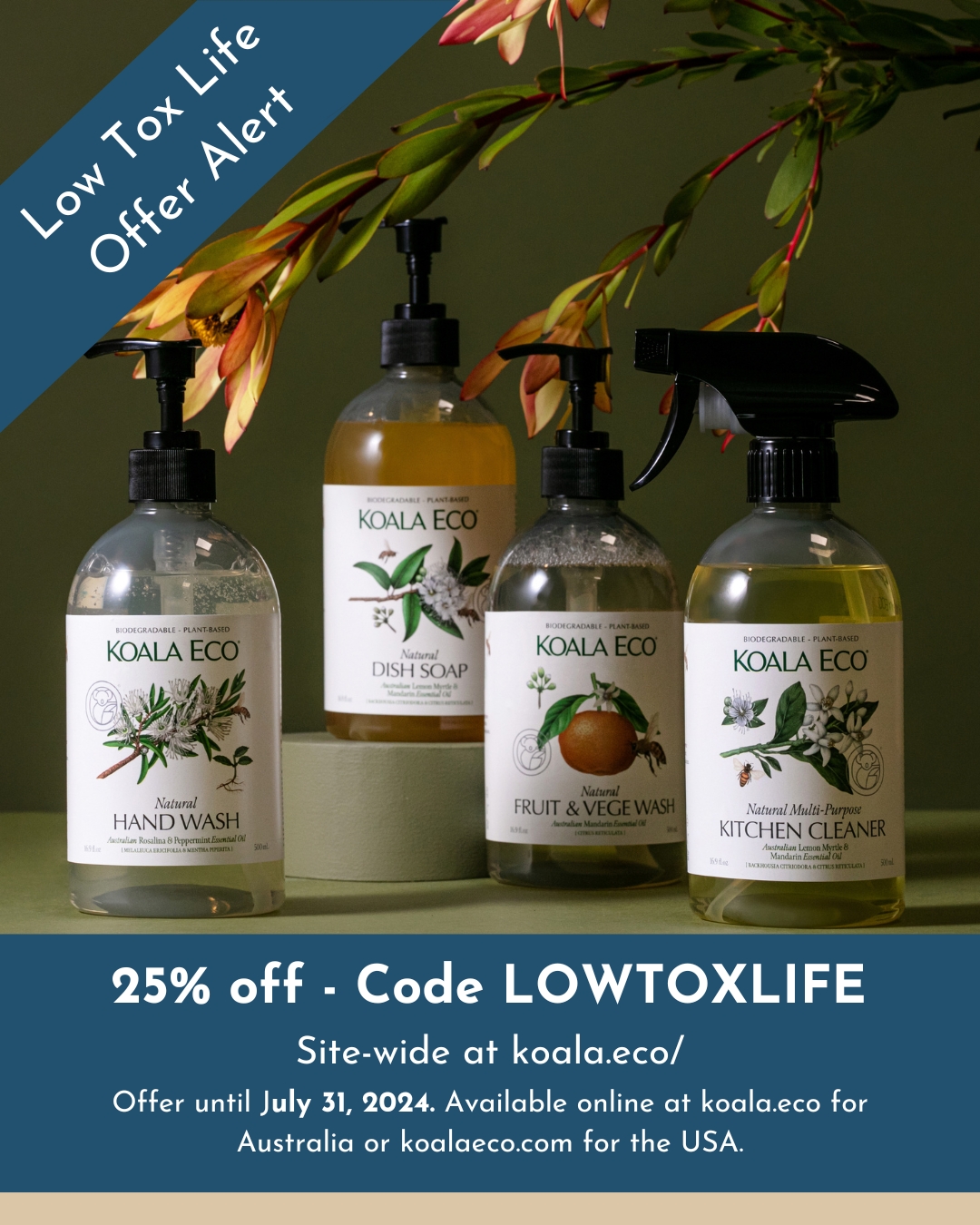
Enjoy the 25% off site-wide with your code LOWTOXLIFE and if you have any questions, feel free to ask in the comments. You can also check out their subscriptions to save even more, which you can cancel any time! Available in Australia AND the USA, a beautiful range of low tox home and personal products.
What to say about this lovely, Aussie/American brand of goodness other than we’ve had the liquid laundry wash, doggy wash and now Stain Spray too, on regular reorder for a couple of years now? Koala Eco is a purpose-led family business founded by Jessica and Paul. They’ve created a range of safe, powerful, plant-based products for a clean home, body and mind. Made locally in the USA with high concentrations of Australian essential oils, the range of natural and eco-friendly cleaning and hand & body products are certified non-toxic, vegan and allergy-safe. I love that they provide refills for products, given pumps are notioriously hard to recycle, and no virgin plastics are used in the range.
Fun fact – the laundry wash is 100 washes per bottle (tell my teen that, though, who always uses far too much!!! hehe) so it’s extremely good value. The Eucalyptus rosemary liquid is our family favourite.
Instagram: https://www.instagram.com/koalaeco
Facebook: https://www.facebook.com/koalaeco
***
Title show track, by LIOR.
Love the podcast music? You will hear excerpts from Lior’s track “Caught Up” – go check it out on iTunes or Spotify if you want to hear the whole song or album, Scattered Reflections. Co-written with Cameron Deyell, it’s a great song and I love the reflective energy of it – perfect for the show, right? Enjoy. Lior is always touring, so do check out his website. It is wonderful to hear him sing live, trust me.
Low Tox Club – The place to bring your low tox life to life.
Want to join a community of like minds and enjoy all the perks of being in the Low Tox Life inner circle such as an online membership platform, 50% off all our Low Tox courses, an awesome chat group, my monthly Q&A, and special guest star interviews for just $49AUD ($29USD/28EUR/23pounds) per YEAR? We have created a special place and set of resources to help you achieve your goals and it’s a wonderful place to be – MORE DETAILS AND REGISTRATION HERE.
***
If you would love reading like me or you just simply want to go through the full transcript, you can check below.
[Alexx Stuart] (0:00 – 5:59)Hard to bring in good new habits or discard habits you know aren’t serving you? Today’s show is all about it. Hello and welcome to the LOTOX Live Podcast.
I’m Alexx Stuart, your host, and today is show 392, and I have a brilliant guest for you. Dr. Gina Cleo is joining me on today’s show to talk about habits. Gina has written a book on habits, so, and she has a PhD.
She knows a lot about them, and what I find brilliant about today’s show is just how soothing it was about how important it to factor in knowing yourself really well when it comes to habits. We address for the first time the idea that neurodivergent people need to look at habits in a different way. It’s something I actually talked to Chris Giebel about when he was on the show a few months ago, and you might have seen the post on Instagram was how you read those habit books as someone with ADHD, and you need that excitement, diversity, things to often be changing or have variable components, and you will be trying to be funneled or trying to funnel yourself into someone’s protocol and wondering why it’s never working is because it’s their success method. It’s not going to necessarily be your success method, and this is a recurrent theme as we explore habits and what it takes to keep them and what it takes to break them on today’s show with Gina.
So, Gina is one of the world’s leading experts in habits. She’s so passionate about translating the scientific piece into the simple actionable strategies that are flexible enough to help you then frame how you are going to do what you want to do and what you want to stop doing. She is an adjunct professor at Bond University and an accredited dietitian.
So, I just think she’s got a really beautiful way of making room for the human in her work, and often people are constantly in a shame and fail state when it comes to habit adoption or habit breaking, and today you ain’t going to feel like that if that’s been you in the past, as well as people who actually are just really good at focusing and getting the habit on board and doing what they need to do. There really is something for everyone in today’s exploration of the subject of habits, but I guess what I wanted to get across was you were going to find a flexibility that you perhaps haven’t felt before and some pretty hilarious personal anecdotes that we both share along the way.
So, I’m going to hook into that in a minute, but remind you that you have 25% off for only another week with Koala Eco, a beautiful Lotox brand available in Australia and the US, this discount. So, make the most of it out there, and the code is LOTOXLIFE. We’re making all podcast code now LOTOXLIFE, so you don’t have to remember anything complicated, but if you like beautiful smelling natural Lotox cleaning products, home products, or even a dog wash, then I would urge you to try a couple of things from the range.
They are a Sydney-based company, actually. Their office is probably about 500 meters away from where I live, funnily enough, and I really appreciate their lack of synthetic fragrance, no new plastics, no dyes. Often a lot of people get tripped up switching to Lotox brands that they think are Lotox, but it’s actually a green wash brand that’s still using like bright green and bright blue petroleum-based dyes, but then there’s a picture of a planet on the front, so people think they’re making a good choice.
It’s not your fault, it’s complicated out there, but definitely no dyes or synthetic fragrances used by Koala Eco, no strange harmful preservatives that are going to irritate your skin, and no phosphates. I’m very obsessed with their clothes washing liquid, I talk about it all the time, so enjoy trying their range. Of course you also have 10% off code LOTOXLIFE again with Oz Climate, our major sponsor, all year.
If you haven’t tried their Winix air purifiers, I want to give a special shout out to the compact four-stage air purifiers that are perfect for bedrooms, especially if you have a family member with dust mite allergy, or let’s just say you live near a road, or you live near agricultural chemicals, or you’re suspecting there’s mold, but it’s going to be a few months of kind of going down that road and you just want to make sure your indoor air is clean, especially where you’re sleeping.
The compact four-stage is fabulous, they have a filter club which you can subscribe to filters to keep the cost of the replacement filters down as well, and of course the dehumidifiers that I always rave about and their new energy efficient cleaning range. Enjoy those wonderful swap offers from our sponsors and now let’s talk habits. Gina, welcome to the podcast.
[Dr Gina Cleo] (5:59 – 6:01)Thanks so much for having me, it’s so good to be with you Alex. [Alexx Stuart] (6:02 – 6:36)
I’m really excited to chat to you, I’ve been following your work for a while, your book is excellent but came out just this January past, and obviously you were doing a lot of work on habits way before you wrote the book on it, and I want to unpack a few different things as we chat today. So first is just a personal question around when did habits start to become something that you personally were trying to unpack, maybe for personal reasons or academically, which one came first for you and why? [Dr Gina Cleo] (6:37 – 7:33)
Definitely personal reasons, I feel like anyone who’s like a super freak in terms of like being really into what they’re doing, in my experience anyway, has had some sort of personal story or journey with you know whatever their interest is. For me, I really struggled with my eating habits, I struggled with not having consistency and I also struggled with not eating to my values, like I wanted to eat healthy and you know live a certain lifestyle and I didn’t, and I felt like I was out of control with that, and that’s what really got me interested in this idea of how to create sustainable change, I can do something for half a day or even a day if I’m having a really good day, but how do I make it sustain long term so that this becomes my life, my identity, who I am, just how I live, and that’s what started my fascination with habits. [Alexx Stuart] (7:34 – 8:05)
Oh I love that, and so it’s so good what you say there around how do I make it true to my values, like how do I get those things to match up, and so why is it that they don’t, because surely you know we do all that values work and we really connect to beautiful stories around health and where food comes from and produce versus ultra processed crap, and then like why can’t we just do it if we know it, it’s the million dollar question. [Dr Gina Cleo] (8:06 – 9:10)
Yeah I mean knowledge is power to some extent, but we’re not driven by our knowledge, we’re driven often by our emotions, it’s our emotions that play the biggest role in why we do the things we do, and yes we might have all this great knowledge about all these beautiful foods and wonderful lifestyle, but there’s all this other world that’s easy and convenient and dopaminergic and it makes us feel good and it’s accessible and it’s affordable and it’s socially acceptable and it becomes really easy to to fall into the things that give us short-term pleasure, because let’s admit it, something like a chocolate or an oreo is going to make you feel good in the more than something like kale or a stick of celery, in the moment your dopamine is like hey I actually prefer the taste of chocolate than I do to celery for example, so those short-term pleasures become tempting, they become yeah like something that we’re drawn to especially when we’re stressed or tired or fatigued. [Alexx Stuart] (9:11 – 9:50)
And the way the modern world is set up from an access convenience and cost perspective, what gets subsidized you know it’s all the grains and you know we could just go on and on about the food system implications, but we really are geared against ourselves in modern life and do you think a part of us starting to actually feel more successful around habit adoption is learning about how hard it is, like can that actually be a part of wow you are doing so great even doing this three days in a row, look at this system that’s doing everything to make sure that you don’t eat healthy. [Dr Gina Cleo] (9:51 – 10:52)
Yeah totally, I actually think I like to call it counting the cost because every single change we make in our life comes with some sort of sacrifice, like my husband and I love making raw desserts and like we just like love making everything from scratch, whether it’s our bread or crackers and we just like take pride in doing things like that. But we know that for us we don’t have children, we’ve got plenty of time, we’ve got resources and the cost for us is it’s not a huge sacrifice because we enjoy it, but for someone else who maybe does have children or both people work full-time jobs, it becomes much more challenging and it’s so important to be really sober about the sacrifice that we need to make in order to achieve our goals because sometimes when we look at it it’s and we can have so much more self-compassion to think okay I did it for three days and that’s awesome because it’s it did take sacrifice to achieve this. [Alexx Stuart] (10:52 – 11:16)
Yeah absolutely, it’s so so important and I think we often dance between pleasure and duty around food and I think that’s one of the self-compassion is like so important because for me that’s the the piece where the one day doesn’t become the permanent fail on the thing that you’re trying to change, right? [Dr Gina Cleo] (11:16 – 11:34)
Yeah so true, I like to say you know one great moment it can change your present moment but a collection of such moments can change the course of your life and it’s about the accumulation of things and your self-compassion plays such a huge role. Massive. [Alexx Stuart] (11:35 – 13:09)
I think there are a lot of books on habits and I’ve read quite a few of them. I am sort of diagnosed if you like neurodivergent ADHD and it helped me make a lot of sense of my life, my choices, things that I found difficult, things that I found super easy say compared to other people as well. I think there are always pros and cons to everything but something that I found fascinating was around habits and I remember a hypnotherapist saying to me in our introduction session he was saying you know it’s like just brushing your teeth you do it automatically and I’m like I’m just going to stop you right there buddy and say I have to every single day set up a whole new neural pathway for me to feel that I can stand there and brush my teeth. That may be mind-blowing to you to consider but I want to let you into my brain and help you understand that it’s not just like brushing your teeth because I actually have to think about it or I forget to do it or I you know and so many people are the same and so I wondered have have you come across these kind of oh you’re not an average case of habit implementation.
I know you talk about various examples in the book and pitfalls and I think that’s fantastic because I haven’t actually seen that before but can we speak to those people who just constantly feel like well habits aren’t even for me because they always feel like I’m starting from scratch.
[Dr Gina Cleo] (13:10 – 13:46)Yeah and like thank you so much for sharing your experience because I am also diagnosed as neurodivergent ADHD and I didn’t realize I was I had ADHD until this like blew my mind until I was reading my book as an audiobook. So I was reading it back to myself and I’m like I am spicy. I am definitely spicy because the things I’m saying about myself how you know I dislike routine, how I struggle with consistency, how I feel suffocated with the idea of structure. [Alexx Stuart] (13:53 – 14:27)
And so it was that a bit of an interesting journey in itself too because I would imagine as an academic on the topic of habits you know you’ve done the research. I actually want to unpack what researchers agree on when it comes to habits as well but then there’s you the individual and you know I think it’s a really interesting thing to unpack how much our individuality then impacts what we know to be true for everybody kind of stuff. [Dr Gina Cleo] (14:27 – 15:44)
And that’s actually the next study I’m really interested in doing is looking at temperament and personality types and trying to understand who is more or less likely to acquire habits long term and who is more or less likely to develop unwanted habits or be able to break their habits quicker because it’s there’s no cookie cutter formula. There’s no one size fits all and it’s so important to know how your brain works. And for people like you and I who don’t really like thrive in routine or structure but also do thrive in routine and structure.
I know for me there are things that work like for I like to exercise most mornings but I won’t do the same thing. I’ll rock up to the gym and be like what do I feel like doing today? This morning I did hot yoga completely randomly.
Tomorrow I’ve got pilates booked in but I might not do pilates. I might get there and decide to do something else. My routine is getting to the gym but what I do has to just be free-flowing and spontaneous and whatever I want to do in the moment and that’s and I’m okay with that.
I’m okay with not being a pro at one thing because that means I have to do it every day and it just doesn’t work for my brain.
[Alexx Stuart] (15:45 – 16:54)Yeah it’s so true. I realized for me it’s exactly the same as that. It’s about creating a sense of broad habit that you want to achieve movement.
Keep it that broad because then 30 minutes of movement is like oh how do I fancy? I might pick up those dumbbells and do a few different Instagram PT exercises and the next day I mean you can always get me to tennis comp. That I will never have trouble being motivated to do but I think it’s fascinating that my favorite sport is tennis because the ball is moving so fast that I have no choice but to follow the ball and something different is happening every single point.
I have to move in a different direction. I have to use a different strategy so it really appeals to my I-need-a-choose-your-own-adventure style of discipline and I think that then speaks to and I want to ask you about that. How much is learning about yourself deeply enough important to then implementing habit change?
[Dr Gina Cleo] (16:55 – 18:20)Yeah it’s so important and alongside that when you learn about yourself and you stop trying to do what other people are doing that’s when we can thrive. I remember during COVID when we were stuck at home for a period of time and I was practicing different stress management strategies to try to help other people and and help myself as well throughout it and I remember downloading every stress management app and meditation app you could think of and I was like I am terrible at this. I struggle to sit still.
I struggle with wandering. My mind’s wandering and I feel like I’m not doing it right whether I am or not. I just didn’t like it and then I remember going outside and playing around with my puppy in my backyard and feeling so chilled and I’m like this is my meditation.
This is my stress relief. This is how it works for me and it was such a beautiful learning moment because when I stopped the noise, when I stopped trying to do what I’m told I should do and what other people are doing and just found what works for me, everything fell into place and I’m like okay this is what I do. I get in nature and I play with my dog and I sit outside for 10 minutes and that’s my meditation and that’s okay.
It doesn’t have to look differently to this.
[Alexx Stuart] (18:21 – 18:55)Yeah, it’s the huge problem for me with externalization, mass externalization of health messages. You’ve got infinite numbers of protocols you could be following, dietary changes you could be making. There’s like if someone’s convincing enough in their sales pitch you could believe anything is the perfect way to do something and yet I feel like every time we listen too much to any one thing we then actually lose that extra little piece of listening to ourselves.
It’s like we erode our own self-connection.
[Dr Gina Cleo] (18:56 – 19:10)It’s so true yeah and when we come back home to ourselves I think that’s the only way we can live the best versions of ourselves but it’s hard because it requires us to stop comparing ourselves to other people. [Alexx Stuart] (19:10 – 19:12)
Oh how do we do that Gina? [Dr Gina Cleo] (19:13 – 19:16)
Well gosh I haven’t worked that one out yet. [Alexx Stuart] (19:16 – 19:21)
Another million dollar question because it’s a huge issue isn’t it? [Dr Gina Cleo] (19:22 – 20:02)
Wow because for me for example I remember hearing someone on a podcast say they exercise three times a week because it takes their body a little bit of time to recover and I’m like wow imagine the liberation of being completely okay with exercising three times a week because Gina’s brain, my brain’s like no girl you’ve got to do five minimum otherwise you’re not really being active. But there’s constantly these lessons where I’m like but that’s what works for that person and they feel good doing that and like you could do the same and whatever that looks like for you but it’s just stopping the noise maybe spending less time on social media would be really helpful. [Alexx Stuart] (20:02 – 21:25)
I think that’d be pretty helpful I mean how many of us are saying we don’t have time for anything that’s important to us and yet we look at our average screen time per day and I think you could carve out a cheeky hour. So it’s one of those hard truths right and it’s everyone’s in it they’re just as hooked as the next guy and I think you know it’s been really powerful for me to even just realize I used to take my phone to every room I was in around my apartment like why does it have to be with me everywhere I’m just going to the living room like it’s not a big place. So I think just really raising your awareness around how dependent you are on socials or how much time online, focusing on other people’s truths and eroding your own truth I think is a huge piece of this.
Oh my gosh so important. Okay I want to talk about what researchers agree on when it comes to habits because that’s a pretty foundational three-point explanation of what we’re dealing with and I love this is right at the start of your book and then something that caught my eye was distinguishing habits from behaviors. So let’s unpack what those three things are and then talk about that.
[Dr Gina Cleo] (21:26 – 22:24)So the characteristics of a habit are that every habit has a history of repetition. So it’s something that we’ve done more than one time before. It has a high degree of automaticity and automaticity is that point where you’re no longer having to focus and think about every step of doing this particular behavior.
It might be something that you do without even thinking of or you don’t need a reminder to do it anymore it’s just something that happens automatically. So that’s automaticity and then the third point is that every single habit is triggered by something in our internal or external environment. So those triggers could be the time of day, the place you’re in, how you’re feeling emotionally, the people that you’re around or what you’ve just done beforehand.
Every habit is triggered by something. We also all agree that it does not just take 21 days to change. I was going to say, yeah, no research around that.
Yes.
[Alexx Stuart] (22:24 – 22:55)And so the high degree of automaticity, why do some things become more naturally easy for us to automate than other things? Because I could name a million things that I do that are really good for me that I find super easy to automate. So why is it the brushing of the teeth that I find, the cleaning of the pan after a meal, like I would defer that a thousand times over and yet it has to happen.
So why are some things, you know, ah, develop quicker.
[Dr Gina Cleo] (22:56 – 24:39)There’s lots of reasons. One of the biggest ones is the complexity of the behavior. So the more complex the behavior is, the longer it takes to become automatic or hit that point of automaticity.
So some of the latest research shows, say somebody asked, was asked to wash their hands every day. It took them about two weeks to hit a point of automaticity compared to someone else who was asked to go to the gym. That took about seven months for that, like that whole motion of getting into the gym to feel completely automatic.
And when you think about it, washing your hands, it’s easy. You’ve always got to tap around. It’s accessible.
It doesn’t take a lot of time compared with going to the gym, which requires motivation, a change of clothes, getting in the car, driving through traffic, like getting to the gym and having much more time to actually like to enact that particular behavior. So complexity is a big one. And the second one is how badly you want it, how much you care about it or how much reward you perceive that you’re going to get from that thing.
Something like brushing your teeth is such a should behavior. Like no one enjoys brushing their teeth. It’s boring.
It’s time consuming. It feels tedious. It’s something you do every single day, twice a day.
Do we have to do this again? One day, if I was to invent one thing, it’s going to be like this mouth bomb. It’s kind of like a Mentos, but like no sugar or toxins.
You just put it in your mouth and it explodes and it’s lost and brushed and done everything you need to. And you just have it once or twice a day. And that’s going to be my invention one day.
[Alexx Stuart] (24:39 – 24:59)I will be your first investor. I am buying shares in that company. I am.
My poor dentist, Lewis, if you’re listening to this, I do actually brush my teeth twice a day. I’m just letting you know, but I just, it’s not automated, never has been. So you think it’s actually, the research is showing us it’s because it’s a should and a have to.
[Dr Gina Cleo] (24:59 – 25:18)Yeah. And I mean, the act of brushing your teeth might be automated, but when you do it might not be automatic. So you don’t have to learn how to brush your teeth.
As soon as you start, you know exactly what you’re doing. You can do it fairly mindlessly, but it’s the act of starting. That’s the hardest part.
Was that fair to say?
[Alexx Stuart] (25:19 – 25:20)Yeah. Yeah. A hundred percent. [Dr Gina Cleo] (25:20 – 25:31)
And it’s because it doesn’t offer you an instant reward. And so it’s just not that enjoyable and you’d rather be doing something else. And so your brain’s like, well, I’m going to go do this instead. [Alexx Stuart] (25:32 – 25:53)
Yeah. Very interesting. And so there’s obviously quite a few types of things like that, that fall into that slight should and have to, and it’s a good idea to category.
So are they the ones that you think spicy people tend to be the worst at?
[Dr Gina Cleo] (25:53 – 26:34)I think so. From my own personal life, a hundred percent. Because we like, spicy people like instant rewards.
We want something to feel good right now. And a lot of the things that are healthy for us, like brushing our teeth or washing the dishes are going to be good for us long-term. So you’re brushing your teeth one time, it’s not going to do anything.
It’s not until you’ve been brushing and flossing for months or years that your dentist is like, Hey, well done. You’re, you’re doing a good job. You don’t need to get dentures or fillings or whatever it might be.
It’s a long-term game and that just doesn’t work for spicy brains. Like we want the reward now.
[Alexx Stuart] (26:34 – 26:39)Yeah. Yeah. Maybe we need the 10 points in a gold star chart in our bathrooms Gina. [Dr Gina Cleo] (26:41 – 26:45)
Actually, we joke about this, but it legitimately helps. [Alexx Stuart] (26:46 – 26:51)
Wow. Even for adults, you found like actually having achievement charts. [Dr Gina Cleo] (26:51 – 27:31)
Wow. We don’t grow out of reward learning as adults, which is why when we’re trying to create a new habit, using something like a habit tracker is so powerful. A habit track is essentially when you write down the habit you want to create, and then you tick off every time you’ve done it.
And the really, really good apps are the ones that are going to give you something like a confetti party or a little like vibration or like a woohoo or something that gives you that hit of dopamine that makes you feel really good about doing it. So you want to do it again. It reinforces the habit in your life.
We never grew out of reward learning. So gold stars. It is every time you brush your teeth, Alex, from now on.
[Alexx Stuart] (27:31 – 27:49)I’m up for it. Who knows? And like, so then if the reward learning works, is it still though about getting us on a path to automaticity?
Like surely at some point you don’t need a fricking gold star. Surely.
[Dr Gina Cleo] (27:50 – 28:09)Definitely. Definitely. Okay.
Once something starts to feel automatic and you start to notice that you’re no longer having to motivate yourself to do it or remind yourself to do it, you know, you’ve hit automaticity. Then you can stop the gold stars. And if you think of something like putting your seatbelt on in the car, I assume that you always do that.
[Alexx Stuart] (28:09 – 28:10)Yeah. [Dr Gina Cleo] (28:10 – 28:15)
That is automatic. You don’t need to give yourself a tick for doing it. So there is a transition point. [Alexx Stuart] (28:17 – 28:33)
So I need to take that. I don’t want to die. I’m putting on my seatbelt automaticity too.
I don’t want feelings that feels revolting. Okay. Yeah.
I’m going to have a play with that because I’ve always been, I always do it, but I’ve always been genuinely curious as to why I’ve never been able to automate it. Yeah.
[Dr Gina Cleo] (28:33 – 28:42)I’m the same. I know exactly what you mean. I always do it, but the time is sometimes it’s first thing when I wake up, sometimes I’m like, I’ll do it after breakfast. [Alexx Stuart] (28:43 – 29:00)
Yeah, because I do a lot of thinking. I’m like, yeah, but then if I’ve had my eggs, that’s going to taste really gross. And then so like I plan it, but then I don’t want to have my first cup of tea and have a minty taste.
And there’s a lot of chat going on in the brain around this daily struggle.
[Dr Gina Cleo] (29:00 – 29:07)Literally I’m like, right, when’s breakfast and can I brush my teeth before or after? And what’s that going to taste like? [Alexx Stuart] (29:07 – 29:51)
I feel like a lot of people are hopefully going to feel a little bit comforted by the fact that sometimes you feel like a failure, but actually there’s just a lot more to it. Getting to know yourself, getting to know your own journeys of automaticity, what’s going to motivate you. This is awesome.
And the third point being triggered in stable contexts. I was intrigued by what that means. What does triggered mean as it is that like, Oh, I’m going to do this now because I’m here and I’m at home and I’ve just had my breakfast and my tea so I can definitely brush my teeth.
Is it, is that what you’re saying? It’s not like a trauma trigger or something.
[Dr Gina Cleo] (29:52 – 30:50)No, although that can also be, but not generally for habits. They’re more for like impulsive behaviors, but think of, let’s say the time of day, like the time that you say, move your body might be similar every day. And your brain knows for me, it’s the morning, for example, my brain knows first thing in the morning, what I do is I move my body.
So my habit to move is triggered by the time of day. The other trigger that I have is say, I always feed my dog straight after I finished my dinner. So my trigger is finishing dinner.
And then my habit is feeding my dog. I never feed her beforehand and I never feed her during my meal. It’s always straight after.
So that’s the trigger. Sitting in the car is a trigger for putting your seatbelt on and the seatbelt is the habit, but you’re triggered by sitting in the car. You take seats, lots of other places in your day, but you’re not triggered to put your seatbelt on anywhere else other than the car.
That’s the stable context.
[Alexx Stuart] (30:51 – 31:55)Got it. Okay. And so with stable contexts then, why is it that with things that we’re trying to build a habit around, some of us can go like two, three weeks and we’re kicking our goals and isn’t this amazing.
And then you miss one day because you feel a bit under the weather, or if you exercise outside, it’s pouring with rain and you cut yourself some slack that day. Then the next day is really busy at work. So you think, ah, yeah, I just, no, I don’t have time.
And then you just jump straight back on the horse and you keep going. No big deal. But someone else is going to get to that two, three week mark, miss one day, tell themselves this horrible story about how it’s not for them.
They can’t do it. They can’t hack it. I’m curious about the impact of generally having negative self-talk and perhaps having positive self-talk, um, and actually working on that as a vehicle for them being more successful at habit adoption.
[Dr Gina Cleo] (31:55 – 33:06)Oh, I love that you’ve asked this. Mindset is everything when it comes, the habits we create in the habits that we break. Every single person, even the most successful people will have setbacks.
It’s not if it’s when like life happens and we will always have a hurdle. There will always be something that gets in the way that we didn’t anticipate. And it’s not a matter of if it happens, it’s when, and then we want to then go, what is my setback strategy?
And I always like to have some kind of, I call them bounce back plans, my bounce back plan ready for when my like hurdle comes because I know it’s going to. And the most successful people aren’t the ones that not fall because we all have falls. They’re the ones that get back up and do it quickly.
The ones that know that success is not linear and they’re bound to have these setbacks and it’s okay. It’s actually part of the process. And they’re able to have that self-compassion to go tomorrow’s a new day or this moment’s a new moment instead of having that all or nothing mentality, which just doesn’t serve us at all.
[Alexx Stuart] (33:06 – 33:20)Not at all. And do you fit, do you have advice for people who are trying to transition from all or nothing to no biggie, this is part of the overall picture because that’s, that’s work to do in itself. Like how could that work look for people? [Dr Gina Cleo] (33:20 – 34:13)
And it’s hard and no, even like the transition of that mindset is going to be a process of two steps forward. One step back, you’re going to be really good and not having all or nothing thinking for a day, a minute, an hour, and then you’re going to fall back into it. And then you can exit out and fall back in because you’re retraining your brain to think differently.
I think just keeping in mind what, what really helped me was to think it’s not if it’s when is that everybody is going to have a setback. The setback is part of it. So for me to create this like beautiful plan and to expect it to go perfectly, that’s not actually how it’s going to happen.
And so when I changed my expectation around the journey, that’s when I was like, okay, this setbacks part of it. I expected this to happen. And I have a strategy for this very moment.
I think that really helps.
[Alexx Stuart] (34:13 – 34:38)Yeah. What’s your bounce back strategy. Let’s say Gina gets the flu and you’re out for the three or four days, maybe even a week.
And like, is there a particular, so this is actually two parts. Is there a particular habit, a healthy habit that you find harder than another one to actually bounce back with? And what is your strategy for the easy and the hard?
Like it, does that change?
[Dr Gina Cleo] (34:39 – 35:59)I am pretty regular with movement, but when I’m not, I’m not. And I don’t know why, like say I’ve had a series of like crappy nights, sleeps, or it’s probably the only thing that would stop me from training to be honest. Cause I don’t really get sick and busyness never stops me from moving.
Cause I need to move for my mental health. So it’s really about like, if I’ve had poor sleep, I don’t go to the gym. I don’t move my body.
And then this becomes a where I’m like, I don’t even know what to do. And I’m there now. And I feel so unfit.
And I, I’m a stranger at this place. And it’s just like this whole mindset goes around it. And then one of my plans is I always remind myself the heaviest weight is the gym door.
You’ve just got to go through the front door. I love that. And the rest is, it’s fine.
You know, exactly. You’ve been training your entire life. You know what to do.
You know how to walk on a treadmill and sit on a bike. If that’s all you do there, it’s absolutely fine. So I just think to myself the hardest, yet the hardest step is that first step and the rest is going to be okay.
So I just need to do that. And that helps me a lot.
[Alexx Stuart] (35:59 – 36:04)So just think of that one little step in front of you and recognize it as the hard one. [Dr Gina Cleo] (36:04 – 36:21)
Yeah. And I’m not trying to get back into fit active Gina. I’m like, I’m just trying to get to the gym today.
And that if that’s all I do this week, that’s better than last week. And that’s all right. So it’s just these micro habits, not expecting big goals or big changes.
I’m just expecting a small change today.
[Alexx Stuart] (36:22 – 37:23)Oh, there’s so much goodness in what you’ve just shared. It’s so true. We, we often create like big statements for ourselves.
I mean, I, I even sometimes I, I do business coaching and I can’t you the amount of times that people have said, yeah, today it’s all about, I’m going to do the website. Okay. That’s quite big.
So how about bullet points for your bio and what that might look like, or, you know, your top three things that you’re going to offer or, you know, really make things smaller and simpler in our minds. Because that for me has always instinctively meant that someone’s actually going to kick some goals today versus you’re definitely not going to get your website done today. Just like someone who’s been out for the count on exercise for a month is definitely not going to feel fantastically fit and strong today.
After that workout, you might think, oh my God, I’m so out of shape.
[Dr Gina Cleo] (37:24 – 37:37)I think we really set ourselves up to fail when we try to aim for things like go hard or go home, or if your dreams don’t scale, they’re not big enough. I loathe those kinds of quotes. [Alexx Stuart] (37:40 – 37:47)
I actually feel allergic to it when I see it. [Dr Gina Cleo] (37:47 – 37:48)
I will literally block you. [Alexx Stuart] (37:50 – 37:52)
I totally agree. [Dr Gina Cleo] (37:52 – 37:53)
It sets us up to fail. [Alexx Stuart] (37:54 – 37:58)
It does. And you’re never going to be that guru. Ever.
Yeah.
[Dr Gina Cleo] (37:59 – 38:43)And there’s no, there’s no need to be, it’s not sustainable. It’s not enjoyable. It’s not desirable.
Like it’s pointless. It’s pointless. But you know, research shows that the smaller the behaviors that we’re trying to change, they’re not only easier to achieve, but they’re much easier to sustain long-term.
And the whole game of habits is sustainability. It’s about consistency, doing things for the long-term and trying to change big things is not sustainable. So there’s really, it’s so counterproductive.
And I think if anyone gets anything out of this chat is start so small, you feel like you can’t say no to doing it. So small and just go with that.
[Alexx Stuart] (38:43 – 39:07)It’s almost ridiculous. The thing that you’ve named. Yeah.
I love that. Love that. I have a question around the things we’re trying to also stop doing and does the brain perceive the adoption of a new habit to be a harder building journey neurologically than a, I want to stop doing this journey.
[Dr Gina Cleo] (39:07 – 41:11)It’s going to depend on the habit, your intrinsic motivation and like why you’re doing it. For example, I worked with someone recently. It was actually my physiotherapist.
He was sort of doing an adjustment and he, I just was just looking down at his hand and he bites his nails and I didn’t say anything, but he noticed that I saw his fingers and he felt embarrassed by that. And he’s like, Gina, I need you to give me a, just give me a tip, give me a hint. And, and I just gave him a little bit of advice around, you know, changing this habit.
I saw him a year later and he said, since I saw you that day, I haven’t touched my nails. I haven’t bit my nails one time. I actually had to go buy nail clippers, which was just like profound for him.
And he said, I did it overnight. And for him, it was such an emotive moment that it meant more for him to not have that moment of embarrassment than to continue in this habit. So for him, it was instant.
Whereas creating a new habit takes time because you have to completely rewire a certain part of your brain. And that time can be anything from two weeks to 10 months. It depends on a whole range of things, but our brain can also see letting go of a habit as losing something, or it could also be very empowering.
It depends on how damaging the habit is for you. I love breaking habits. Like I get a total kick out of it because I like the idea of having nothing in my life that controls me.
I don’t have anything that I have to have or have to do. And so I noticed like, for example, I love a good chai latte that I make at home, but I’m like, Ooh, I’ve been having this for a whole week in a row. I’m going to just have something else instead.
And I’ll go to something else just to make a point to not get stuck in this routine of doing the same thing every day.
[Alexx Stuart] (41:12 – 41:31)You are definitely spicy. I’ve been with my husband for 20 years. He still has to ask me what kind of coffee I want when he orders because I change it up all the time.
I do something different. I’m like, yeah, that’s for piccolo for like a month, but like, let’s change this up.
[Dr Gina Cleo] (41:33 – 41:48)What’s your normal daily routine? I’m like, I don’t have such a thing. Like, what do you normally eat for breakfast?
I don’t know. It’s every day will be different. And I won’t know until I literally pull a plate out and I’ll be like, Oh, I’ll have this.
Like, it’s different. I don’t know.
[Alexx Stuart] (41:48 – 43:19)Yeah. It makes me giggle because I’m exactly the same. And there, it was not my intent intention to make this a, how Nero spicy people can adapt good habits, but here we are.
And look, I think it’s great because I actually talked to the wonderful multi New York times bestseller, Chris Giba recently. He says his name is Gilbert, but I’m French on my mom’s side. I cannot pronounce that that way.
So I say it properly and he laughs at that, but he and I were talking about being Nero spicy and how a lot of the previous habit books we had read. I mean, God bless him, James clear. It’s actually a brilliant work.
The power of habit as well, like really great books. I acknowledge the brilliance, but I couldn’t see myself in them. All I could see was failure.
I genuinely felt like your book was actually a much more open expression of the exploration of the habit topic where lots of different people could say themselves because of the examples you used. And, and so I’m actually thrilled. It’s kind of gone down that road because a lot of people see failure in themselves when they read habit books.
And, and I believe you’ve got something here that is really trying to help someone see what habit means for them and how they can create positive things. So I had to share that because it really was a notable difference.
[Dr Gina Cleo] (43:19 – 44:13)Thank you so much. And you know, I’m so conscious as well, as a habit researcher myself, it’s almost like this expectation that I’ve got the world’s best habits. For the most part, I live a very healthy lifestyle that I’ve designed and I’m really happy with it.
But I also have moments where life happens where I have trauma triggers that totally derail me. And they might derail me for days where I’m just not doing anything I intend to do or desire to do. And we are all human.
And that was such a strong intention with the book is to make it so accessible and relatable to all walks of life, whatever age you are, whatever, you know, journey that you’re on. I wanted it to be like a guide that can just handhold you through all the parts of it. So that means a lot that you’ve shared that.
Thank you.
[Alexx Stuart] (44:13 – 45:19)Oh, you’re so welcome. No, it’s true. I want to talk, we’ve only got a few minutes left, but I do want to explore breaking habits just a little bit more.
Now that we have acknowledged that we find it extremely easy to shake things up and do lots of different things. I want to talk about some of the habits that we know might be self-sabotaging. And yet it’s just like, but it’s after lunch.
I have my chocolate and, but it’s, you know, now, and I’m sad. So I’m going to have the ice cream and I’ve broken up with someone. I’ve got every right to eat a ton of junk food right now.
You know, Hollywood says so. And I think there’s so many cultural subliminal reasons. We end up in these emotional patterns, especially around food.
I wondered whether you could share a few insights if someone’s feeling that going through those, the recognition that that’s something that they’re sabotaging their, their desire for a healthier overall picture in their own habits. Like where do we start with that?
[Dr Gina Cleo] (45:19 – 47:55)Yeah. Oh, I love this. I was the world’s emotional eater.
So I totally relate to what you’re saying. I think it’s getting to the realization that yes, this is going to make me feel good in the moment, but as soon as I’m finished eating this highly processed sugary food, I’m now going to be served with a side order of guilt and shame. And I’m still going to be sad about whatever it was I was sad about.
So actually this is just not a long-term game. Like this is not, it’s not a good idea. And I think when I started to really notice that, that’s when it all changed for me.
The other thing that really helps is every time you do a habit, you’re reinforcing it in your life. And every time you choose not to do a habit, you’re slowly breaking it away from your life. It’s actually called synaptic pruning in the brain where our brain like starts to prune away the neural pathways that we’re not using anymore.
And I remember thinking to myself when I was in the cycle of emotional eating, Gina, you’re not just emotionally eating now. You’re actually making it harder for yourself to stop doing this tomorrow and the day after that. And if you choose not to now, you’re going to be making it easier for yourself to stop this habit for the future.
And that became a point of difference in that it’s hard to just go, well, just this one time, just today, I’ll starting it on Monday because I know that I’m actually going to make it harder for myself. And I’m reinforcing this unwanted habit. The other thing that I think is, is really cool to do.
And it sounds weird, but it’s for some reason works is to really taste the food, like really sit with it. And I remember doing this with, you know, one of my favorite chocolate chip cookie biscuits. And I was like, this actually tastes awful.
Like it tastes like chemicals and it’s all weird. And it’s leaving this weird taste in my mouth. And I actually got this idea from a study they did in smokers where they got smokers to inhale like 30 cigarettes in a row and like describe what it was like.
And they were like, that’s disgusting. And they had a 100% quit rate, which was brilliant. I was like, I’m going to try this.
So I did that. I became really mindful of this food that I perceived as highly palatable and I was super into it. And I’m like, this is actually like, it’s rubbish.
I’m not interested in it anymore. So noticing how I was, how it felt in my body after.
[Alexx Stuart] (47:57 – 49:08)And that mindfulness is so key, right? I mean, because if you grow up and you’ve seen, have a break, have a KitKat a million times on TV, you will equate the break with the KitKat. I remember doing it at uni and I’d never done it before, but all of a sudden we were in between rehearsals for a musical and I was having a break and I had a KitKat and I was like, oh, just like the ad.
I didn’t even really think too much of it. I was 21. But I look back at that and I think, oh, how did you actually break up with junk, Alex?
Because that’s actually quite an interesting psychological journey and people have really different stories. So your mindfulness was around taste. My mindfulness was around company values, how much the CEO is being paid compared to the frontline worker, where the ingredients come from, like becoming just this nerdy a person around everything to do with every ingredient and how it was produced.
And then mindfulness around how awful that all was. It was literally nothing positive.
[Dr Gina Cleo] (49:08 – 49:09)Yeah. [Alexx Stuart] (49:09 – 49:13)
Once I did that. You’re just not interested anymore. [Dr Gina Cleo] (49:13 – 49:14)
I’m not interested. [Alexx Stuart] (49:15 – 49:28)
Yeah. It’s not about, oh, I shouldn’t. Oh, I’m trying to cut down.
I’m trying to be good. Like all that BS we’re used to say to ourselves about I am not giving a penny to that system. No, thank you.
[Dr Gina Cleo] (49:29 – 50:08)The other thing I think of is the amount of research, literally the millions of dollars that food companies put into trying to create the bliss point. And that bliss point is the perfect blend of fat, sugar and salt that makes you addicted and wanting more of the product. And I’m like, I am subscribing and opening a packet of something that’s designed to make me want more and more and more and more of it.
Like it’s designed to hijack the reward system in my brain. And it’s unnatural. And I was like, I’m not going to be part of this at all.
And I’ve I just went cold turkey with I’m not interested in that kind of food anymore.
[Alexx Stuart] (50:08 – 51:54)Yeah, that’s it. And I think there’s a danger now because those marketers are now working for healthier companies and you see things like gluten-free cheesy puffs or organic Oreos. And I’m like, mate, that’s a bit of a stretch, you know, and I think it’s actually, we do need to be a bit smart.
And people used to laugh at me for teaching my boy before he could even talk that the picture of the monkey on the cereal box at the eye level of the toddler walking down the aisle was designed to trick him as if he gets any of it. But the other day I was talking about, we were talking about he’s a ball kid in the summer for summer tennis when all the pros are in town. And there was this pizza party at the end last year and there were no gluten-free options.
He happens to be gluten-free for medical reasons. And I said, Oh, you know, we could bring like a really nice BYO gluten-free pizza. So you and probably a couple of the dudes and girls who shouldn’t be having the gluten, but they’re eating to fit in and all the other things.
He’s like, mom, I wouldn’t even eat the pizza hut pizzas if they did have a gluten-free option. They’re disgusting. They’re so full of crap.
Then, you know, just sort of went on this tirade. And I thought, wow, like it really does matter what you put into our brains, whether it’s the good stuff or whether it’s the evil, insidious advertising stuff, it goes in there. So I think to your point, which we see throughout your book, like let’s start feeding the brain positively and then positive things home.
[Dr Gina Cleo] (51:55 – 52:04)Yeah. And coming home to yourself and your values, what works for you, what you’re being told by whatever industry. [Alexx Stuart] (52:05 – 52:41)
Yeah, exactly. So my last question then is around coming home to yourself and your values, because in this crowded, hyper-externalized world where we’re taking in so many more messages than we were ever designed to do, what could some really positive, lovely things be for someone to do to start doing that work this week? So you’re more in touch with the why of, of adopting habits that you want to adopt and haven’t maybe successfully done.
So in the past, what could it look like?
[Dr Gina Cleo] (52:42 – 53:07)I think, I guess to the theme of that is really about noticing it’s noticing you noticing how you feel when you do something compared to something else. Like for example, we know journaling’s a good idea. The research tells us that I hate journaling.
I hate it. I’m like, I feel like I’m talking to myself. It’s really awkward.
I don’t know what to say. Like I’ve got terrible handwriting. It’s just, I don’t like it.
[Alexx Stuart] (53:08 – 53:12)We are sisters, Gina. I cannot stand it. Yeah. [Dr Gina Cleo] (53:13 – 53:19)
But you asked me to write three things I’m grateful for and do a gratitude journal. I’m all about that. [Alexx Stuart] (53:20 – 53:26)
We do it around the dinner table. I find verbal works for us. So that’s what we do. [Dr Gina Cleo] (53:26 – 54:00)
Yeah. What went well today? Exactly.
And I, so I think it’s notice it’s if something doesn’t feel good, don’t feel bad about it. Just go. It just doesn’t work for me.
Own it. Be okay with it. Like accept that that’s you and you are a beautiful individual and that’s all you need to be.
And if journaling or meditation or gratitude journals, aren’t your thing, that’s perfectly fine. There are 10 other options you can pick that are going to serve your wellbeing. There’s no point trying to have this uphill battle with yourself.
[Alexx Stuart] (54:02 – 54:50)Can you imagine chastising yourself for not journaling? I mean, and that is the world we then live in because if you’re doing a protocol and you’re doing someone’s online course and they’re saying today, I want you to write, you know, this much. And, and like, if you already feel like you failed, you’re not even going to get to the good stuff in their program because you don’t like the journaling.
So that is a brilliant piece of gold to finish with. Well, I encourage everybody to get your book. I think it’s fabulous.
Details in the show notes talked about it in the intro. We can of course connect with you online. And I love, I have not done Confession, the masterclass that you have on offer, but I do want to mention it.
Can you just share a little bit about what’s in it? Because I was intrigued about it when I was researching, but of course I didn’t have time.
[Dr Gina Cleo] (54:50 – 55:41)Yeah. So it’s a free habit masterclass. It’s this five short videos that get sent to you that teach you all about what is a habit, how to create new ones, how to break old ones, why self-control doesn’t work and what to do instead.
And it’s, it’s not one of those resources where I like will spam you with emails after I’m terrible at marketing. So it really is just a free resource. I’m like, sign up to my newsletter.
I’ll hardly ever bother you. Don’t worry. I literally have written two newsletters ever.
I’m like, be a subscriber, get in the know. And I don’t write to people, but maybe one day. But the idea is that it’s a, it’s a free resource as just something to share with people, to teach you the foundations of your habits.
So the short five short videos, you can sign up to it on my website.
[Alexx Stuart] (55:42 – 55:46)I love it. What a beautiful next step. Thank you so much for joining me, Gina.
This was awesome.
[Dr Gina Cleo] (55:48 – 55:51)Thank you. Thank you so much. My spicy sister. [Alexx Stuart] (55:52 – 58:48)
I hope you loved today’s show as much as I loved bringing it to you. I want to remind you that if you are someone who craves a low-tox community, that is judgment-free, full of empowerment, has health professionals and building health professionals that can support you as well as me in there answering questions multiple times a week, I want to invite you to join the low-tox club for the price of less than a cup of coffee a month. You have an annual membership for $49 Australian.
So it’s about $30 US or Euro that allows you to have a member masterclass every single month with a health professional or global expert from the podcast, where we have them to ourselves for an hour to ask questions and deep dive further. You have the beautiful supportive chat group. You have Q and A’s with me, me answering questions.
We read books and talk about them and a whole bunch more. You can head to lowtoxlife.com, hit the explore tab and join the club is the very first option on that list. Of course, we have over 10 evergreen courses that you can jump into anytime, whether it’s navigating everyday low-tox swaps with our go low-tox signature course, whether you have kids and you’re wanting to know how to best support them with our low-tox kids course, whether you’re planning a family and looking at a healthy low-tox preconception journey, reducing inflammation, especially the chronic kind without inflammation ninja course, many, many other courses. You can again, head to lowtoxlife.com, hit the courses tab, and you’ll see all of the options, which includes a business course, my low-tox method program. A lot of people don’t know, but I was doing a lot before starting low-tox life in 2009. And I was a business consultant across hospitality, health, retail, and cosmetics. I have been in business consulting for a very long time.
So I absolutely adore helping people move into the low-tox space or develop their low-tox businesses. So that’s a way I can support you. And then of course, there’s our wonderful social media communities at lowtoxlife on Instagram.
And of course the website with over 250 gluten-free recipes, blogs, downloadable PDFs to help you navigate wanting to get rid of synthetic fragrances in your school or office. I could go on. So head to lowtoxlife.com, see what takes your interest or fancy. And thank you so much for being a part of our podcast community. I love, love, love reading your reviews. I appreciate every follow and subscribe.
And I want to just remind you to finish off that if there’s anything you heard that you found interesting from medical or scientific perspective, it is intended as education only. Please always chat to a health professional who knows you and your situation best. I’ll see you next week.
Bye.
