







About this show:
If you’ve been confused about hormone testing – this week’s show is here to help.
Dr Leah Hechtman, takes us through hormone testing options for age, stage and situation, as well as things that impact the accuracy of a test.
We cover:
- Saliva, Urine and Blood testing – when which one or all are helpful and for whom.
- What reference ranges are based on – and most of us aren’t IT 😳
- Pill effects at puberty & perimenopause (without shaming!)
- The constraints with the medicare model for test ordering and clinical significance, ie, a lot can be done before a crisis occurs that requires a medication.
- How urine testing can be your best guide when considering HRT
- Histamine and run-away estrogen – there’s usually a 3rd party reason beyond hormones that this pathway is activated.
- How progesterone is the good, reliable friend that keeps estrogen from too many wild parties!
- What you can achieve without spending any $$$ exploring your hormone health, up to the breadth of what one can do if you wanted to.
How’s that for ground covered!?
Dr Leah Hechtman (PhD) is a globally respected naturopathic clinician, a revered lecturer and a sought-after keynote speaker who is widely recognised for her expertise, receiving numerous referrals from specialists and fertility clinics on a global scale. Such a pleasure to have her back on the show.
Hope you love it as much as we loved recording it for you, Alexx x
Alexx Stuart
Founder of Low Tox Life and the Low Tox movement
Join me on Insta @lowtoxlife
Questions we explore in the show:
- Hormone testing: What do we know about various hormones and the best ways to test? What can we do at a GP vs naturopath vs endocrinologist that gives us a greater ability to complete a picture when we’re trying to figure things out?
- Hormone testing in different situations and how it can be helpful: Puberty; Preconception; Post Partum; Peri/Meno – so stages, and then scenarios/symptoms – thinking: a few months gone by and trouble conceiving? – Painful Periods; Heavy/clotty Periods;
- Amennoreah; Irregular periods; Histamine-intolerant presentation; Resistant weight loss/weight gain despite lack of change to lifestyle; fatigue/wakefulness when we should be the opposite, ie tired days, wakeful nights…
- If budget is front of mind, how can having a good clinician that can ask the right questions, help us find/piece together a picture of what might be wrong?
- How to audition for a great practitioner, whether it be a GP/Integrative Do/ObGyn/Endocrinologist/Naturopath/Nutritionist/TCM doctor, when it comes to wanting to investigate hormone imbalances that fit your values but also can effectively work with you towards feeling better.
***
Thank you to this month’s show sponsors for helping you make your low tox swaps easier:
@ausclimate gives you 10% off their range for the whole of 2024, with brilliant Winix Air Purifiers, the best Dehumidifiers I’ve ever used and their new energy-efficient heating range. code LOWTOXLIFE https://bit.ly/ShopAusclimate
@blockbluelight_official gives you 20% off site-wide, including their brilliant red light panels, to help you achieve the perfect light balance in your home and for quality sleep, rest and repair. Code: LOWTOXLIFE https://bit.ly/4cRGf6d
@cleannectarine gives you a huge 20% off site-wide to help you make your low tox personal care and beauty swaps achievable! Wow. So generous. CODE: LOWTOXLIFE (excluding water filters) https://bit.ly/4g1Ixm9
Be sure to join me on Instagram @lowtoxlife and tag me with your shares and AHAs of this week’s episode.
***
About Dr Leah Hechtman:

Dr Leah Hechtman (PhD) is a globally respected naturopathic clinician, a revered lecturer and a sought-after keynote speaker.
Driven by her insatiable curiosity and a passion for the nexus of science and spirituality, Dr Hechtman (PhD) constantly endeavours to enhance her understanding of medicine. She shares her insights through lectures, events and programs.
Widely recognised for her expertise, Dr Hechtman (PhD) receives numerous referrals from specialists and fertility clinics on a global scale.
Her Clinica Naturopathic Medicine Book is available on Amazon for Australia peeps and in the US, too.
Connect with Dr Leah on the following platforms;
Instagram— @drleahhechtman
Website— drleahhechtman.com
More about this month’s sponsors:
Thank you to this month’s sponsors for partnering with our show and helping you make your swaps with their special offer:

Ausclimate’s highly recommended range of WINIX Air Purifiers is the ideal solution for cleaner, healthier indoor air. Easy to use, reactive features and settings with a truly comprehensive 4-5 stages of purification, including Hospital Grade True HEPA Filtration and Winix’s unique PlasmaWave® technology. Perfect for smoke, dust, pets, viruses, bacteria, household odours, and allergies (covering a variety of allergens). Breathe easier, sleep better, and feel better. Winix; is the most complete air purifier on the market!

Offer: Ausclimate is now giving all Low Tox Life followers an EXTRA 10% OFF their already discounted prices. Simply enter the discount code of LOWTOXLIFE on check out via: https://www.ausclimate.com.au/
This discount can also be redeemed for over-the-phone orders verbally.
Website: www.ausclimate.com.au
Facebook: www.facebook.com/Ausclimate
Instagram: www.instagram.com/ausclimate
 Blockblue light are a wonderful company and you might remember Daniel, the founder, being both on the podcast last year discussing the light spectrum, but also doing a masterclass in our Low Tox Club on infrared, sauna and the ins and outs of different options.
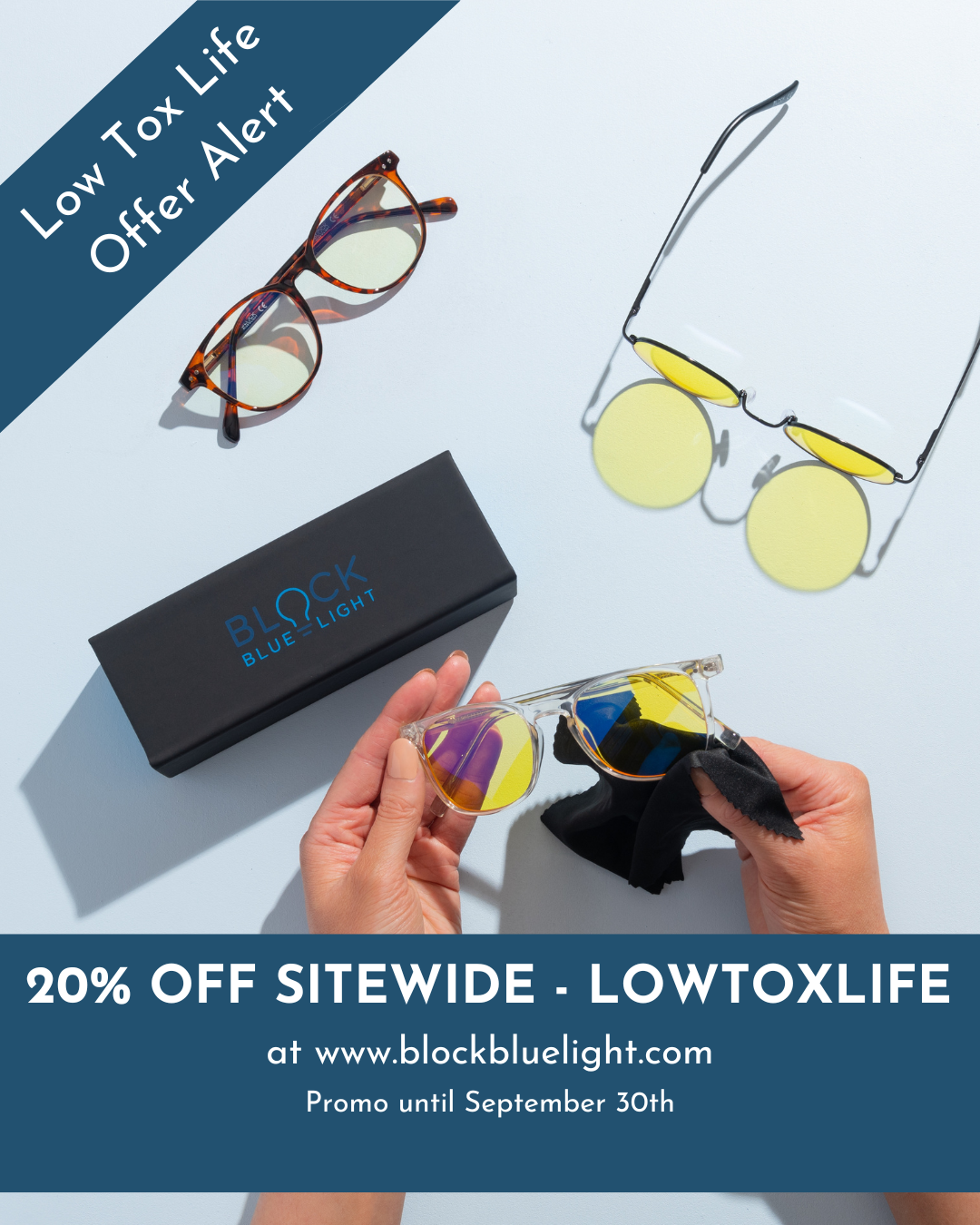
If you’ve been wanting to see whether incorporating light bulbs that keep the blue light out of your evening home space (we do this by only using our lamps in the evenings and having the bulbs in there, or getting a good travel lamp for blue light avoidance in very-well-lit hotel rooms and air BnB’s, or trying an exceptional quality red light panel (can be used for face as well as injury and mitochondrial support and are much better quality infrared than those landfill face masks btw!) or trying a pair of glasses for the day time when you’re at the computer, or the night-time ones when you are mid-exciting-show but want to avoid blue light and also would like to look more like a rockstar… then you are most definitely in luck.
September 1-30th = 20% off site wide. CODE: LOWTOXLIFE
Instagram: instagram.com/blockbluelight_official
Facebook: facebook.com/BlockBlueLightOfficial
What to say about the good news that my good friend Irene Falcone is back on her terms with a brand new and beautiful low tox store – Clean Nectarine. Clean Nectarine is a beauty and health low tox store with strict ingredient vetting and fast shipping Australia wide – orders packed every day by local school mums. When Irene built Nourished Life to be the huge business it was it was no longer doable on her own. She thought selling it to a big company would be the answer but then had to watch them ruin all her hard work of 10 years and her legendary status as an amazing customer service focused business.

I just love and admire so much her resolve to start all over again on her terms and in a way that will work for her AND her customers.
And to celebrate it? Irene is giving us (Aussies) 20% off store wide with the code Low Tox Life
- This is excluding filters (you still have 12% off those on Waterscofilters website though remember till mid-September with code Low Tox Life)
So many things to love on the site – some of my favourite low tox businesses like Weleda, Mukti, 100% Pure (omg the apple enzyme products – helloooo fresh, vibrant skin!) and the Hurraw tinted lip balms. The only things I wear on my lips that don’t dry them out. I also love the 100% pure make up – the eyeshadows a fun yet natural and make me feel like I’m still wearing my skin, not covering it.
Enjoy taking a look around and making the most of the 20% off this month!
Instagram: Instagram.com/cleannectarine/
Facebook: facebook.com/talkingclean
***
Title show track, by LIOR.
Love the podcast music? You will hear excerpts from Lior’s track “Caught Up” – go check it out on iTunes or Spotify if you want to hear the whole song or album, Scattered Reflections. Co-written with Cameron Deyell, it’s a great song and I love the reflective energy of it – perfect for the show, right? Enjoy. Lior is always touring, so do check out his website. It is wonderful to hear him sing live, trust me.
Low Tox Club – The place to bring your low tox life to life.
Want to join a community of like minds and enjoy all the perks of being in the Low Tox Life inner circle such as an online membership platform, 50% off all our Low Tox courses, an awesome chat group, my monthly Q&A, and special guest star interviews for just $49AUD ($29USD/28EUR/23pounds) per YEAR? We have created a special place and set of resources to help you achieve your goals and it’s a wonderful place to be – MORE DETAILS AND REGISTRATION HERE.
***
If you would love reading like me or you just simply want to go through the full transcript, you can check below.
[Alexx Stuart] (0:00 – 12:49)If you have any confusion about hormone testing for age, stage, type, and situation, then today’s show is for you. Hello and welcome to the LOTOX Live podcast. I am Alex Stewart, your host and founder of the LOTOX movement, and I want to welcome you to this show 397.
We are fast approaching show 400, and we are now officially into our ninth year. Thank you to our loyal listeners, if that’s you, over the years. An extra special thank you if you’ve left a review or a five-star rating, and a huge welcome to some of you who might have joined us a little more recently.
There is a treasure trove of every aspect of type of topic we could cover for leading a LOTOX life, from food, to body, to home, to mind, to looking after our beautiful planet, and I welcome you to check out all of the past shows. My guest today is Dr. Leah Hechtman, and she’s back after a brilliant show that we did on PCOS last year, through all the ages and phases of PCOS, both development, presentation, and ways we can work with, ways we might be able to reverse or remit, and it was just a fantastic show. So that was 355, if that’s a show you need to dive back into the archives for.
But today’s show, I really wanted to bring Leah on to discuss hormone testing. She has a PhD, she’s a naturopathic clinician here in Sydney, and her waitlist is yonks. It’s very hard to get in to see her.
Why? Because she is an incredible investigator as well as marrier of research and science with the person that is in front of her, and you can feel that desire to support compassionately and back with research and science in the way she presents topics, which today we are discussing hormone testing. Now, I wanted to bring a show about hormone testing on because a lot of people are either, A, this could be you, in the camp of, I had my hormones tested at my doctors and they said I was fine, so it’s not that.
But then you kind of have this feeling but maybe it is my thyroid or maybe it is my sex hormones. I just feel off and you have a sense that it’s hormones but you’ve kind of been given a bit of a dead end. Then there’s the camp that might be getting the wrong kind of hormone testing for their situation and only getting a snapshot that shows one story from one very specific set of circumstances.
We go so far as to say how getting cut off in the traffic by an aggressive driving moment can affect how you get treated with medication, no less, for something like cortisol results. Then, of course, starting to build a better literacy around the different types of testing, therefore, and how to more accurately rely on the testing and couple it with your situation, i.e. actual life experience, symptoms, and anecdote. That’s really what we’re trying to achieve with today’s show.
We’re going to go through saliva testing, hormone testing through blood. We’re also going to look at urine and urinary metabolites and how they can help complete a picture, especially around deciding whether or not to do HRT or preparing to rather as well. It’s super comprehensive.
Lea is just incredible and I’m so grateful that she made time to join us back on the show. I’m already planning what I’m going to invite her back for next year. If you have any suggestions, you know you can always reach out and make those.
It’s a new month, which means we have new supporters making your low-tox swaps a little easier on the hip pocket. The first one I’m going to mention is Block Blue Light. I love these guys.
I’ve been a loyal, loyal, loyal customer for over 12 years now. As Daniel and the team have brought out different products and different types of the same products to make more people able to use them, i.e. light bulbs, styles, and fixtures, then I have always kind of added to my collection here and there. It’s about as biohacky as I get.
And he has made, and the great news about this particular offer is it’s international. So they have an international shipping. It’s 20% off with the code LOWTOXLIFE site-wide.
And I just want to make a quick mention because I’m seeing all of these ridiculously expensive. Now, no shame if you’ve bought one of these, by the way, I’m prefacing it. Super expensive face masks with infrared technology to support acne and general skin health, collagen, etc.
All the research that exists to say infrared light can be very helpful in enhancing the, I don’t want to say quality of our skin, the health, that’s better, the health of our skin. And you could be getting a good red light panel that you can then use for sports injuries, for scar tissue healing on any part of your body, not just your face. And the red light panels actually offer better technology, more advanced, better quality than these super expensive face masks.
So I just wanted to point that out because the red light panels are RxE as well, but 20% off this month. Well, maybe that will help you get across the line. And I found having one of those, Daniel lent me one of the desktop ones.
It’s fantastic. So easy to set up because you don’t need to balance it on anything or hang it up. That’s my kind of thing.
When I broke my foot with a hairline fracture last year, I did that religiously every single day, was back on the tennis court in a month. Anyone who knows me knows that that’s extremely important to me as a metric for success. So just flagging the red light panels and that 20% off with the code LOTOXLIFE is very helpful for those.
But of course, my faves in the general range are the nighttime full blue light blocking orangey glasses. My husband calls me a rock star with those if we’re watching a show together and I whack them on. I always do my night reading.
If I’m reading on the phone with those glasses on as well. And I love the Sweet Dreams light bulbs. We have those in our lamps and we tend to only use our lamps in the evenings.
But some people, a lot of LOTOXs have loved the light spectrum. So the full spectrum lights, especially if you’ve got a bit of a shady part of the house, it’s a bit darker, or maybe you’re in a terrace style house. And so it’s generally a bit darker.
You’ve got the daylight mimicking and then into the evening and then into the night each time you flick the switch. So they’re pretty groovy as well. They came out a couple of years ago.
We even just invested recently in the LED blue light blocking track lighting that you can put under your kitchen cabinets and have that beautiful soft light in the evenings in your kitchen if you’re going in to grab something, take a supplement before bed. Anyway, second offer. This one is for the Aussies.
I am so excited to say my friend Irene Falcone is back and she is the founder and creator of Nourished Life, who many of you got to know Irene through and is something that I supported from the very first moment she was selling a few lip balms from her kitchen table, because we met back in 2012 when she was just starting out. I had started the blog a couple of weeks, a couple of years before. Anyway, it grew too big for her to manage.
The stress of paying 50 people payroll meant she wanted to sell to one of the big guys. They promised the world. They ruined her brand.
They still made her the face of it. So she copped all the flack. Long story short, there’s a non-compete clause when you sell a business in that particular industry.
She had to wait a while. She is now back and she’s doing it her way. She’s capping it.
There are school moms packing the orders every day with love. It is called Clean Nectarine. It’s just the most amazing story for her to be back and for what she’s been through behind the scenes.
The fact that she even had the courage to do that, but it’s very exciting. It’s a beautiful online beauty store, some great brands being added to every day. She’s still finding a way to get some cool exclusives from some U.S. brands that come in like the Heror deodorant pastes that she just got recently. And I love the 100% Pure makeup products. They’re eye products that all I’ve used for years. They’re really nice and pigmented and rich.
So a little goes a long way. I could go on and on. The apple enzyme that you put on under your moisturiser at night with a little bit of fruit acid in it.
Very good for that midlife skin experience to keep you youthful and glowing. Mind you, I don’t want to say youthful anymore. We learned that with Carl, right, on the podcast recently.
Keep you feeling like you’ve got fresh, energised skin. There we go. No need to equate youth with success.
Right. So 20% off, guys, 20% off with the code LOTOXLIFE again. Go check it out.
Enjoy. And see what Irene’s doing on socials as well. I’ve got all the details in the show notes.
An absolute cracker of a giveaway this week. If you happen to listen to the show live and hot off the press, you will be rewarded by being able to enter that giveaway. And then, of course, our major sponsor, Ozclimate, giving us 10% off all year round.
Again, if you’re listening to this live, they have been out of stock of the dehumidifiers. They are starting to come back into stock this week. I emailed them personally.
The 16 and the 35 litre are back in stock this week and the rest of the range over the next month. So keep an eye out if you’ve been wanting to stock up on dehumidifiers before the humid summer. Your code is also LOTOXLIFE.
I’m just making it LOTOXLIFE for all podcast related sponsorships and swapping because it makes it easy for you to remember when you’re on their site. Enjoy all of those. And now let’s talk hormone testing.
So good. Leah, hello. So good to have you back.
Thank you for having me. Good to be back. Oh, I’m excited because today we’re talking about a topic that is close to my heart in that I’ve probably had every type of hormone test under the sun.
A, you know, when you’ve dealt with a complex chronic illness, it definitely becomes part of the mix. But B, also because in doing so, looking back and speaking with others, it often makes you think, oh, did we really need to test for that? Or was that the best kind of testing to be doing at that time?
And given your incredible knowledge on the subject and helping people with complex hormone issues, I thought you were perfectly placed to guide us through the world of testing when it comes to hormones, age stage situation, we’re going to try and go everywhere. So can I ask you to start when as a younger practitioner and, you know, starting to like, oh, but this is what I’ve been told. This is what I’m going to test for this.
And when did you actually start to see some areas that you felt needed more clarifying and where you would, was starting to want to do things differently yourself? Like that would surely happen in the journey of being a clinician.
[Dr Leah Hechtman] (12:50 – 14:19)I think one of the most fascinating things for me as a clinician is the way I work is I sort of always learn something and then change things clinically and then stretch my wings and then go, no, I want to learn something else. And then I sort of do that. So depending on when you catch me, you’re either going to catch me in the, no, no, no, this is what the science is at place versus this is where my instinct is taking me.
And I think as a clinician, your instinct evolves as you evolve. And as what I find most fascinating is now I’m 46 and I’ve got patients that I’ve had for 20 odd years or whatever. And as we’ve evolved together, how our interpretation of things has changed and how far I want to go.
So the young version of me, you know, 21 out there graduating, it was textbook stuff. It was, this is where the data is, this is what I’m meant to do. And then when you realise that science doesn’t have all the answers, you start stretching and going beyond.
So that was probably within the first six months. But then when you come to the other end of the spectrum, which is where I did a whole PhD on assessing hormones and all that sort of stuff, you realise that we put so much emphasis on numbers that there are so many variables that influence the interpretation and the accuracy of it. We really need to strengthen that clinical muscle more than anything else, because the piece of paper is one thing, but yeah, I mean, just inter-lab variabilities, let alone different labs comparing, let alone different types of specimens, let alone all the different things.
And you get so much different information depending on what you’re looking at.
[Alexx Stuart] (14:20 – 14:37)So would you say the most important thing for certainly any clinicians listening would be to be filling in the majority of your gaps assessment and decisions with who you have in front of you and what they’re experiencing? [Dr Leah Hechtman] (14:38 – 15:14)
A hundred percent, a hundred percent. And also trusting that firstly, your patient has a need that science may not have a test for, but also that your instinct of how to help them may actually not have a black and white scientific result that explains how and why what you do works, which is tricky. And so when we’re younger, we’re not as confident and we go, well, I don’t know anything, so what do I know?
But then as you get older and you get more experienced, you realise that supporting the patient based on their instinct will invariably give you the outcome and the piece of paper may not be the guidance.
[Alexx Stuart] (15:17 – 16:21)So with that in mind, hormone testing. So can we go through what we know about various hormones at this particular time? I mean, that’s like a three-day lecture.
I completely appreciate that. Just keep it abridged. Keep it abridged crib notes for the Gen X listeners and the best way to test for those as has become apparent.
And I mean, you could be talking about time of day, even or day of cycle, like go as far and wide as you want to on this. But I really feel like people find it very hard to know. And I remember looking at a lab result, which said everything was fine.
And then thinking, I’m just going to do my own research on that type of patient on this. And then it turns out for whatever I was testing at the time, I can’t remember, but it was a specific time of the cycle that was really important to capture. And otherwise it would just be completely irrelevant, whatever the piece of paper said.
[Dr Leah Hechtman] (16:21 – 20:42)Yeah, a hundred percent. So let’s start, let me try and organise this as simply as I can. So let’s talk about generic hormone tests for men and women, and then we’ll start specifying and based on sex and age and all the bits that go with it.
So generically with hormones, there’s a couple of basics depending on, so the endocrine system, which is our hormone system, got different glands in different parts of our bodies, depending on which gland produces which hormone and depending on which hormone you’re trying to look at determines the environment with which the person needs to be in to get the accurate result. So for example, a lot of the hormones that are secreted by the brain, they need to be seated for about 20 minutes before their blood draw. They need to be not stressed on the day.
Some of them, they need to be fasting. Some of them they need to have eaten. You need to be quite specific about those variables, but you can get, for example, a hormone prolactin.
I’ve had a patient where she sat for 20 minutes and was de-stressed and was totally fine. And a hormone level, which was completely normal. I think it was somewhere in the three hundreds versus two days before totally stressed, ran in the phlebotomist kind of jabbed her a few times, 1400.
So 1400 is like a clinical pathology, 300 is completely normal. And so the interpretation of the dynamics of how they are, and because the fundamental principle of the endocrine system is that it’s a series of dominoes. So if one is out, all of them are affected.
So if she fasted the night before, or he fasted the night before, if they ate breakfast, if they drank a diet Coke, like whatever it is affects the harmony of the whole picture. So making sure that you’ve got, I guess, is clear structure and uniformity of how you’re testing things. That’s the baseline for everybody.
The men, depending on which endocrine gland you’re looking at, realistically, they’re generally very stable, except frequency of ejaculation, frequency or intensity of exercise and sleep will influence things dramatically as well, obviously, as food and things. But any day of the week, it’s generally fairly constant. But obviously, if you’re looking at adrenal hormones, for example, and he’s rushing to work versus it’s on the weekend, you’re going to get variations.
So just be mindful to ask the questions of where were you? What were you doing? How was the experience of getting whatever sample it is collected?
When you’re looking at that result with that person, and potentially, if you know that they’ve got a vulnerability for x or y, you know, coach them around it before they get a sample collected. Women, on the other hand, it’s a much, much bigger, more complicated picture. You’ve got to factor in her age, her menstrual cycle, if she’s menstruating or not menstruating, if she’s on any contraceptives, if she’s on IUDs, if she’s perimenopausal, if she’s menopausal, 101 things will affect things.
And also things like pregnant, not pregnant, stage of pregnant, how old her kids are, if she’s breastfeeding, you name it, as well as all the general things. For the average female of reproductive age, when we’re wanting to look at her reproductive hormones, we’re wanting to look at them on particular days of her cycle. So the textbook definition is that for a woman, you’re wanting to look at the bulk of her hormones on day two of her menstrual cycle, but you’ve got up to about day five to seven.
And that what you’re trying to achieve is a baseline of all of her hormones, so that there’s not a lot of activity for her cycle. Obviously, further along as she progresses in her cycle, everything’s going to change. If you know the day that it is, you can calculate the reference range and whatever, you can do it.
But in the early stages, just be quite clear on what that is. And then you want to check her hormones seven days after ovulation. So seven days after ovulation, if she’s a textbook is day 21, but the average woman isn’t a textbook, which means you’ve got to work out when did she ovulate, and then seven days later, how to look at it.
But for women, her hormones are affected by every single thing she’s exposed to, emotionally, physically, mentally, dietary, exercise, you name it. If she fasted and did like a detox the week before, if she had a really heavy period and then checked it just after, like so many things will affect it. So it’s about trying to understand what was going on for her at the time, so that you’re quite clear about how to interpret it.
Do you want me to go through forms of tests now, or does that sort of give a bit of a base?
[Alexx Stuart] (20:43 – 21:40)It gives a really good baseline. And I think I just want to ask a, like a deeper question around that piece of like profiling the woman or the man, like, were you in a rush the morning of? Like, I don’t think I’ve ever been given a, you must be seated and calm for 20 minutes, deep breathing.
No one talks about that. And so, you know, I was thinking about the cortisol test. Like I have been told do that first thing in the morning, um, and don’t like to exercise before it.
So, I mean, I guess that was, that was a good little ad in there, but that’s it. So if, if you found it really hard to find a park or someone cut you off in the traffic, it was an arsehole. And then, and then you kind of arrive a bit angry with the world and you’re readjusting.
And that’s when your blood gets taken when you’re still in that fight or flight from having a narky traffic experience. That could be, yeah.
[Dr Leah Hechtman] (21:40 – 23:01)So there’s so much influence that’s happening from all of the surrounding experiences. And if a woman gets her prolactin again, for example, at the beginning of a cycle, or at the end of the cycle, depending on what’s going on with her progesterone completely changes it as well. So it’s the specificity of that moment, that day, everything that she’s doing.
It’s phenomenal, the differences that you can see. And I guess I have the privilege of seeing so many bloods from so many people, but also so many bloods from one person. When you can start to see patterns for them.
And I think that’s, to me, I find that’s one of the most beautiful things of working with people for a long time. And you kind of go, no, no, I remember when this happened to you last time, this is what your bloods did. That’s what this means.
And you’re both understanding the rhythms of each person because the rhythms are what make us, you know, always in the back of my mind, when I think about a piece of paper that tells me where I’m at in that moment, it’s a reference range that was based on a reference group of population. And you may or may not know what that reference group consisted of. So is it male or female?
If it’s female, what were their ages? What was their demographic? What was their ethnicity?
What was like 101 things come into the mind, but the reference range is meant to be a good cross section, but it won’t be everybody. So it’s about trying to get a sense of what’s your reference range when you thrive.
[Alexx Stuart] (23:03 – 23:29)And the poor GP, no, but I think of the poor GP with 15 minutes to see someone for one issue. How can you consider it? Then I think of the poor government with their medical costs and half of these hormone tests would be completely useless.
Yet they’re paying for them. You know, like, I just think big picture. We’ve really, we’ve got a few things playing against us.
[Dr Leah Hechtman] (23:30 – 24:08)Yeah, we do. And, you know, the limitations of Medicare, if we think about the thyroid where a woman’s or a man’s TSH is between a certain range. And we know based on the literature that that range that TSH, for example, when it’s above 2.5, we know that there’s a subclinical thyroid condition going on, but Medicare will only cover T3, T4 when it’s above four or five, depending on the lab when they’re already in overt symptoms. So the idea of integrative, holistic, preventative treatment is outside of access for a lot of people based on knowledge, based on their clinician, based on limitations. It’s a hard one. [Alexx Stuart] (24:09 – 24:41)
It is a really hard one. And so you mentioned, obviously, the blood is only one small piece of what’s going on with hormones. There’s obviously been the introduction of, dare I say, trend towards urinary metabolite testing.
How do you feel about that in terms of what it’s brought to your practise? And has it added to the picture or kind of made you say one to be more useful than the other? Any changes there now that you’ve got both in the mix?
[Dr Leah Hechtman] (24:42 – 24:46)Absolutely. Do you want to give me an age group that you think would be best that we talk through? [Alexx Stuart] (24:46 – 24:47)
Okay. [Dr Leah Hechtman] (24:47 – 24:49)
Because we can translate it all of them. [Alexx Stuart] (24:49 – 25:07)
Yeah. Let’s talk about a menstruating 20 something year old woman without a pregnancy or postpartum picture. Let’s try and pick the least complicated female stage. [Dr Leah Hechtman] (25:07 – 25:31)
No PCOS, regular 28 day menstrual cycle blanket. Totally regular. So totally regular, predictable textbook female.
All right. So also remember that all the reference ranges for hormones are based on 20 year old women. They’re not based on 30 year old women.
So just know that. So I remember doing the PhD and I was like, hang in a second, but what about 30 year old women? What about perimenopause?
And they’re like, we don’t have reference ranges for them.
[Alexx Stuart] (25:32 – 25:33)Oh my gosh. Still. [Dr Leah Hechtman] (25:34 – 30:09)
We still don’t. Yeah. Okay.
So average 20 year old woman, 25 year old we’ll say, because that her cycle’s predictable at 25. So for her, if we go into a blood test on her and we’re really specific, and we do it at the beginning of a cycle, seven days post ovulation, we specify which hormones on which days we do all the back six. Yeah.
For her, we’ll get a sense as to what’s going on, because there’s a rhythmicity and a regularity to her cycle. It’s usually predictable month to month. So the blood will be fairly indicative of what’s going on.
We can test for sure, anti-pituitary hormones, like FSH, follicle stimulating hormone, luteinizing hormone, which we can’t test through saliva and urine, but we will also get a snapshot of progesterone, oestrogen, cortisol, things like that. And we’ll be getting a snapshot of a generic picture of what are the hormone building blocks for her cycle. If we were to test her through urine, so the drive metabolites, what we’re getting an understanding of is we can do it a couple of ways.
One is where we do her full cycle through urinary metabolites, and we can map the changes and fluctuations through the cycle. But the most interesting day where the reference ranges for dried urine are the most, what’s the word, not accurate, but the most predictable is that equivalent day 21, that seven days post ovulation environment. And in that space, when we look at that day, we can get information about hormones that are at a different level.
We can get information about hormones that are further along pathways of metabolism. So we can look at things like not just oestrogen in blood, which is technically E2 or estradiol, which the ovaries produce. We can also look at estrone and estriol, which are E1 and E3, which are different variants of oestrogen.
And then we can look at that oestrogen and go, well, okay, so we’re producing different types through different tissues. How is it metabolised? What are the byproducts?
And then what are the toxicity concerns of how that oestrogen is metabolised? And that’s information that you cannot get from blood. So you get an understanding of what does my body do with that hormone?
Where does it get stuck? Where is it working? Where is it not working?
And are the other hormones that actually interfere with those pathways supportive or hindering anything that goes with it? In addition to the urine though, often you’ll combine it with saliva. So you can get saliva for just saliva, or you can get saliva and urine in combination, which is my preference, because then you can test things like cortisol at multiple intervals through the day.
So that blood level of cortisol that a person can do is interesting, but me at 9am on a Monday morning in blood is going to be dramatically different than me at 6am when my alarm went off, 7am when I finished exercising and 10pm when I’m trying to go to bed. But the saliva gives us the opportunity to see the movement of cortisol through the entire, well, 24 hours technically, but you can do six. So you can even wake people up in the middle of the night and understand what it is.
And the cortisol pattern or something that’s known the cortisol awakening response or CAR helps us understand the movement of cortisol through a body. So a patient last week had a five phase cortisol pattern through saliva, and her blood levels looked great. And I was like, I don’t believe this.
And we could see that she wakes up in a panic of cortisol. Half an hour after waking, she’s still in a panic. And then she just crashes and has nothing left for the rest of the day.
So that’s a completely different picture than what that blood level tells you. Because the blood level is just going to your adrenals function or don’t they? Can you actually produce cortisol?
Not what do you do with cortisol through the day? And where are your vulnerable points? And where can we implement measurements to actually measures not measurements to support you through your 24 hour window?
So personally, I will always do blood, urine and saliva if I can, in a 20 something year old, I might just start with blood. But if there’s things there, and I’m like something feels a bit fishy, or I don’t feel like I’m going to make the most difference, I’ll add it. But as a woman gets older, I’ll always do the urine and saliva.
Because as we get older, the way I see the endocrine system is like it’s, there’s a container of how the endocrine system works beautifully. And then as we get older, all of a sudden we turn 40. Or 35, 36, depending on you and your makeup.
But the whole thing is that the doors open and then you start your, your bandwidth of what normal is for you start stretching. So the lows are lower, the highs are higher. And that’s where we need to understand what’s going on underneath it.
[Alexx Stuart] (30:09 – 30:29)And so for someone who’s having a turbulent perimenopausal phase, then let’s say, what is the saliva versus the urine versus the blood telling you, and of course, the person in the room, telling you that helps you know how you’re best going to move forward? [Dr Leah Hechtman] (30:30 – 30:35)
Okay, so the thing that I, it’s a little bit of a long answer. I’m sorry. [Alexx Stuart] (30:35 – 30:38)
Never apologise for one of those. [Dr Leah Hechtman] (30:38 – 33:22)
The thing I always say to patients is I always have three cats. So I am a researcher. I am a clinician and I’m also a human being.
The researcher in me wants to test a perimenopausal woman every month, because I want to see exactly what’s going on. And I want to know the data and I want to know this month, you do this in this month, you do this in this month, you do that. The clinician me goes, so you have all that data.
Does it change how you treat them? Probably not. The human in me goes, who the hell wants to test everything every month?
It’s not going to happen. So in the middle of that, you kind of look at it and you go at the beginning of treatment, it’s definitely a one month blood process in the sense of a day two and maybe a day 21. If I can, it’s always a urine because we need to understand what is and isn’t working in your pathways.
And the saliva gives me a sense of other aspects to it. I don’t tend to use saliva for estrogens that much anymore. I don’t find them that accurate or they don’t change how I treat, but the urine changes it dramatically.
A big, big difference because the thing with perimenopause is there’s no regularity to anything. We’d love there to be this clear, unified structure of this is what happens here in year and year. But if you get a woman and she’s in her oestrogen chaos.
So oestrogen chaos is you started to reduce your ovarian reserve. You started to sometimes ovulate, sometimes not ovulate. And then all of a sudden the oestrogen goes, whoa, there’s no progesterone to contain us.
We’re going to do what we want. This is the phase where I always say to perimenopausal women, if you’re starting to have like a sexual explorative type of phase of your life, that’s your oestrogen chaos because your ovaries are releasing multiple eggs in a month. This is why women in their early 40s make all the babies, they have a higher chance of twinning.
They kind of go, whoops, we have this baby at 44. What’s going on? It’s this incredibly fertile time because the body’s like, it’s your last hurrah, go for it.
So to try and get some linearity to that in the test, you got no chance. And what happens with women is they don’t have this 28 day structure or like 28 day structure. They’ll be ovulating multiple times in the previous cycle for this cycle.
It’s just all a bit of a mess. So you get a blood draw and you don’t know what you’re looking at because it might be the high oestrogen moment, the low oestrogen moment. But if you do the urine, you kind of go in amongst all that noise, you still don’t process your oestrogen well, and you still have a higher chance of toxicity or higher cancer risk or under methylation of it or whatever it is that’s consistent.
So that’s where I find it’s actually really helpful because this is where you have conversations of, do you want herbs or nutrients or bio-identical hormones? And I don’t let anyone go anywhere, any hormones until I know that they’ve got safe pathways.
[Alexx Stuart] (33:23 – 33:29)And that is what the urinary testing is the most helpful at? [Dr Leah Hechtman] (33:29 – 34:10)
Yeah. Yeah. Gives me the confidence around it because blood, honestly, you could literally test them six months in a row and get six different pictures.
One month they’re FSH, off the charts, they’ve got no oestrogen. The doctor’s like, you’re about to go through menopause or you are. The next month their oestrogen is 4,050.
And you know what I mean? And the FSH has gone down because it’s what is happening. Yeah.
Obviously after oestrogen chaos, they start just raising their FSH and things are running out. But so many women come to me and they’ve been diagnosed as, no, no, no, you are menopause. And they’re like, hang on a second, that makes no sense.
I still feel like I’ve got oestrogen or whatever. It’s just the ups and the downs. And just being caught on the one month of the down.
[Alexx Stuart] (34:12 – 34:44)Wow. Yeah. I feel like I want to move into a consult with you.
So fascinating. And so let’s talk about these pathways because I guarantee you a few people are like, but which pathways and which ones are the worst ones? And you know, just in case my clinician doesn’t know, so I can research and bring it to them.
[Dr Leah Hechtman] (34:44 – 34:44)Yeah. [Alexx Stuart] (34:45 – 34:46)
Could you just expand there? [Dr Leah Hechtman] (34:47 – 35:14)
Yeah, of course. So we call this the sterogenesis pathway. Yeah.
So the first thing you’ve got to be mindful of is that the liver produces cholesterol. Cholesterol, we believe that the human body has, each individual human body has a set point for how much cholesterol they need to survive. Cholesterol is not the devil.
It’s not the problem. Cholesterol then gets converted into pregnenolone. Pregnenolone that gets converted into a number of pathways from DHEA to testosterone to the progesterone pathway.
[Alexx Stuart] (35:14 – 35:34)Oh, can I interrupt you there then? Please. So could the reason that perimenopausal women experience elevation in cholesterol be the body’s way to go, come on, help us make some more pregnenolone and sex hormones, somebody please.
Is that going on?
[Dr Leah Hechtman] (35:34 – 37:41)Yes. So you’ve got two things. So remember my analogy before, which is we have a band with the hormones and then the doors open.
Okay. So have that in the back of your mind. So as a woman’s going through perimenopause, you’ve got the E2, which is the estradiol, which is produced by the ovaries going up and down and up and down and then eventually down, down, down.
And so then the body produces what we refer to as secondary sex hormone synthesis, i.e. that E1 or E3, but predominantly the E3, the estradiol. And the estradiol is the form of oestrogen that a woman uses postmenopausally as best as she can. And so in perimenopause, apart from the fact that she’s producing so much E2, as well as all the other E1 and E3, her body is trying to get that secondary sex hormone synthesis up so that after menopause, her body has another mechanism.
So for all women, when they’re going through pericholesterol goes up, but the bandwidth of how high it goes is your genetics. So if your genetics is a strong family history of hypercholesterolemia or high cholesterol, your bandwidth might take your cholesterol to nine or 10. Nine or 10 is obviously not an ideal, that’s total cholesterol, not ideal and increases your risk of cardiovascular event, but your bandwidth might only be to five.
And then you don’t really have to think about it. If you’re a nine or 10, the latest research at the moment is calcium scores are the test to do before you entertain the prescription of statins, because this will go down. So you may have a five year window where it’s a bit up.
And if you have lots of fibre and maybe you go on to various supplements or you’re exercising and doing things and your cholesterol score is fine, cholesterol score is basically a CT scan of the heart and you want to include the neck. If there’s no calcium deposits, there are no risks. You can just keep monitoring the cholesterol rather than jumping on a statin because you need that cholesterol molecule.
And remember that the cholesterol molecule is for any steroid hormone, which includes cortisol. So any woman that’s perimenopausal, what do we need cortisol for? We need it to just cope with perimenopause.
Yeah. Cause it’s a bit of a ride. So if you block cholesterol.
How diplomatic of you Leah. It’s a ride.
[Alexx Stuart] (37:41 – 37:56)Let’s be frank. It’s a ride. It’s a terrifying roller coaster at times.
And then sometimes it’s really relaxed little bit at the end where you’re pulling into the dock and you’re like, Oh, I can do this. I’m okay. I’m not losing it.
[Dr Leah Hechtman] (37:56 – 38:06)We’re fine. But yeah, my concern is the women that go on statins when they don’t need it and then they block their cortisol and then they just don’t cope. [Alexx Stuart] (38:06 – 38:13)
And literally in that case, sucking up the last of their sex hormone synthesis. Wow. [Dr Leah Hechtman] (38:14 – 38:46)
Which then makes it harder for them for their secondary sex hormone synthesis. But I guess it’s to be mindful that, you know, mainstream medical model at the moment is don’t treat it until you’re through menopause rather than prevention. And the thing that my brain always does is that bandwidth idea again, if I can keep the doors closed, then all of my Achilles heels of potential disorders or genetics or risk factors, I’m containing them rather than waiting till I’m at the finish line and seeing all these diseases starting from bone health to cardiovascular health to all the things. [Alexx Stuart] (38:47 – 41:58)
Wow. It’s fascinating to me to hear this as someone who, and I won’t say has had, I’m still going through learning about mould toxicity myself because I haven’t reached a point where the resilience piece is back where I don’t react to normal levels in buildings and even household items. I will react massively and in a very inflammatory way.
When did it all kick off though? When I was 40. Interestingly enough at 40 had a general anaesthetic, a surgery ENT because I had a leaky tear duct, which of course later was just inflammation from being in a water damaged building.
But what was super fascinating, I know your researcher mind is going to love this, is I went from having a slightly irregular 32 to 40 day cycle kind of, who knows, and really trying to figure it out for ages to boom, after that GA 28, 28, 28, my cycle shortened. For the first time in my life, I had a reliable cycle and have had touch wood, don’t go away yet, since. But what’s fascinating to me about that is it almost feels like the reset encouraged perimenopause acceleration because my entire health just went a bit barney after that.
And there are so many women I’ve spoken to who have similar, maybe it was the epidural in the emergency C, or maybe it was something about the toxic load of an anaesthetic. If you’re already maybe having a hormone picture that’s starting to creep up or this or that, and then boom, you’re in some kind of weird overdrive that you find really hard to control. So speaking to that too hard basket, given there are a lot of people in our community that really feel like they find it hard to calm the farm and the hormones, whether it be thyroid, whether it be sex hormones, seem to all be in pictures of either an autoimmune presentation, all of a sudden that you didn’t have before or, um, mould toxicity where, yeah, you might’ve been susceptible, like gotten a snuffling nose or post nasal drip, but you never had like a full on catatonic experience. What is it about our hormones that it sounds like they get involved and act like kind of unnecessarily urgent and, um, and, uh, hypochondriac messengers for us sometimes, or are they like it?
Yeah. Yeah. Or are they sorry?
Yeah. Or, or are they, um, or is it really that urgent and we’re just not listening, right. And, and because of our, um, lack of knowledge, uh, clinically at this point and, you know, research being far away from where clinic, um, needs to be to help people get well in these more complex situations.
Like are we, I think you understand what I’m trying to say. I don’t want to ramble. Yeah.
[Dr Leah Hechtman] (41:58 – 44:38)No, no, no. You’d never ever, um, let me know if I miss it though, if you need me to go in a different direction, but I think the thing to be mindful of with hormones is they’re chemical messengers. So they are messengers of communication between glands and tissues or organs or systems.
And when something intercepts that communication, IE general anaesthetic or vaccine or illness or infection or mould exposure or major stress by anything, when anything intervenes with that chemical messenger signal, it’s all about some substance being picked up by a receptor. So if there’s an interference, then they don’t find each other and situations like, if we go back to that pair of menopausal thing, it’s different in a sense that the usual normality for that woman has to change into a completely different architecture. So when it’s a different architectural design, which is the same as puberty, if you go backwards, when it’s an architectural design piece, the whole orchestration from the brain is what’s evolving and what’s changing.
So then the intercommunication is upgrading as the brain is evolving. So it’s when it happens at those very key transition points in life, any vulnerability, because the gates are open, any vulnerability sets it off in a way that becomes quite dramatic and changes the course and the direction quite aggressively. So whether or not your cycle, when it was 32 to 40 days versus 28 days, I don’t know which one your normal was, but because it was a change synchronistic to an experience, my instinct says it was where the doors were a bit open being 40, but that you probably weren’t ready to go to that change necessarily.
If you can bring it back, obviously ideal, but it’s a difficult one because a general anaesthetic is a fairly toxic experience for the body, necessary, but toxic. But when you bombard the body with that, if we get really functional about it, general anaesthetic, trying to be metabolised by the liver, liver manufacturing, cholesterol, sterogenesis from there, that interception at that liver level meant the liver went, I’m a bit overwhelmed. And the liver and the brain talk every second based on hormone signalling, and they’re constantly trying to modify, tweak, adjust based on what we’re exposed to.
So it’s an amazing system of the body, incredibly intricate, incredibly intricate. And you think about the domino thing I said about before, just having a memory, a smell, a touch, a taste, any sense that’s up a whole new cascade of hormones. Like we do a meditation and our hormone levels change.
It’s incredibly delicate. And that’s the thing that I think we all underestimate.
[Alexx Stuart] (44:39 – 45:46)So to that point, can a big message of positivity, hope and empowerment be, like, if we think about Bruce Lipton’s work, you know, and could it be that the biology of belief in these doors are open, receptors are a bit off moments, be really key to us recognising how important it is to do that work, whether it be the brain retraining stuff that’s turning up or limbic system techniques and calming and vagus nerve toning. And, yeah, I feel like it’s no accident that chronic illness, I actually sometimes think it’s always been there in a massive magnitude.
It’s just that people got called crazy a lot more often in the past. And now that we’re talking about that, other people are realising that their fields of medicine and science and research can help. And we’re all talking more.
And I don’t think it’s an accident that it’s all starting to connect.
[Dr Leah Hechtman] (45:47 – 47:03)I mean, this is where, you know, mainstream medicine’s dissection of everything is getting more and more problematic because of the interlinkage between everything. But I mean, any of the I guess when you take a step back and let’s say we’re talking about you at 40 again, if they’re okay, we keep using as an example, you know, at at that particular moment, your brain was restructuring itself with all the Lisa Musconi work, I know we both love, it was restructuring itself to move towards that postmenopausal brain. My interpretation that’s been like this for a long time, in that restructure, you know, remember Christine Northrop wrote about this 30 years ago, the idea of being, you know, externally service orientated versus self loving.
I actually think that all of our different just to extend on it, all of our different histories, our memories, our traumas, our experiences, whatever, they all come up for us to go, is this going to be part of the new brain that we create? So then all of those positive thought patterns, all of the, you know, the manifestation ideas, the affirmations, whatever it is that you choose to do that resonates for you. It’s about the change in how you direct what will be your new bandwidth after that transition.
So then all the hormones come back into it to create new reference ranges for you.
[Alexx Stuart] (47:03 – 47:26)Yeah, brilliant. And reading between the lines of what you’ve just said, it sounds like you’re really giving people agency to discover what aligns for them, rather than picking something, seeing someone else talk about something else, and then going, Oh, I’ve chosen the wrong thing that looks like it’s better, you know, really tuning in is actually one of the biggest invitations of any tumultuous hormonal time. [Dr Leah Hechtman] (47:27 – 48:12)
100%. But also in the, in the open gate, if we keep using that analogy, in the open gate period, it’s the opportunity to also experience the greatest peak and the lowest low of whatever that is, for yourself to discern what it is that you want, but also to understand it in a different way. Like, I don’t know about you, but that’s sort of as my brain is going through all of this, I’m understanding everything in such a different way, because I’m understanding what those lows were, or what those highs were, and which bits I want to take and where I want to move the barometer of what my new range will be as I get to the next phase.
Because I think it’s so much better, no disrespect that I have two sons, but it’s so much better than the male model, because they don’t have such a brain change to what we know yet.
[Alexx Stuart] (48:13 – 48:51)Yeah, it’s almost like for men and boys, they have to blow everything up to put it back together again. But we’re actually literally forced to blow everything up and put it back together again. So it’s actually part of our process, that kind of, wow, it’s all changing, and how do I want it to be for the next chapter?
They’re like, Oh, God, nothing’s changing. And do I want it to stay the same? That’s actually in many ways a harder journey.
Much harder, much harder. Poor boys. We’ve all got our ups and our pros and cons.
[Dr Leah Hechtman] (48:51 – 48:51)We’ve got our challenges. [Alexx Stuart] (48:51 – 49:48)
Yeah, yeah, there you go. Okay, so can we talk about testing in different situations, and different clinical presentations, so that we can kind of grab a few different groups of people having various issues or concerns at the moment. Puberty.
Let’s go with girls and like big highs and lows in mood and super heavy periods with a bit of acne. Now, when I was going through school in the late 80s, I would have been in my mid teens, and that was popper on the pill. And I remember like three of my friends who had that clinical presentation were put on the pill to fix it.
Now, what kind of testing could we be doing instead that gives us a more complete picture of what’s going on?
[Dr Leah Hechtman] (49:49 – 51:40)Similarly, to the perimenopausal woman, you’ve got a brain that’s changing. So because the brain is changing, we know the research at the moment is suggesting that it takes two to four years for the brain ovarian access to create their communication appropriately, which means that if any of your friends, for example, in those first two years may have given skewed results, if you did a test on them, and it may not have actually been the clarity that was needed. I do think that some people, they sort of have genetics where it takes them longer or shorter.
And you can look at people’s body weight distribution to give you an indication of speed. So generally, the very thin, tall people up and down a lot of curves, they take a longer period for the brain and ovarian access to develop that real type network of communication versus people that have more curvaceous oestrogen types. They do it a bit quicker because there’s so much oestrogen there.
So that’s why the body increases fat distribution and anticipation of puberty, so that it can use that fat to signal and carry the hormones around. So that can be helpful. But in those situations, if that girl is not on the pill yet, you’ll get much more accuracy, but you often won’t get a clear picture because she’s too young.
And that goes for insulin, it goes for thyroid, it goes for everything. Like I’ve got, you know, you sort of go through waves of types of people that you see. And I’ve got a batch of these 13, 14, 15 year old girls that have periods and then all of a sudden have nothing for like two years.
And the endocrinologist refer them to me and I go, what’s going on? And we’re looking at their insulin levels or their thyroid. And we’re looking at all the other endocrine glands, getting them all happy.
And then the cycle comes back and it’s fine. So it’s so much in that instance where a blood level will probably send you on the wrong pathway if you don’t look broad enough, but also don’t jump up and down and assume that that blood level means everything because it’s so changeable.
[Alexx Stuart] (51:41 – 52:10)Yeah. Wow. And so would that particular case scenario be more about really listening for what the person’s experiencing?
And like, again, you wouldn’t, I mean, maybe I don’t want to judge people who really do find that the end solution is the pill and that’s their SOS while they long game explore, you know, other options. I always want to be really mindful of that, but what would then be some of the things that you would do in that situation?
[Dr Leah Hechtman] (52:11 – 52:16)So this is where, and shut me up if I’m going on a tangent that you don’t go to. [Alexx Stuart] (52:16 – 52:17)
I love tangents. [Dr Leah Hechtman] (52:17 – 52:24)
Good, good. Just wait. You haven’t heard it yet.
I’m kidding. Long time to have a sip of tea. Sorry.
[Alexx Stuart] (52:25 – 52:25)Sorry. [Dr Leah Hechtman] (52:26 – 55:54)
One of the areas that I find really fascinating is the idea of hormonal changes to the microbiome. So if you take one end of the spectrum, you take the puberty girl versus the parent, menopausal menopausal woman. So the easy one is the menopausal woman.
So she’s there and it’s all winding down. And so to ease her estrobilone or her oestrogen metabolism through her gut microbiome changing. And this is one of the reasons why women lose hair because their hair microbiome is changing, why they lose collagen in the skin because their skin microbiome is changing.
Like all of it comes back to their gut function and how they assimilate and digest food. Similarly, on the other end, you’ve got the pubescent or puberty aged female, her gut microbiome is changing from a paediatric microbiome into a woman’s microbiome. And the acne is often a reflexion of her poor metabolism of the oestrogen surges as she’s trying to work out what the hell is all these hormones and what do I do with it?
And the thing we’ve got to be mindful of is that the gut microbiome directs the microbiomes in every other area of the body, from your eyeball to your ear, to your hair, but also to the entire peritoneal cavity of the abdomen. So every reproductive organ has its own individual subset of species within the microbiome and the gut microbiome directs and tells the species what should be there and shouldn’t be there based on where we’re at with research now, but also clinically. And so for example, the microbiome within her uterus may not be robust enough to be able to tolerate the changes of aligning, growing and shedding and that sort of stuff.
So fixing her gut will actually help things a lot. If you then extend that and go, okay, so she’s been put on the pill because it’s socially difficult because it’s, you know, she’s profusely bleeding and staining everything for whatever reason was appropriate. We have data that shows that a girl on the pill when it’s too early, her amygdala shape, both sides, the shape of it, the size of it is different, which means her fear receptors and her brain development is different, which means who she is and how she interacts with the world is different.
We have studies that show that a woman that’s on the pill, her attraction to someone is different. So there’s all of these psychological things that are developing that are probably gut microbiome related. And we know that species are vastly different to a woman that’s on the pill versus off.
So it doesn’t mean straight away, rip her off the pill. It means really work on the gut, really work on optimising particular species to protect against some of the pathways, because if that’s the choice and that’s what she needs, then work with it. But fundamentally, her brain needs to get used to her own oestrogen, her own progesterone.
It needs to mature. It needs to learn the ebbs and the flows. And do remember that the menstrual bleed in inverted commas on the pill is not a menstrual bleed.
It’s a breakthrough bleed. The hormones that they’re on are synthetic versions that will never fit the receptor sites in the same way. So her body is exposed to synthetic molecules that will achieve some things, but won’t mature it in the way that it could.
And we just don’t have long term studies yet. We don’t have long term studies that go, a woman that’s on the pill, what’s her perimenopause like? What’s her menstruating years like?
What are the long term effects of her emotional wellbeing? We just don’t know. Again, not the worst thing you can ever do, not shaming anyone, but just think these things through.
[Alexx Stuart] (55:55 – 56:21)Yeah, absolutely. And so then you mentioned it’s never going to be the same receptor communication on the pill. Is that why so many people in perimenopause go on the pill in a last ditched effort of just quietening every receptor down?
Like does it literally blunt the experience and that’s kind of the lure of doing it at that stage in your life?
[Dr Leah Hechtman] (56:22 – 58:05)100%. I mean, women do it because it shuts down the process so they don’t get the ups and the downs. And again, this is not a shaming or judgemental thing, but their experience of their bandwidth is dulled.
So they can’t know because they’re not feeling anything. Like literally the intention of the pill is to downregulate and suppress the hormonal changes and to give you a synthetic version. I’m fine for hormones, but I’d love it to be the hormone molecule that your body knows.
So at least you don’t miss out on the gifts of that hormone. Because ask any woman that’s on the pill, she does not feel the same way in herself about the world, her perception of everything. And again, no shame, totally respect people’s decisions, but it’s a completely different experience of existence.
So particularly with perimenopause, all the things that we spoke about just before, if she could work with someone and be given some bioidentical hormones, because remember the pill is progestin, not progesterone, for example. So progesterone as a hormone, it soothes us. It makes us recover.
It makes us be confident in an introspective, independent experience of our existence. Whereas oestrogen is about connexion. It’s about kindness.
It’s about giving to other people. And when you don’t feel the movement of both of them, and you don’t understand that the ups and the downs of the menstruating years moves into a consistency of it, the consistency is another gift of interaction with the world. But the pill then just basically shuts it all off and then leaves you on the other end.
And most of those women that were on the pill, and then at the end of menopause, they’re really lost. They really don’t know who they’ve turned into. And so it’s a really interesting journey for them.
Difficult for most.
[Alexx Stuart] (58:06 – 58:12)I can literally feel the story of one of my closest girlfriends, as you say that, who’s 54. Wow. [Dr Leah Hechtman] (58:12 – 58:41)
Yeah. My heart hurts for them. You know that as much as our hormones can be challenging, yeah, that’s probably the nicest way.
They can be challenging. They help us learn our capacity and our resilience and the women where it gets shut off. And it’s the same as women that go through IDF, where they felt like they’ve been shut off and then they’re pregnant, and then they’ve got a baby in their arms.
And then they’re like, what the, who am I? What is going on here? It’s the idea that remembering that they’re chemical messengers of processes.
[Alexx Stuart] (58:44 – 58:47)Yeah. Oh, I need a deep breath after that little section. [Dr Leah Hechtman] (58:48 – 58:51)
Sorry. I warned you there was a little segue. [Alexx Stuart] (58:51 – 1:00:19)
There was a little segue there. And okay. Something that a lot of women experience, it seems to be rife.
And I had the beautiful, I’m going to try not to get a lump in my throat when I say her name, Beth O’Hara on my show a couple of times over the years. And she passed away recently. And what I want to say to speak to her incredible body of work, really lifting the lid on the conversation around histamine issues, mass cell activation.
And what I almost feel like she was about to jump into a lot more given her age was this overlap in late stages of being an ovulating person, how it seems to during the chaos years, really be chaotic. And the psychological ramifications of histamine being a bit out of control with oestrogen being a bit out of control must be huge clinical things that you see so often. Can we offer some comfort and empowerment either through better testing, better conversations with health professionals, for the people who are feeling like, why do I have to take fricking Telfast half my cycle now?
And, you know, because that’s awful for the gut as well. But so many people are lost in that category, Leah.
[Dr Leah Hechtman] (1:00:20 – 1:02:12)100%. There’s three parts to that one. So four really, but let’s start with three.
So the first would be around histamine being a neurotransmitter. Yeah. So recognising the importance of the personality influence that it provides positive and negative, recognising that histamine interacts with oestrogen.
So when oestrogen is high, histamine is higher, but also recognise that histamine is generally in response to something, which is generally an infection or mould or a toxicity or something along those lines that is setting that pathway off, which means the immune system is then mediated and directed by it, which then means that the identification of what was triggering or is triggering is super important, which then also comes back to the gut microbiome again.
So the challenge of the chaos of oestrogen is multicellular and multi-system and underestimating how much impact it has on women. Generally, I will see women where their mood is that low. And it is because of the chaos, because the oestrogen is just growing everything because oestrogen is a growth hormone.
It’s an expansive growth hormone. And so if someone has a gut pathogen or they’ve got Candida or they’ve got any form of growth or infection, it will be worse as the oestrogen goes up each time. So you ideally want to enter perimenopause with all of the infection aspects of your body addressed so that you can just get the positives of it and moderate against it.
But remember that oestrogen and progesterone always work together. And so when oestrogen goes chaotic, if you don’t have progesterone there to oppose it, oestrogen goes, haha, I’ve escaped the gates, basically. So progesterone comes and goes, come back down.
And oestrogen goes, no, no, no, I want to go higher. And progesterone goes, no, no, no, come back down.
[Alexx Stuart] (1:02:12 – 1:02:15)Bad idea, sweetheart. Off the loop. You know what I mean?
Bad idea, come back.
[Dr Leah Hechtman] (1:02:16 – 1:02:56)And so progesterone is always the one that brings oestrogen back into, no, no, no, these are our gates. These are our bandwidth extremes. Don’t go too far out there.
So the first thing when women have histamine and they’re in that life phase is progesterone. It’s not going to fix the driver, but at least it’s going to dampen down the intensity of it so that you can start to get that the, you know, the bandwidth just narrows enough so you can see some clarity. And then you can go, okay, what’s actually pushing this oestrogen up?
Is it just ovarian stuff? Or as the ovary is releasing multiple follicles, is the ovarian follicular fluid actually full of some sort of virus or some infection or mould or whatever? And that’s what’s driving it.
[Alexx Stuart] (1:02:57 – 1:03:45)It certainly checks out with my experience of living in a water damage building and how hectic that time was. I mean, and I remember I was the one who explained to my naturopath, it is at this point in my cycle and this point in my cycle that all goes crazy. So it seems to be related to oestrogen.
And she looked into it and she’s like, oh my God, there is a connexion because this was eight years ago. And it really is very new science for us to be even talking about this. So I feel incredibly hopeful for this next chapter where, you know, people can find answers much more quickly than me digging in chat forums eight years ago at three in the morning going, I’ve got to find something.
I know I’ll find something and then finding it.
[Dr Leah Hechtman] (1:03:45 – 1:03:47)Yeah, for sure. [Alexx Stuart] (1:03:47 – 1:04:42)
Wow. Fascinating. Okay.
So let’s talk about budget, because that is obviously a very real concern. As we record this, we’ve also got the cost of living, you know, so many things have gone up and yet salaries and wages and small business have not necessarily. And so people are more mindful, but we obviously still want to support people in the best way possible.
How can we get the most bang for our buck? If a clinician says to us, I want to do all of this testing and it’s going to be, you know, a grand, how can we feel empowered to say, could we just start with maybe X based on what you recommend might be the most bang for buck to start with?
[Dr Leah Hechtman] (1:04:42 – 1:06:54)Okay. I think the cheapest is they can start doing tracking themselves. So symptom thermal methods are tracking their temperature, cervical fluid and their menstrual cycle details and starting to see patterns and starting to understand when cervical fluid is increasing.
It’s likely that that means that oestrogen has gone up, which likely means a follicle will be released. So that should be a predictor of ovulation and, you know, confirming that with temperature and that’s, there’s no cost to that. Next level would be whether or not they want to do other methods themselves, like urine testing to confirm ovulation if they’re cycling and, or any of the newer devices like mirror and things like that.
There are aspects of them that are accurate, aspects of them that are confusing and, you know, trying to understand them. The greatest challenge of all of those is time because you need three, four, five, six cycles to really start to understand what’s going on. So if you’ve got time on your side and limited funds, start there.
Your next would be to go to a GP. They may or may not look at the breadth and detail of hormones. You’re within your rights to request what it is that you would like, whether or not they see the justification or understand that that’s going to be the challenge.
There are lots of different options from a sort of a Medicare GP grade and starting there should technically be at no cost to you or nominal cost to you. Beyond that, you’re starting to go into, I want to look at every hormone and then I want to look at every hormone and every different delivery. It starts getting expensive.
So Dutch or the dry urine testing, different labs are better than others, saliva, things like that. You’re looking at somewhere around $500, but up to $900, depending on how much you’re wanting to go into it. But definitely don’t be doing that on your own without having someone help you because otherwise it’s just information that you’re not going to be able to use very well.
And generally you could just do that. Beyond that though, you’re looking at things that influence hormone pathways and that’s when it starts to blow out. So depending on how much you want to go down, you might want to look at methylation testing, for example, to understand your metabolism with hormones, or you might want to look at microbiome and things like that.
But starting just from a hormonal perspective, that’s probably, you know, your zero cost to high cost. And then you could go from there.
[Alexx Stuart] (1:06:55 – 1:08:02)Yeah. Nice. Oh, and so last question.
Sorry. No, but it’s just good to know what all the different levels are. And I really appreciated that you started with something completely free.
Like a lot of people book a clinician and start with a clinical conversation. Whereas that clinical conversation is going to be way more useful if you’ve done some free GP hormone testing and you’ve done some symptom and cycle tracking and just book your thing like in a couple of months. Obviously not in an SOS situation.
I mean, you’d be going to ER in an actual SOS, but sometimes some of us just feel super crappy, but we’ve kind of gotten used to feeling super crappy. So what’s another month. And so then you’re bringing information instead of bringing a, I feel awful.
What can I do? And then the whole session is on questions that you haven’t actually collected answers to yet. Would you say that that’s a really good way to start feeling a bit more empowered?
[Dr Leah Hechtman] (1:08:03 – 1:08:37)Yeah. But also know that, you know, your body better than anybody you’re in your skin, you’re there month after month, seeing the changes and just starting to get a sense like you, you know, you hunted through the chat forums and stuff. You knew something was wrong.
You knew exactly when it was happening. You just had to work out what the answer was. Had you seen a clinician at that time, you had a clinician though, maybe having that conversation that she could have pieced it together with you as you discussed, but then you showed her what it was because you’d done the searching.
We know our bodies really well. We know when something feels off. Every woman on the planet knows when perimenopause starts.
You may not want to admit it, but she knows it.
[Alexx Stuart] (1:08:37 – 1:09:13)Well, yes, she knows something’s up, but thanks to being largely kept in the dark on women’s health situations, it’s usually a few, a few years into it where you’re like, okay, so now I’m on the ADHD meds, the anxiety meds that I’ve had. Something’s not quite right. I never used to have to deal with all of this stuff.
Yeah, it’s so true. A message of hope around hormones. Would you like to leave us with something?
Yeah, something uplifting. I feel like, you know, that’s where we need to finish.
[Dr Leah Hechtman] (1:09:14 – 1:10:30)Yeah, no, absolutely. There’s two parts to it. One is if we go back to the idea of our state of mind influences our hormones, we’ve got enough research to show that someone that meditates or does breathing exercises or listens to frequency patterns or is in nature of something that resonates to them, you know, hearing the ocean waves crash or something like that, we literally will change every single one of our hormones.
So nature provides a lot for us and we absorb things through every sense and it will direct it. But equally, we change our hormones through human connexion. So when we have a beautiful experience with someone, be it platonic, sexual, romantic, our children, whatever it might be, oxytocin is like the balm for every hormone cascade.
Don’t underestimate it. You know, you just get a really good hug from someone and it’s like your hormones calm down because they often at times start to scream at us to get a message across and sometimes they just need that balm of oxytocin. And it’s fascinating.
I’ve done a few talks in the last year just looking at oxytocin in different hormone pathways and it still always comes back to the same thing. We release endorphins when our oxytocin is high, we achieve good levels of oxytocin through human contact.
[Alexx Stuart] (1:10:32 – 1:10:34)Our bodies are screaming out for a hug. [Dr Leah Hechtman] (1:10:35 – 1:10:39)
Basically, that’s I think where we leave it. Yes. It’s basically what it is. [Alexx Stuart] (1:10:39 – 1:10:48)
We’re complicated plants that need love and hugs and the occasional glass of water. I love it. [Dr Leah Hechtman] (1:10:48 – 1:10:48)
Okay. [Alexx Stuart] (1:10:49 – 1:13:58)
Yeah. Thank you so much, Leah. Always a pleasure.
I always get so much out of chatting with you and bringing these amazing insights to our community. I appreciate you. Thank you so much.
Thanks for having me. I hope you loved today’s show as much as I loved bringing it to you. I want to remind you that if you are someone who craves a low-tox community that is judgement-free, full of empowerment, has health professionals and building health professionals that can support you, as well as me in there answering questions multiple times a week, I want to invite you to join the low-tox club.
For the price of less than a cup of coffee a month, you have an annual membership for $49 Australian. It’s about $30 US or Euro that allows you to have a member masterclass every single month with a health professional or global expert from the podcast where we have them to ourselves for an hour to ask questions and deep dive further. You have the beautiful supportive chat group.
You have Q&As with me, me answering questions. We read books and talk about them and a whole bunch more. You can head to lowtoxlife.com, hit the explore tab and join the club is the very first option on that list. Of course we have over 10 evergreen courses that you can jump into anytime, whether it’s navigating everyday low-tox swaps with our go low-tox signature course, whether you have kids and you’re wanting to know how to best support them with our low-tox kids course, whether you’re planning a family and looking at a healthy low-tox preconception journey, reducing inflammation, especially the chronic kind with our inflammation ninja course, many, many other courses. You can again head to lowtoxlife.com, hit the courses tab and you’ll see all of the options, which includes a business course, my low-tox method programme. A lot of people don’t know, but I was doing a lot before starting low-tox life in 2009 and I was a business consultant across hospitality, health, retail and cosmetics. I have been in business consulting for a very long time, so I absolutely adore helping people move into the low-tox space or develop their low-tox businesses. So that’s a support you.
And then of course there’s our wonderful social media communities at lowtoxlife on Instagram and of course the website with over 250 gluten-free recipes, blogs, downloadable PDFs to help you navigate wanting to get rid of synthetic fragrances in your school or office. I could go on. So head to lowtoxlife.com, see what takes your interest or fancy and thank you so much for being a part of our podcast community. I love, love, love reading your reviews. I appreciate every follow and subscribe. And I want to just remind you to finish off that if there’s anything you heard that you found interesting from medical or scientific perspective, it is intended as education only.
Please always chat to a health professional who knows you and your situation best. I’ll see you next week. Bye.
