






About this show:
Food is a brilliant unifier across political divides, if we’re brave enough to let it be. We all eat. And in this community, regardless of ‘diet type’ we all want food to be:
- Accessible
- Nutritious
- Good quality
- Good for the planet in the farming methods used
- Fair for the farmers – especially small holder farmers!
- Culturally appropriate and respectful
I don’t know if anyone else is sick of all the nit picking on socials about food and ‘which whole food does it better’ for our health and the planet – when most people are wondering if they can stretch the budget for those blueberries or that mince this week, but I am.
Tammi Jonas has led the charge for many years, in making things better across all of these aspects of a fair food system and we talk this week about how much we can all do to mobilise – taking that active ‘next step’, to ensure a fairer food system is forged for all.
She is an agroecologist in principle and in practice, farming heritage-breed pigs, cattle, and garlic with her bricoleur husband Stuart at Jonai Farms and Meatsmiths on the unceded lands of the Dja Dja Wurrung, where they share rent-free land with the young First and Second Nations market gardeners of Tumpinyeri Growers. Tammi is the focal point for farmers with the Australian Food Sovereignty Alliance (AFSA), advocating for everyone’s right to participate in decisions about food and agriculture systems. In 2024, she completed a PhD on the rise of agroecology in Australia, and collectivising to deal with the problem of the state, as well as publishing a cookbook to help everyone Eat Like the Jonai.
Please listen and share widely. Alexx x
Be sure to tag me @lowtoxlife if you share the show – Love to see when pennies drop or ahas happen for our community!
LOW TOX LIFE – Wherever you listen to podcasts, we’ll be there.

Alexx Stuart
Founder of Low Tox Life and the Low Tox movement
Join me on Insta @lowtoxlife
Want to support the show?
Free option: Leave a 5 star review wherever you listen to Low Tox Life – thanks SO much!
Paid + Member PERKS: Join the Low Tox Club – monthly practitioner live masterclasses, a suite of low tox store discounts from around the world and the most supportive and lovely chat group on all low tox topics on the internet: Check it out and join here for just the price of a coffee per month! https://www.lowtoxlifecourses.com/offers/YzLXThRQ/checkout
***
Thank you to this month’s show sponsors for helping you make your low tox swaps easier:
@ausclimate gives you 10% off their range for the whole of 2024, with brilliant Winix Air Purifiers, the best Dehumidifiers I’ve ever used and their new energy-efficient heating range. code LOWTOXLIFE https://bit.ly/ShopAusclimate
@cleannectarine is giving you 20% off the beauty and personal care ranges with all orders over $99. Code LOWTOXLIFE (excluding water filters). Try awesome low tox brands such as 100% Pure, Kora, Weleda, Moo Goo, Mukti and more as you make your low tox beauty swaps for 2025.
Be sure to join me on Instagram @lowtoxlife and tag me with your shares and AHAs of this week’s episode.
***
About Tammi Jonas PhD
Tammi Jonas is an agroecologist in principle and in practice, farming heritage-breed pigs, cattle, and garlic with her bricoleur husband Stuart at Jonai Farms and Meatsmiths on the unceded lands of the Dja Dja Wurrung, where they share rent-free land with the young First and Second Nations market gardeners of Tumpinyeri Growers. Tammi is the focal point for farmers with the Australian Food Sovereignty Alliance (AFSA), advocating for everyone’s right to participate in decisions about food and agriculture systems. In 2024, she completed a PhD on the rise of agroecology in Australia, and collectivising to deal with the problem of the state, as well as publishing a cookbook to help everyone Eat Like the Jonai.
Instagram: https://www.instagram.com/tammois/
https://afsa.org.au/
jonaifarms.com.au/abattoir
More about this month’s sponsors:
Thank you to this month’s sponsors for partnering with our show and helping you make your swaps with their special offer:

Ausclimate’s highly recommended range of WINIX Air Purifiers is the ideal solution for cleaner, healthier indoor air. Easy to use, reactive features and settings with a truly comprehensive 4-5 stages of purification, including Hospital Grade True HEPA Filtration and Winix’s unique PlasmaWave® technology. Perfect for smoke, dust, pets, viruses, bacteria, household odours, and allergies (covering a variety of allergens). Breathe easier, sleep better, and feel better. Winix; is the most complete air purifier on the market!

Offer: Ausclimate is now giving all Low Tox Life followers an EXTRA 10% OFF their already discounted prices. Simply enter the discount code of LOWTOXLIFE on check out via: https://www.ausclimate.com.au/
This discount can also be redeemed for over-the-phone orders verbally.
Website: www.ausclimate.com.au
Facebook: www.facebook.com/Ausclimate
Instagram: www.instagram.com/ausclimate

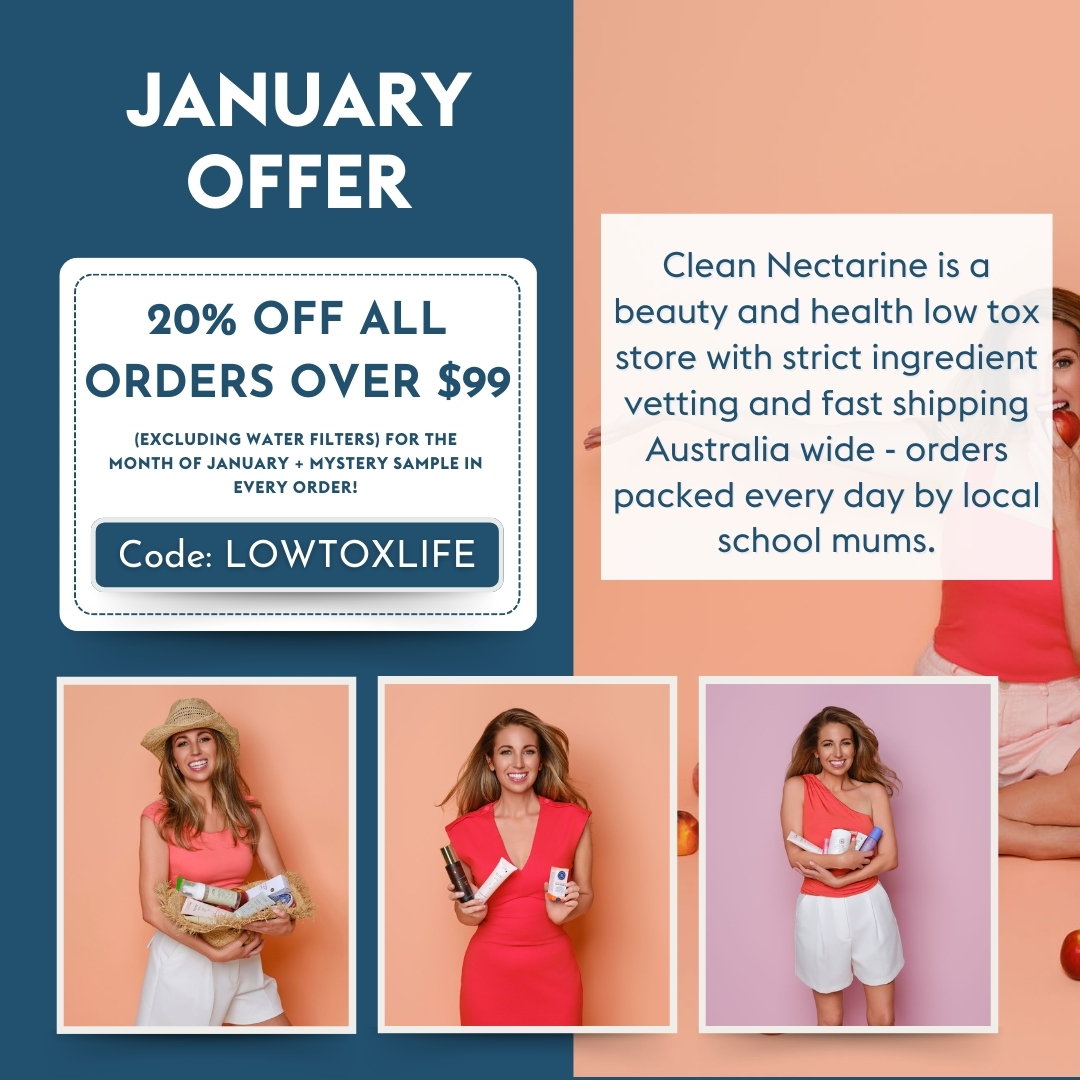
What to say about the good news that my good friend Irene Falcone is back on her terms with a brand new and beautiful low tox store – Clean Nectarine. Clean Nectarine is a beauty and health low tox store with strict ingredient vetting and fast shipping Australia wide – orders packed every day by local school mums. When Irene built Nourished Life to be the huge business it was it was no longer doable on her own. She thought selling it to a big company would be the answer but then had to watch them ruin all her hard work of 10 years and her legendary status as an amazing customer service focused business.
I just love and admire so much her resolve to start all over again on her terms and in a way that will work for her AND her customers.
And to celebrate it? Irene is giving us (Aussies) 20% off store wide with the code Low Tox Life
- This is excluding filters (you still have 12% off those on Waterscofilters website though remember till mid-September with code Low Tox Life)
So many things to love on the site – some of my favourite low tox businesses like Weleda, Mukti, 100% Pure (omg the apple enzyme products – helloooo fresh, vibrant skin!) and the Hurraw tinted lip balms. The only things I wear on my lips that don’t dry them out. I also love the 100% pure make up – the eyeshadows a fun yet natural and make me feel like I’m still wearing my skin, not covering it.
Enjoy taking a look around and making the most of the 20% off this month!
Instagram Link: https://www.instagram.com/cleannectarine/
Facebook Link: https://www.facebook.com/talkingclean
Website: https://cleannectarine.com.au/
***
Title show track, by LIOR.
Love the podcast music? You will hear excerpts from Lior’s track “Caught Up” – go check it out on iTunes or Spotify if you want to hear the whole song or album, Scattered Reflections. Co-written with Cameron Deyell, it’s a great song and I love the reflective energy of it – perfect for the show, right? Enjoy. Lior is always touring, so do check out his website. It is wonderful to hear him sing live, trust me.
Low Tox Club – The place to bring your low tox life to life.
Want to join a community of like minds and enjoy all the perks of being in the Low Tox Life inner circle such as an online membership platform, 50% off all our Low Tox courses, an awesome chat group, my monthly Q&A, and special guest star interviews for just $49AUD ($29USD/28EUR/23pounds) per YEAR? We have created a special place and set of resources to help you achieve your goals and it’s a wonderful place to be – MORE DETAILS AND REGISTRATION HERE.
***
If you would love reading like me or you just simply want to go through the full transcript, you can check below.
[Alexx Stuart] (0:00 – 8:38)A fairer food system for all eaters who want access, ecologically sound, nutritious food wherever you are. That is today’s show on the Low Tox Life podcast. Hello and welcome to the Low Tox Life podcast.
I am Alexx Stuart, your host, and today is show 416, and I’m welcoming back the wonderful Dr. Tammi Jonas. She is now armed with a PhD since the last time I had her on the show on agroecology. And you may know Tammy as the leader of the Australian Food Sovereignty Alliance, but she is continually advocating for mobilising around fair food system issues globally and locally.
She is making sure farmers, smallholder farmers especially, get seats at the table at all levels of government to create a fairer food system for all, a more just system for farmers. And we explore across political party lines what it means to farm. We explore across different dietary philosophies what it means to eat in a just food system.
And we explore that also across accessibility and cultural appropriateness. It is a really powerful, ridiculously well-rounded conversation. Tammi is a wealth of knowledge.
And what I especially love about what we’re talking about today is that Tammi helps us create and articulate those building blocks around what regular people like you and me can do to mobilise more effectively around the issues that matter to us. I often feel like, and we talk about this in the show today, these days, because everyone’s talking so much about issues we care about on social media, we think we’re doing something about them. But we’re not.
And it’s those simple things like adding signatures to petitions and continuing to stay in touch with organisers of things like protests or mobilisation days that are going to actually help us be a part of the change we wish to see in the food system. So while I applaud everybody who raises the alarm on harmful food additives and processed food, we talk about how harmful those are today as well, we also need to be shaping and playing a part in shaping a better food system. And today you will feel like you know what that looks like and how to start doing that in your local area.
So powerful. So I’m going to hook into that show in a little minute. I want to say a huge thank you to our partners who help you make your low-tox swaps possible for the month of January and through now to the middle of February because I was worried people might not have seen the offer from Irene at Clean Nectarine with holidays and festivities and people being away.
So you have 20% off all orders over $99 for all your low-tox personal care favourites. So if you’re making some beauty swaps at the moment or you think oh I’ve been wanting to try a different shampoo or a different face mask, I know I am definitely in my era of face masks. I’m really loving them right now.
I find them to be a fantastic little 10 minutes, 15 minutes of self-care and relaxation and looking after me in this busy midlife world with a million things to do. So that’s actually been a category that I’ve really enjoyed exploring myself. But cleannectarine.com.au you will find beautiful Australian and international brands so you can shop your values and really high-performance stuff. And what I love about Irene is it’s not just about some of the you know just parabens for example, but she really dives deep and makes sure that she doesn’t just stock a brand because it looks good and a couple of ingredients lists pass the test, but she actually individually checks all because sometimes you find that brands may have a ton of fantastic low-tox verified products but then one of the products doesn’t quite make the cut and so she won’t stock that.
So if you really want to feel like you’re shopping somewhere confidently cleannectarine.com.au is a great option. Your code is LOTOXLIFE and for orders over 99 for the month of January and through to the middle of February, Valentine’s Day let’s call it, you have a 20% off. So enjoy that and then of course we have AusClimate.
I’ve been running my filters and dehumidifiers in this very humid part of the year here in Sydney as anyone living on the east coast up and down would know. AusClimate.com.au you get 10% off even on top of anything they might have on sale with the code LOTOXLIFE and that is for the whole of 2025 as well. They’re continuing on as our major podcast partner.
I absolutely love their work and we even get to have say in design issues and things that we’d love to see in the future. So if you ever have any ideas, DM me or let me know in the LOTOX club, our membership, because I can then bring that and say, you know what we’d really love? And they’re just the most amazing brand, great group of people, really responsive, very dynamic.
And now it’s not just dehumidifiers and their Winix air purifiers, but it’s also their air circulators. They have a heating range to tuck away in your mind for when it gets cooler and portable air conditioners that are more energy efficient as well. So that’s all I have to say from our partners.
Now let us roll our proverbial sleeves up and start to see what we can all do better for a just food system. I hope, I hope this show touches you as it did me having this conversation with Tammy and I feel grateful to bring it out to you. Hello, Tammy.
How are you? I’m great. Thanks, Alexx.
How are you? I am awesome. I am so thrilled to have you back on the show.
You are someone I look up to in the food space and have always done since I came across your work at the Australian Food Sovereignty Alliance. And I’ve been on a couple of panels over the years that you’ve hosted with amazing people where we’re really focused on our overlaps, uniting people around food and what that looks like for them from a cultural perspective, socioeconomic perspective, access perspective. And I truly value your work.
So what I’m excited to bring to everybody is basically a look under the hood of smallholder farming, as well as how we all need to realise we need to step up if we want to keep access to buying from directly from farms and discussing climate change in food and how that’s become a bit of a poop show, kind of overtaken by really dominating corporate messages. So a bunch of bad guys can keep polluting. So we shall start by talking about your recent PhD, Dr. Tammy Jonas. Oh, yes. Thank you. Can you step us through the journey of first deciding what to write about and explore and research and how that journey went for you and what you found along the way?
Any surprises? I think it’d be great to learn more.
[Tammi Jonas PhD] (8:39 – 11:16)Yeah, it was I had said I would never go back to university, having abandoned a PhD a decade ago, actually, once we got here to the farm. And then when COVID grounded all the planes and I couldn’t do the international advocacy that I was doing so much of. Well, we did, but we did it online at 2 a.m. instead of on a flight to Rome. I was given the opportunity to do this PhD with my supervisor, Katie Gresio, who used to be on the Office of the National Committee, actually, years ago. And it was around rare breeds. And we have only heritage breed animals because we believe in saving the biodiversity in agriculture.
And I thought, oh, that’s interesting. But I wonder if I can turn that into a whole thesis about food sovereignty. That’s not only about heritage breeds.
And so that’s what I did. I used heritage breeds as the kind of the device into what is a much bigger picture of what food sovereignty can look like and agroecology is looking like as it grows in Australia. And the thing that appealed to me most was that I was going to be given the luxury of time to read what everyone else was saying about our movements.
And so instead of just being in the movement and doing the work, it was a chance to reflect on it and reflect with others. And when I first started reading the Peasant Studies literature, I felt so seen. I was like, they’ve been writing about our movements for the 30 years that it’s been existing.
And I mean, there were research articles about meetings I’d been in in Rome. And I’m like, that’s not a quite accurate account of how that went. And so it just I was drawn very quickly into how good it is to think with academics while also being able to see the limitations of the way they interpret what they’re seeing.
And then I had some experiences through the whole process of reading things that were not quite accurate reflection of the movement, but then going, oh, this is what they say. Those who write history, they determine what the history is, even if it’s not true. So I realized we need more of us to be writing the history ourselves, to say this is what it is and setting the record straight and putting our movements, the people’s movements in the books and accurately.
Not that there aren’t heaps of academics doing that. There are. Yeah, so that was the opportunity.
And it ended up being much more, I think, even more fulfilling than I expected it to be. What I learned about the rise of a new peasantry in Australia, which is, we don’t use the term, I should unpack that. We don’t use the term.
I know, I’m like, hold on, we’re back.
[Alexx Stuart] (11:16 – 11:17)Yeah, I know. [Tammi Jonas PhD] (11:17 – 12:49)
We don’t use the term peasantry lightly. We’re really conscious of being from a global North country and largely non-Indigenous and relatively middle class movement of small scale farmers. We started asking the global movement how they felt about the language of peasantry in an Australian context years and years ago.
And comrades from all across the global South said, we would like you to use that language because then it’s a solidarity with us and it helps build our movement and it helps governments from every part of the world to understand that smallholders are a force everywhere and we still exist. We haven’t been driven out of existence. And as much as there’s been de-peasantization, there’s also a re-peasantization movement all around the world, or in the case of Australia, probably kind of just a peasantization because we never really had a peasantry before invasion or after invasion.
It’s kind of new here. So we identify strongly with that global peasantry because peasant just means person of the land. And that’s what the people in our movement feel themselves to be.
And we’re grappling with the difficulty of being people of a land on unceded lands. And so in a settler colonial context, we have a complex relationship to being people of this land. And we’re moving through that carefully and in a complicated way and in solidarity with First Peoples as well.
Like, for example, even the Food Sovereignty Alliance changed our constitution last year and we no longer have a president. I’m not president anymore, finally, Alex.
[Alexx Stuart] (12:49 – 12:50)Oh, yay! [Tammi Jonas PhD] (12:50 – 12:53)
You totally always wanted to de-peasantize yourself. [Alexx Stuart] (12:53 – 12:55)
Oh my God, it’s been so long. [Tammi Jonas PhD] (12:55 – 14:10)
So now I’m the focal point for farmers and we have a focal point for First Peoples. And so we’re now co-led by farmers and First Peoples. And that’s one of the things that the PhD was looking at.
It’s like, how are these farmers navigating these complex relations with country and with First Peoples and not continuing with the legacy of colonization? How do we farm in decolonial ways? And what I found was an incredible movement of people thinking and working really hard on those questions.
And also the other part of it is kind of non-capitalist behaviors. Most of the new farmers who come into our movement, they don’t necessarily start out as anti-capitalist like I did when I was here. But they come in kind of non-capitalist, if you like.
They’re sort of not wedded to commodity structures. They’re trying not to grow commodity food. They’re trying to grow food for people in relations.
And then I think we’re going to talk later about some regulations. What happens is when they run into the constant overburden of regulation, they have to collectivize to deal with it. And yeah, many, many do become anti-capitalist.
Absolutely. Yeah.
[Alexx Stuart] (14:12 – 14:30)So what you’re saying is a lot of farmers join the movement because they can recognize the system is broken and they want to be a part of the solution, but how far they go to being anti-system is seen when they actually continually get challenged over and over again by the system. [Tammi Jonas PhD] (14:30 – 15:05)
That’s right. Yeah. And start to, especially because we’re in a global movement that’s thinking and working on these problems all the time.
So you start to understand that system, like what makes it tick, who owns it, who controls everything. And not in that conspiracy way, like we’re not, the food sovereignty movement is not a conspiracy theory movement. Things aren’t as coordinated as some would like us to believe they are, but there are definitely elites who have too much control and are not letting the rest of us have enough control.
And whether they’re working in a coordinated fashion or not, doesn’t actually matter that much, to be honest.
[Alexx Stuart] (15:06 – 15:14)And so if I was to ask you who does have all the control, what have we found? I mean, it’s what is the answer? [Tammi Jonas PhD] (15:14 – 16:18)
You know, it’s the super rich, you know, it’s true. That’s who’s controlling the system. And the worst egregious examples of it are, you know, coming out right now in America, where you’re looking at that billionaire class and theirs is getting a lot more coordinated, to be fair.
Like it’s pretty gross, that example. I think in Australia, though, even if you take like the impact, the influence of the Murdochs on the system here because of the control of the media, that is, again, conspiracy is the wrong word because it’s basically one family. It just controlled the way information is or is not shared until there’s no other form of truth out there or very little unless you go looking for it.
And some people aren’t going to go looking for Green Agenda or, you know, Monthly Review, like they don’t know about these other strong traditions of leftist thought. They just know that there’s got to be something better than the Australian. So but what is it?
It’s probably not the age, you know? Yeah.
[Alexx Stuart] (16:18 – 16:45)Oh, well, then we go on to completely unregulated media who are profiteering as influencers, if you like, from polarisation on big tech algorithms. And I think we have to recognise that it is a far more complex picture than us just being able to go, they’re right and I’m going to pick that side. There’s so much nuance, so many layers. [Tammi Jonas PhD] (16:46 – 17:15)
And basically never trust just one individual. I think like you can have you can have trust in individuals, but don’t take anybody as your sole source of truth. You know, that rise of the manosphere and all of that stuff, like it’s just so gross, this idea that we would listen to those those people who want us to be their followers.
You know, the rise you and I have talked about this, that rise of gurus, you know, it’s where we say in our movement, we don’t need a guru to run a revolution. That’s people’s job.
[Alexx Stuart] (17:16 – 18:42)Yeah, exactly. Well, I mean, yeah, look at France, Napoleon led that revolution and got guruised. It’s very easy for your ego to take over, I think.
And then you end up in a palace and you go, oh, shit, this was not what I stood for. But this palace is nice. So I’ll take it.
We see it over and over again in history. And I think a lot of people pay out things like arts degrees. I did one myself, European political science, two languages, and studying and writing 10,000 word essays after 10,000 word essays where you have to bring in multiple perspectives.
You have to have historical context. You have to understand how left and right medias play against each other and play to people. I consider that to have been genuinely a godsend to my existence on Earth as we navigate these very polarised times, because you just, you proceed and say, I am buying that and like, look for the nuance.
And I genuinely invite people to start thinking in that way, because you will certainly feel a lot more agency and you will feel way less like you’re selling your soul on a bunch of issues where you think, oh, but this issue really matters to me. So I guess I have to go along with the rest of those issues. That’s not real good politics.
It’s certainly not peacemaking.
[Tammi Jonas PhD] (18:42 – 18:47)No, definitely not. Definitely not. And that’s not how we do things in the food sovereignty movement at all. [Alexx Stuart] (18:47 – 19:10)
Can we talk about food sovereignty? Because I know we’ve talked about it on the first show that we did and I’ll have the details of that show for people to dig deeper into the founding of that movement. But what exactly does food sovereignty by definition offer all of us to unite around?
Because I think that’s really special.
[Tammi Jonas PhD] (19:11 – 21:02)I think that the core of it, obviously, is wanting everyone to have access to culturally appropriate and nutritious food that’s produced and distributed in ethical and ecologically sound and socially just ways. But the one that brings people together, I think, the most actively is our right to democratically participate in the food system. And so that’s what really activates the movement in that what can we do is what we’re asking.
What will we do? What can we do? What will we do?
And then we go and we do things. And so if we see that we’re being excluded from important decisions about the food system, when they change a new planning law that’s going to affect small scale farmers, why aren’t we in the room? In Queensland, when they make a change to legislation up there, we’re not in the room.
They don’t work closely with AFSA on issues that will impact on smallholders. But in Victoria, they do. They don’t even consider making a change that might impact on smallholders without consulting with us because we’ve built those relations for a long time.
So we can see just even in this country, the difference between how things go when you’re involved in the decision making processes and when you’re not. And so that’s what unites. And that’s also like we’ve been building up the First Nations participation in the organization for many years now.
And in early days, again, because First Nations weren’t involved in the process of a lot of things to do with farming in particular, but we were trying to bring those voices forward until the point that now we have such a strong membership of First Nations, they’re bringing their own voices forward. Nobody’s having to like speak on their behalf anymore. And that’s a really powerful change, too, that First Nations are having a say in decision making around agriculture and food systems.
Gee, who would have thought that was important?
[Alexx Stuart] (21:02 – 21:39)I know, right? OK, so something I want to ask you just to dive deeper into being in the room where it happens. Sorry, Hamilton fan.
So you mentioned in Victoria, you’re very much a part of those conversations. But I also want to ask how dependent is it on who’s in power at the time? Like, do you then like a government changes and then it hangs in the balance as to whether you’ll be invited to the table when the next government comes in?
Is there anything there that kind of jeopardises the voice?
[Tammi Jonas PhD] (21:40 – 22:32)I think I do think generally speaking, the coalition is not as friendly to democratic participation of organisations like AFSA, for sure, especially since our politics don’t marry up very well with theirs. And because there’s a lot more kind of elites in that space. But having said that, when you’re doing political organising like we do, you’re not only working with the political class, you’re also working with the bureaucrats.
And there isn’t a complete changeover of bureaucracy when that happens. So you continue to work closely with those in the departments that are important to our cause. But sometimes there might be limits, on what they can do.
But then it’s not necessarily the case either, because like, for example, the Libs love to deregulate, right? Yeah.
[Alexx Stuart] (22:32 – 22:40)And that’s the kind of interesting complexity of all of this left, right, like we’re all trying to decide. [Tammi Jonas PhD] (22:40 – 23:05)
Yeah, totally, because Labour loves more regulation, the Liberal likes less of it. Well, yeah, exactly. It’s more just like, it’s actually more about that question of voice.
So the actual legislation, you might have a chance of getting something more to the favour of smallholders, but getting in the room and having your voice counted is that’s where the political class kind of can be a barrier to participation.
[Alexx Stuart] (23:06 – 23:28)Okay, cool. And so how would it look to get more of a voice in more state governments, or if people in the US are listening to this and saying, we never get consulted in our state about smallholder farming rights, what does the path look like? How did you get a seat at the table? [Tammi Jonas PhD] (23:29 – 25:42)
Patience and persistence. That’s always the way. And it’s about building relations, which is really hard when you have constant shuffles of where somebody works, you’ve built up a good relation with an advisor, and then that minister changes again, and now you get all new advisors.
And so the relations part is hard. But as well as relations, the patience and persistence part is putting in the same kind of reforms that you’ve been asking for, having a document trail so that even when the people change, you go, oh, we’re just going to show you what we showed your predecessor and the fall before that, and take the case of the abattoirs that we’ll talk about later. There’s a particular bit of reform we’ve been putting in in Victoria for nearly seven years, and been getting very little interest from a series of ministers, because it just didn’t seem urgent enough to them.
We kept saying we’re going to lose access to the big abattoirs, we need some enabling legislation for us to build small ones. And they kept going, oh, it’s kind of interesting. And some people in the department have been more interested.
But then when we lost the last one here in Victoria, that’s not going to take us anymore from the first of Feb just recently, then they all got very interested. And so the fact that we built up this legitimate position and a long trail of saying, hey, we said this was going to happen, and here’s what our proposal is about what to do about it, means we had a meeting with the minister like the next week, she was like, I need to talk with you. You clearly have some ideas.
And so now we’re working really closely with them. So it’s just, even if some of them found us kind of annoying in the early years, you just keep turning up and you’re a national organization, you represent many hundreds of people, and they have to meet with you because you’re a democratic organization. So you just keep turning up until somebody listens.
And now, you know, on Christmas Eve, one of the groups in the department released the eGuide for building micro laboratories, like, it gives you it’s a whole tool to navigate the legislation to be able to build a micro laboratory. So wow, that’s amazing, right?
[Alexx Stuart] (25:42 – 26:45)That is huge. So to the person listening who likes to shop direct to farmer and get their monthly drop when the you know, like if it’s CSAs in America or here, we have much more direct relationships with specific farms, which is amazing. How do we then recognize what part we can play in facilitating the work you’re doing?
So not everybody’s going to be able to, you know, have the PhD Tammy Jonas mind and, you know, be at every conversation to feel confident advocating or even mobilizing and we can talk about those different levels of, of that. But people still have to believe for this to for our food system and food access to be protected. And for actual food sovereignty to exist, they have to believe they can make a difference, even with limited knowledge, simply by caring to make a difference.
[Tammi Jonas PhD] (26:46 – 27:07)Yeah, the, the biggest one, honestly, is is joining organizations like AFSA. Because, you know, one thing we say all the time is a crowd is not a movement. So a bunch of people saying stuff on Instagram, or a bunch of people who even even turning up to direct action protests, that’s powerful.
But then what, then what’s the next bit of organizing?
[Alexx Stuart] (27:08 – 27:14)So and anyone who’s gone to a process just felt that I felt that where you go, yeah, it was a great day out. [Tammi Jonas PhD] (27:14 – 28:39)
And I feel like I did something but if there’s organizations who are organizing it, they’re the ones people should be staying involved with the organizations who actually pull those things together, you know. And so adding you and even if it’s just like by signing up to an organization like AFSA, then we get when we’re talking to the ministers, we have more numbers to cite. So your name might only be one name and you don’t know everything that I know about food sovereignty, but you’re one more name on the list, one more number that builds us up from 300 to 400 to 1000 to 2000.
You know, those numbers matter to politicians. So being actual signed up members of things, you know, unions have said this for years, like you need to actually turn up. And so, so that’s one thing.
And then I think, in terms of other things people can do, by joining organizations like AFSA, by the way, as you know, you’ll be trickle fed lots of information that you can dip in and out of when you have time in your busy life to learn more about the food system and learn more about the kinds of advice that we’re giving about what can you do. So, for example, about the abattoirs right now, we have an e-petition up in Victoria that will be going to parliament in February. And again, the numbers on that are really important.
So signing petitions and next week, I hope, the week after, if not next week, we’ll be launching the same thing, versions of those e-petitions in every state. So of Australia, obviously. That’s fantastic.
[Alexx Stuart] (28:39 – 28:45)So by the time we go live with this show in four weeks, yes, I will be able to be able to update that. [Tammi Jonas PhD] (28:45 – 29:02)
That’s right. So fantastic. Great.
So signing those petitions, you know, that’s again, you show the politicians, the numbers of people who want a change to the system. Those I mean, those are the it’s numbers and they’ve got to be real signed up numbers, not just I talk about it on Instagram. I can’t use that.
[Alexx Stuart] (29:02 – 29:03)Yes. [Tammi Jonas PhD] (29:03 – 29:07)
They data, you know, cannot. Oh, yeah. Everyone on Instagram agrees with us. [Alexx Stuart] (29:07 – 29:08)
Yeah. [Tammi Jonas PhD] (29:08 – 29:13)
We got social reach. No, it’s not. That doesn’t that doesn’t change politicians minds. [Alexx Stuart] (29:13 – 29:13)
Yeah. [Tammi Jonas PhD] (29:13 – 29:38)
The other thing I would say is, you know, as you know, we updated the People’s Food Plan last year or was it 2023, actually. And that has heaps of of suggestions across all the thematic areas of food sovereignty of how people from the individual up to the political or organizational level can get involved and do something. I actually did it in my cookbook to know that I just. [Alexx Stuart] (29:38 – 29:39)
Yeah. [Tammi Jonas PhD] (29:39 – 30:29)
And so the cookbook has well, it actually has the sections called Read Like the Journey at the at the each section starts with a politics of so politics of dairy, politics of eggs, politics of pork. And at the bottom of that is a read like the journey. But what’s also in it is what can you what can you do like in your own home?
How can you if you don’t want to eat factory farm pork and poultry? What are your options? Like, how can you and I go through like butter, butter, grow butter by is the is the kind of hierarchy without wanting to say that everyone’s going to be in a position to do those things like I’m really clear this is not going to work for everybody.
If you live in a food desert, your options are going to be super different to if you live here on this farm.
[Alexx Stuart] (30:29 – 30:37)Yeah, it’s certainly not about making people feel guilty in a country that’s only got one Woolworth’s that they’re, you know, then causing the planet a disservice. [Tammi Jonas PhD] (30:38 – 30:40)
We can still make a difference in discourses are not helpful. [Alexx Stuart] (30:40 – 31:10)
Yeah, exactly. And I think this is where these very specific like vegan versus carnivore debates are just useless to the actual goal of everybody having food sovereignty, because you you just end up fighting over which food wins, instead of access for a wide range of people outside of middle class privilege on the internet, who are actually fighting real food battles every day. [Tammi Jonas PhD] (31:11 – 32:50)
Yeah, that’s right. And, and actually, it’s interesting, because again, part of the international movement, I’ve heard a lot of versions of these, but what I hear from comrades from Africa or India, or parts of Southeast Asia, these, these middle class debates about whether you should be eating meat or not eating meat are like, like, like, what even are we arguing about? I’ve heard, I’ve heard many stories of I’m just thinking of an example where I was talking with a man from Zimbabwe.
And I was telling him about the fines that were brought in here for raw milk sales. And, and he he teared up and he said, but if we couldn’t, if we couldn’t drink the milk from our cows, like we’d die, like what, what do you mean, you can’t drink the milk from your own cows. And to have someone go tell him that dairy is a bad thing, you know, or to tell me the milk’s weenie here, and, you know, our cow.
And when that’s not the point, the point is, everyone should have a right to access the food that is going to nourish their bodies, and not destroy the planet. And lots of people, particularly in our parts of the world, actually don’t have access to much beyond ultra processed foods, you know, over 50% of the Australian diet is UPF. And that’s in some states as much as 65% of the trolley.
Yeah, it’s awful. Like, that’s not even food. And it’s destroying everything from the ecosystems in which the seeds or grains were grown to the lab in which they’re made, and then to the gut they end up in, you know, they’re just like nuclear blasts at every level of production and consumption.
[Alexx Stuart] (32:51 – 34:02)100%. And then the packaging consideration, you’ve got both the petroleum packaging factor, and then the logistics of moving that stuff around and producing it. But you’ve also got the hormone disruptive aspects of soft plastic packaging.
And that is now very well researched. So on a number of levels, if we’re making that the majority of our food, there’s no surprise, and certainly no prizes for seeing how we ended up here. And so let’s just say someone out there is a parent who’s doing the shopping for their family of six, and they’re just trying to make ends meet, because like food costs a lot of money now, all of a sudden, the last few years.
What is the pathway to them getting involved? Because you might hear messages of food sovereignty and regeneration, just think, yeah, but like, that’s not my world, because this is my reality. And so it might not even help them realise that part of changing the world they’re in is actually getting to know what they could be doing.
[Tammi Jonas PhD] (34:03 – 35:37)Yeah, the trickiest thing there is, as you say, like the risk of shaming people or moralising at people who don’t have a lot of options, and are in those cases, often not time rich to go in and investigate what those options be. So I think in terms and you know what, that’s, oh, I just I get really nervous of sort of trying to give advice to what individuals who are who are locked into Woolworths as their only option should do, because I think you can say all the things about choose as much minimally processed foods while you’re in there as you can. And all of that is good if you can.
And if you have the time and skills to do that cooking and all of those things, and can afford the increasing costs of gas to do that much cooking. I mean, all these things are real, right? So I, I tend to work more at the end of we’ve got to change the whole system, you know.
So while I’m glad that there are community kind of activists who are helping people figure out how to do more fresh meals with their families, those, those, that’s really important work. But meanwhile, those are just Band-Aids on cancer, really, what needs to happen is people need to have genuine options to better food, and not just to supermarkets to choose from, and not just highly processed foods, you know, and which are cheaper than fresh fruit and vegetables. People need to not be forced to work, you know, 60 hours a week, you know, to pay rent, you know, like, yeah, the system being completely broken.
[Alexx Stuart] (35:38 – 35:38)Yeah. [Tammi Jonas PhD] (35:38 – 35:48)
So food sovereignty works at it very much from that systemic level, like we’re, we’re trying to change policies that are making it harder for people to access genuine food. [Alexx Stuart] (35:50 – 36:40)
And so that brings me to sort of come back to something we started talking about, which is for people to mobilize for people to begin more advocacy work. So maybe they have a platform, they’re listening to this, and you’ve only got a few hundred people, but you’re really passionate about making concrete change to a broken system. What do the different levels of involvement look like?
And what would some of the things be that we could be doing that perhaps passionate people who are currently just communicating in social media, or with their friends and family saying, Oh, no, I’ll teach you, you know, something less processed of this and that. So there’s passion there. But I feel like there’s still a disconnect with what actually makes the difference to the food system.
[Tammi Jonas PhD] (36:41 – 39:53)Yeah. And I guess, actually, it’s funny, I hadn’t thought about it, Alex. But that’s, that’s probably me 15 or 20 years ago, the one who was, you know, passionate blogging away about food ethics.
And I think I did a lot of shaming people about not going to the supermarket, because I didn’t know any better. And I hadn’t thought deeply enough about the systems at play. So there’s, there’s some work that AFSA has been doing recently on the difference between advocacy, mobilizing and organizing.
And so, in super brief terms, advocacy is usually done by people who are not constituents of the group they’re advocating for. So you get a lot of NGOs advocating for things, you know, people for disadvantaged groups, or forest dwellers to have access to the forest. These, these sort of groups are mostly advocacy.
And they’re usually paid, actually, these are not volunteer groups, in most cases. Mobilizing discourses is something that AFSA ourselves, I think we go in and out of how much mobilizing we’re doing versus how much organizing. Mobilizing is that kind of, you know, calls on social media to get people to sign the petition, for example.
So you’re mobilizing others to do something. And mobilizing spaces can be like those of us who are constituents of the movement. And those of us who are not, it doesn’t, it’s not a clear line.
Organizing, organizing is when you’re actually doing stuff on the ground. So organizing is like the national campaign we’re launching next week for micro-abattoirs to become normal. That’s, that’s like writing legislative reform, that’s contacting ministers and advisors, that’s, that’s putting together a starter pack for meat collectives to build their own micro-abattoirs.
Like it’s, it’s the, that’s the bones of the work. And that’s also going out into communities, not talking at them from social media, because you will never get out of a mobilizing discourse from social media. Organizing has to actually be done, you need to be in person, you know, you need to be people and do it together.
And it’s not one person, you know, it’s, it’s groups of us doing things together. So the Agroecology Roadshow that we had up the East Coast at the end of last year, we went into 10 communities and ran agroecology dialogues. And they’re, they were amazing.
Just hearing, again, the same problems in different communities in terms of, you know, the loss of small scale farmers, particularly the loss of dairies up the East Coast, the purchasing of, of more and more land by larger corporates, corporate entities, especially up in Queensland, the loss of abattoirs, we heard that in every community, except the vegan community actually didn’t hear that one there. I didn’t realize I was in a group of entirely vegans until I asked near the end of a six hour workshop.
So that was, yeah, that was a different conversation. They were peri-urban from Gold Coast. And in, but what we heard in those communities was they were so excited to have organizing happening where they were being brought together to go, okay, but now what?
It wasn’t just come to a talk fest, we’re all wearing linen in a tent in Byron. I’m sorry.
[Alexx Stuart] (39:53 – 39:55)Yes. Oh my gosh. Yes. [Tammi Jonas PhD] (39:56 – 39:56)
Yes. [Alexx Stuart] (39:57 – 40:02)
And no, no offense to anyone who has found themselves speaking at any of these events because no, totally. [Tammi Jonas PhD] (40:03 – 40:10)
And I’ve gone and listened to things like that before. My theory of change says I don’t need to go to them anymore. Yes. [Alexx Stuart] (40:10 – 40:20)
Because you realize eventually that the a hundred dollar ticket to go see a bunch of people speak still doesn’t change anything. And that’s why we are talking today. [Tammi Jonas PhD] (40:20 – 41:44)
That’s right. Because it’s actually about collective organizing. That’s, that’s what changes things.
So, so when I’ve said, realized that, you know, post COVID we’re starting to get together again to do genuine organizing, we needed to meet communities where they were, find out what their constraints are, find the kind of organic leaders within certain communities. So like there’s one where they’ve already built a micro abattoir. So it made perfect sense to go and meet at that property.
And all the others kind of saw what was possible. And now there’s talk of another one nearby. And there’s at least three of those 10 communities are like actively working on projects that were not actively working on it before we came in.
So that’s organizing. That’s like, that’s, that’s step changes in the system, right? When you actually have local communities going, what can we do for our community?
You don’t have to do it for the whole nation. You don’t have to be involved in our national committee and say, we’re trying to help the whole country, if not world. But you, your thing might be very much in your community.
We’ve had committee members who’ve come on to the committee, who were really good local activists, who after a year on the committee kind of went off, I’m not really, I don’t really want to do the national level work. I’m better at organizing in my community. And they’re the ones who’ve, you know, who’ve built farmers markets or programs to teach more people how to farm.
And they do that very locally in relations with the people in their communities.
[Alexx Stuart] (41:45 – 42:01)So yeah, is that enough of a, yeah, I think what I’m hearing is, is there are many ways to get involved and to use your skillset and your bandwidth. There’s, there’s a place for everyone, literally. [Tammi Jonas PhD] (42:02 – 42:14)
There really is. There really is. And I mean, that can be, gosh, I know so many lovely people who’ve like started community gardens and that really helps with social cohesion in their area.
And that’s what they want to do.
[Alexx Stuart] (42:15 – 43:08)Yeah. Because up until this point in our conversation, we’ve obviously mentioned abattoirs and that’s actually a huge problem for food sovereignty to exist is the threatening of taking them away and corporatizing with just large ones where you lose traceability. And well, they’re just kicking us Exactly.
Which then a lot of small holders historically have ended up selling because it’s just all become too hard. And so I don’t want anyone who tends to favor plant-based eating or or for anyone to think that this is a carnivore conversation, because it’s certainly not our intention. Could you speak to how food sovereignty is important to benefiting all types of eaters?
[Tammi Jonas PhD] (43:09 – 44:14)Yeah, absolutely. I mean, by all types of eaters, we’re definitely looking to benefit, you know, whole produce grown as near to you as possible. But I’ll give you an example of the work we’ve done.
I mean, I’m a livestock farmer, obviously, but we now share our land with Tampanuri growers who are a market garden. And they’ve been here two years now growing vegetables for the local community. And in that time, AFSA lost a battle with Fusayans.
The government proposed to bring in what we call a license to sell lettuce. And we put in submissions over the five years that they ran two reviews saying, please don’t make small market gardens register and pay a fee and have audits and have standards applied to how they do their wash and pack and all of these things. But we lost that battle because the it’s it’s a longer story.
There have been 11 outbreaks of pathogens from vegetables, fruit and vegetables, so berries, melons and leafy greens in the last decade. And they’ve all come from industrial agriculture. Like, like, let’s not.
This is it.
[Alexx Stuart] (44:15 – 44:23)It’s the smallholders are hardly ever the issue. And yet they stand to suffer the most from these regulations. [Tammi Jonas PhD] (44:24 – 45:30)
So so AFSA mobilized strongly and got into action. We’ve been working with all the states that would meet with us, which is mostly just Victoria and New South Wales, to be honest. And New South Wales even took a long time to come to the party.
But here in Victoria, where we worked with them from the beginning, the implementation of these standards that actually now apply from from this month, the implementation is is actually scaled. It’s taking into consideration that small scale market gardens are totally different to a big industrial horticulture operation. And so it’s got scaled fees.
It’s got scaled audits. It’s got scaled. It’s actually quite outcomes based in terms of how you meet the standards.
So they’re not dictating what your wash and pack shed has to be like. They’re just saying you have to have potable water and to wash the vegetables, that sort of thing. So how is food sovereignty important to things other than meat?
Well, we thought that vegetables were pretty safe because they weren’t overregulated until recently. And then when we saw that they were going to be overregulated, we sprung to action.
[Alexx Stuart] (45:31 – 45:46)Mm. Amazing. And so when someone joins the someone joins AFSA, that means they can be any type of eater advocating across any type of food freedom, if you like. [Tammi Jonas PhD] (45:47 – 45:52)
Yeah, that’s right. And we’re not going to. Food sovereignty doesn’t dictate what you should eat. [Alexx Stuart] (45:52 – 45:53)
And yes, exactly. [Tammi Jonas PhD] (45:53 – 46:25)
So important. Yeah. Yeah.
It actually doesn’t it’s not even that interested so long as it’s nutritious, ethical, ecologically sound and socially just. Those are the rules. Right.
You know, nobody should be damaged by the way the food is grown, what your work is in growing it or processing it for that matter, like for the processing. Everyone should work in a safe and healthy environment. They should be paid a fair wage.
All of these things. That’s what we fight for.
[Alexx Stuart] (46:26 – 46:53)Absolutely. And I think people can be scared of words like comrade and think, oh, it’s just, you know, socialism is bad. But what you’re speaking to is just a general sense that all people can feel a sense of freedom around access, availability, safety.
It’s that is the unity message there. Not to be confused with 1940s Russian leaders, if you like.
[Tammi Jonas PhD] (46:53 – 46:53)No, no, no, no. [Alexx Stuart] (46:53 – 47:00)
I mean, yeah, but this is the problem with a lack of context that a lot of people have today. [Tammi Jonas PhD] (47:00 – 48:13)
To be honest, Alex, I think that countries like Australia and America, we were so brainwashed after the hideous things that came from communism in the Eastern blocs and and I mean, plenty of places that we’re not even allowed to talk about Marx. You know, we’re not allowed to talk about what social justice in an economic and political system look like. And it’s a huge body of work that’s been kind of thrown out with the bathwater, if you like.
And it’s it’s such a shame when when I’m in other parts of the world, people talk about the contributions of Karl Marx because they’re important. He helped us understand the elites were controlling the system. And that’s not how it should be.
And workers should have rights and people should have rights. And yeah, nobody wants to see, you know, the Bolshevik revolution or or the cultural revolution in China. Nobody wants that.
But Marx didn’t want that either. So I think it’s a shame that we ignore a huge body of economic theory that helps us understand why society is so bloody unfair.
[Alexx Stuart] (48:13 – 49:49)And yet GDP, gross domestic product, just totally took over, really. And it’s a measure of how well we’re tracking. That’s it.
But I just think it’s very interesting to discuss these points because a lot of people don’t have the historical context and they don’t see the irony of like going all in, let’s say, on a right wing government because you see deregulation as a positive without also recognising that with smallholder deregulation also comes big head honcho elite deregulation to continue polluting more than ever before, sometimes buying up more land than ever before, sometimes.
That’s right. I mean, and I think we have to start recognising the nuances of all systems, all sides. I’m certainly not talking about making this podcast even a political show, because for me, this is about removing the stronghold of any sort of definitive political identity and coming back to the roots of what makes healthy people and And if we start there, then we will recognise that there is very much a blend of great ideas and within all of it needs to come debate.
Debate needs to come back. Public need to have access to debate to see ideas float to the top based on debate, rather than who’s jacking the algorithm of big tech more effectively.
[Tammi Jonas PhD] (49:50 – 52:26)Absolutely. Well said. Totally.
And I think, you know, in the Fitsanti movement globally, it’s the largest transnational social movement in the world. It has literally hundreds of millions of signed up members of organisations like ours all around the world. And that’s heartwarming.
Oh, it’s amazing. Yeah, like amazing movement to be part of. And the thing that really identifies it as a movement, not a crowd, is that we regularly get together and we debate and we so we test the principles of food sovereignty, if you like.
We say this is what we tried in Brazil. It didn’t work. Let’s try what we tried in, I was going to say Russia, but that’s not true.
There’s no Russia. Japan. The point being, you know, we constantly say, is this going to be a good solution or is this a false solution?
And there’s another global gathering this year, a Nihalini gathering in India. It’s the third such gathering. The first was in 2007.
The second was in 2015. Both of those were in Mali. Now we’re meeting in India.
And what that meeting is, is that it’s the I guess the leaders of the movement across the entire world, you know, about a thousand people will come together for a week to not have talking heads talk at us, but to strategize, to analyze the original definitions and actions for food sovereignty, for agroecology. And we’re bringing in it’s much more intersectional this time. We’re bringing in the well, feminist movements being part of food sovereignty for a long time, but also the like workers movements and climate movements, environmental movements that don’t already work within the food sovereignty movement.
Because if food sovereignty, like if you fix the food and agriculture systems, you kind of fix everything. So when you’re dealing with climate change, aside from mining, food is the major issue we need to be talking about, right? If you’re talking about effects on the environment, food and agriculture and mining are the two main ones.
But food sovereignty identifies a vision together collectively all the time and fights for that vision. Climate change activists and environmental activists are always trying to fight against something that they’re trying to hold a line that we keep losing. It sucks, right?
I think it’s really exhausting to be, and those are genuine movements, obviously with some, you know, amazing organizations, but food sovereignty has taken a different tactic. It says all of those things are impacted by our food and agriculture systems. We know what it could look like, and that’s what we’re going to fight for.
[Alexx Stuart] (52:27 – 52:59)And so then to a climate activist who’s gone in thinking, but I need to be advocating for more, I can’t believe it’s not butter type products or fake bacon or, you know, on the meat side. How does one have a constructive conversation? Is it, you know, I was speaking to Kurt Gray about moving from fact-based arguments to storytelling arguments.
Is that something AFSA is doing as well?
[Tammi Jonas PhD] (53:00 – 53:28)Yeah, for sure. And I think that, I mean, that’s why even my cookbook is, you know, I call it kind of an anarchist handbook disguised as a cookbook, because by, you know, by telling the story of the Jonah and painting the picture of what the good system can look like, you know, you’re instilling in people a much more hopeful vision than we’re all going to eat. I can’t believe it’s not, it’s called butter.
I mean, there’s actually.
[Alexx Stuart] (53:28 – 53:32)While the people in petroleum and seed oil laugh all the way to the bank. Yeah, exactly. [Tammi Jonas PhD] (53:32 – 55:00)
So yeah, that’s right. I mean, that’s the seed oil industry is one of the worst in the world. Right.
And I mean, that’s the stuff, what we can say to them. It’s not just stories. There are facts, of course, as well.
The fact that the vast majority of the grains produced in this country, that people say, we’ve got to feed the world, mostly aren’t feeding the world at all. If anything that actually gets out of here and is turned into a so-called food product is an ultra-processed food, aside from the meat, that’s actually the one whole foods that they are shipping out and feeding to people as a whole food, whether they should or not is another debate. But at the seed, the grains and seed space, you know, more than 50% of it goes out as biofuels and animal feed, livestock feed to feed more factory farmed animals that we shouldn’t be eating and that shouldn’t be destroying ecosystems.
So the bit where we certainly agree with the climate activists is that food and agriculture systems should not be causing deforestation. That’s not a healthy system. But that doesn’t mean that we should have a soy-based butter as the replacement.
What it means is to tackle the demand curve for meat across the world, instead of taking it as a given that everyone’s going to just keep eating increasing amounts of meat. Even as a livestock farmer, we say eat better meat less. We’re not advocating for higher meat consumption, but we’re also not advocating for none.
We’d like eat what’s going to make your health, your body healthy.
[Alexx Stuart] (55:01 – 55:11)And what you have access to locally and what agrees with your cultural and ancestral diets. And that’s what I love. It is, there is a space for everybody if we get it right. [Tammi Jonas PhD] (55:11 – 55:52)
Yes. Yeah, actually, that’s something I thought of before too. I like some, again, when I’m in at meetings in Rome, we’ll have people from everywhere in the world, right in our movement.
And it’s actually the peasants from across the global South, who really draw our attention to how impoverished our diet is, even in a place like Rome, where everyone goes, Oh, it’s such a wonderful food culture. And sure it is. But the ingredients are so industrial now.
Some of my mates from Indonesia, they bring their own food, because they can’t bear the highly processed carbohydrates in everything. Even the noodles, they’re like, they’re not good.
[Alexx Stuart] (55:53 – 56:19)I had an Italian friend teach me how to shop for decent pasta the other day. And she just gave me like the steps on, I have to eat gluten-free for health reasons. But even there, you can tell what’s been more processed than not.
And in terms of visual inspection and how industrial the processing equipment is. And that was really enlightening to me.
[Tammi Jonas PhD] (56:20 – 56:48)Yeah. I mean, we don’t actually, it’s funny you say, because I can’t eat dry pasta anymore, not because I have any issues, but because it doesn’t make, I don’t feel good if I eat dry pasta. Not good, mostly.
But then because we even produce some of our own wheat here and I mill some of the flour for our bread. I’m even fussy about like what my flour is like to make my own because I can taste the difference and feel the difference in a highly refined flour compared with one that’s been milled recently or locally.
[Alexx Stuart] (56:50 – 57:28)The problem, I think, like I always listen to things like half listening to my guest agreeing, half as like the person on the street listening to this podcast in the park going, oh, well, you know, I’m not going to just be able to start milling my own wheat over here. Thank you, snobby farmer. And I’m not calling you that.
But people just instantly jump to, oh, well, that’s not me. So this is all I can do. And I think I love that this has come up a couple of times where we’ve said it’s not about judgment.
It’s about this is how good a food system could be if we got it right.
[Tammi Jonas PhD] (57:29 – 58:03)Yeah, totally. If we hadn’t lost, I mean, same as the abattoir issue, if we hadn’t lost access to all the grain mills, you would still have local farmers producing smaller volumes of grain, milling it locally and selling it into the local market. You know, there’s only like two, I think, in Australia, well, in Victoria, Woodstock and Toorung Farm, and they’re growing and milling their own grains.
And that should be everywhere. You know, you do travel. I think we don’t realize mills, you know, yes, people bring their rice to millet.
[Alexx Stuart] (58:04 – 58:24)And I think we think we know more about factory farming because that’s had a lot more press and therefore know more about if you are going to eat meat, then we need to strive for this as a and move away from factory farms. But I don’t think we discuss it in plant foods enough. [Tammi Jonas PhD] (58:25 – 59:20)
No, definitely not. And I think the obvious ones, because it’s because of the processing facilities. So this is one of the major bottlenecks in the food system is that they not only are increasingly buying up all the land, they’re buying all the processing infrastructure.
So right now, what’s topical is abattoirs, but we should have never stopped talking about dairy and grain mills, because they both require further processing. And as soon as the farmers didn’t have control of those systems anymore, you know, you only ended up with industrial options. And, and increasingly, these are actually not only industrial, they’re foreign owned now, and a lot of it’s being exported.
And I’m no xenophobe, but I do want Australian food security. And, and we’re losing that. So when I researched the politics of sugar bit for the cookbook, because I don’t eat much sugar, I don’t have a sweet tooth.
So because I don’t eat much of it, I kind of knew the least about the sugar system.
[Alexx Stuart] (59:21 – 59:34)I come from Mauritius, which, you know, my mom’s side, which is a colonial sugar island. So we know quite a lot about that whole situation. So tell me what you found about Australia? [Tammi Jonas PhD] (59:34 – 1:01:30)
Well, so for one thing, I didn’t know that CSI stood for colonial sugar refinery. And I mean, I think a lot of people know a bit about the like history of slavery and blackbirding of with Pacific Islanders in our sugar industry up north. So and I need some of those things.
What I didn’t know is that now all of the sugar refineries are owned by multinationals. There’s only two in Australia, they’re still actually owned by Australians. And by the ones a co op owned by farmers up in Queensland, and only sells locally.
And then the other one, I can’t remember where it was, it was in might have been Bundaberg or somewhere, but but Bundaberg is not owned by Australian companies, nor is CSI. You can’t really buy any Australian processed sugar in this country. And obviously, people know the environmental impacts of cane sugar production, especially on the reef can be really horrific, even though there have been improvements in some ways.
And Australia is one of the most mechanized sugar production companies in the countries in the world, which is actually kind of a good thing, because the labor in sugar production is so dangerous. So there’s some benefits, I guess, to the way we’re doing it. But while I was in Tassie recently talking, somebody told me that Port Macquarie, the sugar refinery there, just announced their closing.
And they’ve just left all the cane farmers with no options. So it’s the same as what’s happening with the abattoirs. So now, another group of farmers are suffering with no other options.
And I mean, I think, you know, things grow better up there. I’d love to see them all convert to like agroforestry or something. Yeah, yeah, pretty amazing.
But, but yeah, this is this is all happening, because the government’s letting them sell all of our infrastructure out from under us. Yeah.
[Alexx Stuart] (1:01:30 – 1:01:57)And I think we talk about, you know, especially people who are aware of climate change conversations and talking about a just transition. And like, I genuinely believe we need to widen just transition, especially if you think about AI, all the other things. We need just transitions for so much more than like oil to electric.
And that’s even a debate as to whether that’s a just anything.
[Tammi Jonas PhD] (1:01:58 – 1:02:03)I don’t think if you live in the Democratic Republic of Congo, you’d think it was very democratic. [Alexx Stuart] (1:02:03 – 1:02:03)
Exactly. [Tammi Jonas PhD] (1:02:04 – 1:02:04)
Right. [Alexx Stuart] (1:02:04 – 1:02:19)
So it’s, I think we need to broaden our definitions of what transitioning to better ways of doing things looks like. And again, for me, that comes straight back to more people debating and more public access to those debates being had. [Tammi Jonas PhD] (1:02:20 – 1:02:29)
Absolutely. And just control just people having a say and being able to be directly involved in what any of these transitions look like. [Alexx Stuart] (1:02:29 – 1:03:20)
Yeah. And I think for me, the assurance of it’s certainly I don’t want this to be like an ad for becoming an Australian Food Sovereignty Alliance member, although I’m sure you wouldn’t mind that secretly, Tammy. But I genuinely think it’s one of the best things people can do because you then sidestep all of the media controlled one way or the other government conversations controlled one way or another through very carefully crafted PR campaigns to garner more votes and support.
And you get straight to the root of the conversations being had and the debates being held around the world. And I think people are really starting to crave that proper, like real information from real people living the real experience of what food sovereignty means. They are.
[Tammi Jonas PhD] (1:03:20 – 1:04:52)And I mean, the difficulty there we’re finding is that thing about algorithms and control of media, control of the means of communication. You know, we talk about needing control of the means of production, but communication has turned into one of the most vexed areas that there are and the amount of misinformation out there. And I guess it brings us to what is a tricky topic to talk about in these post-COVID times.
But the rise of like kind of the sovereign citizen movement, which sometimes finds they think there’s going to be something appealing in our movement because we have food sovereignty, sovereignty is in our name. And yet it’s a sliding doors moment, isn’t it? Because these are people who genuinely, like us, are really frustrated at the lack of freedom and control over our own lives.
But because I believe because they haven’t had a movement to debate and come together with and because justice isn’t central to it for like as in collective justice, that those who are deep into those movements, you know, it’s a it’s a deeply narcissistic kind of space. And and yet a lot of them came to the Agroecology Roadshow, the dialogues, actually, and the ones and the ones who were kind of like food sovereignty curious because of that notion of sovereignty and self-determination, which also I find really problematic when white people use that language in those ways in this country.
[Alexx Stuart] (1:04:53 – 1:04:56)OK, so can we unpack that? Why do you find that problematic? [Tammi Jonas PhD] (1:04:57 – 1:06:01)
Because we’re trying to invite a whole bunch of white people to the Yeah, because that is the language of indigenous struggle here. And I don’t we should be appropriating language. I mean, self-determination should be a human right for everyone.
But in a settler colonial state like Australia, where First Nations have been fighting for self-determination and sovereignty quite specifically with that language. Got it. It’s it’s really uncomfortably with me.
And even though, like I said, absolutely, the principle remains, everybody has a right to self-determination and sovereignty. But when you start asserting it from a middle class white bedroom, like I’m sorry, that’s I find it offensive to the extent that this year we’re undertaking a piece of work. We’re considering changing the name of the Food Sovereignty Alliance because we are uncomfortable with the way sovereignty is being used by non-indigenous people.
And we definitely don’t want to advocate for sovereignty at the expense of anyone else. You know, sovereignty should always come at the benefit to the benefit of everyone.
[Alexx Stuart] (1:06:02 – 1:06:28)Yes. And that’s the thing. And that that that’s missing from the feminist movement where we see men being disempowered and young men especially feeling like, well, where do I fit now that women can do everything?
You know, I think we really have to make sure people feel like from someone getting a seat at the table that didn’t have it before. It doesn’t mean your seat goes. It means we create more equity around.
[Tammi Jonas PhD] (1:06:29 – 1:06:34)Yeah. I mean, the feminist one, that’s a tricky one, isn’t it? Because it is.
You know, that’s a really tricky one. It is.
[Alexx Stuart] (1:06:34 – 1:06:36)But because we can’t argue. [Tammi Jonas PhD] (1:06:36 – 1:06:56)
Well, and you actually create these, as you were talking about before, you create these divisions that are kind of false. You know, nobody’s nobody’s trying to. Well, most people in the feminist movement are certainly not trying to say there’s no place for men.
Right. The way we talk about these things and debate these things can create kind of false divisions.
[Alexx Stuart] (1:06:56 – 1:07:28)And it can and it can allow opportunistic politicians to then create the story to say to reinforce that it’s about men no longer having a place. Right. So and then you end up with with that whole issue of more violence against women.
So I think it’s really important. I really like that you’re doing that work, Tammy, because no one would want a food sovereignty movement to then feel like people didn’t have a seat at the table, whoever they were in trying.
[Tammi Jonas PhD] (1:07:28 – 1:08:00)No, and we’ll never give up the language of food sovereignty either, because it’s a global movement. But we just think in a settler colonial state, we need to be talking about this slightly differently. And it’s that’s a politics of solidarity with First Nations that we are not going we would like to take that language out of our name, because it and it also it’s a it’s also a politics of we are not a sovereign citizen movement.
That’s that’s not at all what this movement is. This is a movement for justice for everyone, not just ourselves.
[Alexx Stuart] (1:08:01 – 1:08:01)Yeah. [Tammi Jonas PhD] (1:08:02 – 1:08:03)
Yeah. [Alexx Stuart] (1:08:03 – 1:08:18)
Justice, not at the expense of others. Nothing at the expense of others. Nothing at the expense of Yeah.
Well, it’s an important point, isn’t it? Yeah. Yeah.
I mean, polarization happens when we decide our justice matters more than someone else’s. That’s exactly right.
[Tammi Jonas PhD] (1:08:18 – 1:11:21)And actually, it’s funny that it relates to what I’m working on at the moment. I’m working on a little piece on debt to help the people who are trying to build infrastructure understand how to do that without taking on debt. And if you look at indigenous knowledges or you look at the degrowth or the diverse economies movements, they talk about, you know, to each according to their need.
What does it teach according to their need from each according to their ability? And here at Joe and I, we say we want to contribute and receive commensurate with needs and capacity. And it just shifts the way you think about things.
You know, you’re not owed anything. In fact, in our view, in our world view, only country is owed anything. We all owe country life and and she gives us life.
So there we are. But the rest of the things that we have in the world, I mean, obviously, it’s like right to shelter and food and these things, but you’re not you’re not owed things. And so, for example, our land sharing agreement, we don’t charge rent for that because we’re not trying to replace the rentier class.
We’re trying to transform the system so there is no rentier class and we’re not owed a rent just because we happen to hold title to this unceded land. We think we have enough land to share. So why wouldn’t we?
We have we have enough. So and so we share. And that’s our capacity commensurate with our capacity.
And we don’t need more from that. We don’t need more money from them. We earn money from farming.
And so why would we ask for that when they don’t have a lot of money? They’re not earning much at this stage either. So and even if they were, we don’t need their money.
So we’re not owed it. We don’t need it. That’s not what the arrangement is.
And I think these are the kind of things that food sovereignty is really fierce about. And I had somebody who was kind of in that sovereign citizen movement say to me at one of the dialogues, but I just feel really worried about like if I let somebody have things that I worked very hard for that they won’t appreciate it, you know. And and I said, well, I think that’s a really unfortunate way to think about somebody who might be working 60 hours a week but just doesn’t earn the same wage as you did working 30 in your high paying professional job.
Like it’s not a question of how hard people work and whether they get to have the things right. And someone else asked, but isn’t it OK if I still have a mortgage? Isn’t it OK to have them pay me rent to help pay the mortgage?
And I said, sure, if they get to keep a part of the house, you know, like, why do you get the money? You get to keep the house, but they help make the payments. Like what this logic that we believe in in our society, that we’re owed something or that we deserve things.
It’s crazy to me, actually. And I’d like more people to think about whether whether we are owed anything in terms of, especially financially.
[Alexx Stuart] (1:11:22 – 1:11:40)That’s such a huge leap from the system we’re all kind of stuck in. And, you know, a lot of people know the system isn’t working and we can definitely feel some late stage vibes. But at the same time, it’s such a leap.
It’s a leap of faith. You’re asking people to start entertaining.
[Tammi Jonas PhD] (1:11:40 – 1:11:44)I believe it totally is. I’m getting into my twilight years here, I think. [Alexx Stuart] (1:11:44 – 1:11:45)
Yeah. [Tammi Jonas PhD] (1:11:45 – 1:11:56)
Now that I’m in my 50s, I’m just going to go a little bit harder every year. Yeah. Push us all to think harder about how to contribute more than we receive. [Alexx Stuart] (1:11:56 – 1:12:17)
Yeah. I love what you said. The only thing we owe is country and we owe it life.
I think that’s a beautiful way for us to think about starting to make a more powerful contribution. If we believe in food sovereignty and good quality produce grown locally, then we actually have to start contributing to that being a reality for more people.
[Tammi Jonas PhD] (1:12:18 – 1:12:28)Absolutely. Everyone, everyone. When people say, you know, like, what do you want for your birthday?
Which is nothing. We don’t do presents around here. But I’m like, I want everyone to have what we have.
I want this to be normal.
[Alexx Stuart] (1:12:28 – 1:12:44)Yeah. Wow. Tammy, I always learned so much from you.
Thank you for challenging us, expanding our minds and inviting us to have a seat at the table when we talk about what food sovereignty really is. It’s just always such a pleasure to chat.
[Tammi Jonas PhD] (1:12:45 – 1:12:49)Thanks, Alex. Thanks for having me. It’s been really good.
That’s been a broad ranging conversation.
[Alexx Stuart] (1:12:49 – 1:12:53)I know we went some places. See you next time. [Tammi Jonas PhD] (1:12:53 – 1:12:54)
Thanks. [Alexx Stuart] (1:12:55 – 1:15:50)
I hope you loved today’s show as much as I loved bringing it to you. I want to remind you that if you are someone who craves a low-tox community that is judgment-free, full of empowerment, has health professionals and building health professionals that can support you, as well as me in there answering questions multiple times a week, I want to invite you to join the low-tox club for the price of less than a cup of coffee a month. You have an annual membership for $49 Australian.
So it’s about $30 US or Euro that allows you to have a member masterclass every single month with a health professional or global expert from the podcast, where we have them to ourselves for an hour to ask questions and deep dive further. You have the beautiful supportive chat group. You have Q and A’s with me, me answering questions.
We read books and talk about them and a whole bunch more. You can head to lowtoxlife.com, hit the explore tab and join the club is the very first option on that list. Of course, we have over 10 evergreen courses that you can jump into anytime, whether it’s navigating everyday low-tox swaps with our Go Low Tox signature course, whether you have kids and you’re wanting to know how to best support them with our low-tox kids course, whether you’re planning a family and looking at a healthy low-tox preconception journey, reducing inflammation, especially the chronic kind with our Inflammation Ninja course, many, many other courses. You can again, head to lowtoxlife.com, hit the courses tab and you’ll see all of the options, which includes a business course, my low-tox method program. A lot of people don’t know, but I was doing a lot before starting Low Tox Life in 2009. And I was a business consultant across hospitality, health, retail, and cosmetics. I have been in business consulting for a very long time.
So I absolutely adore helping people move into the low-tox space or develop their low-tox businesses. So that’s a way I can support you. And then of course, there’s our wonderful social media communities at lowtoxlife on Instagram.
And of course the website with over 250 gluten-free recipes, blogs, downloadable PDFs to help you navigate wanting to get rid of synthetic fragrances in your school or office. I could go on. So head to lowtoxlife.com, see what takes your interest or fancy. And thank you so much for being a part of our podcast community. I love, love, love reading your reviews. I appreciate every follow and subscribe.
And I want to just remind you to finish off that if there’s anything you heard that you found interesting from medical or scientific perspective, it is intended as education only. Please always chat to a health professional who knows you and your situation best. I’ll see you next week.
Bye.
