





About this show:
When I started low tox life, for years I’d get excited when, say, Campbell’s soup or Hershey’s would announce they were banning GMOs from their products… or when M&M’s announced they’d stop using petroleum based colours. “We’re winning” – but were we?
In recent years I’m way less excited when mega corporations change their recipes to be better – even though it is still a good thing – it’s not a slightly better ingredient list on an ultra processed ‘gluten free’ cheesy puff that’s going to make us healthier and our planet more resilient. Nope.
What excites me is food systems change – less sexy, less algorithm eye-catching and way more complex/multi-faceted It also requires YOU and ME to do the majority of the work for that change.
It’s more regenerative, healthy farming methods, family farming, small-holder support, localised food, access to cultural/ecologically sound foods that is going to radically change both planet and people’s health.
And so… it’s why I find wonderful farmers and authors like @stephanieandersonwriting who tell farmer storiers and explore systems change, to bring powerful conversations to the show for us to think about what really matters most.
My conversation companion for this week’s show is Stephanie Anderson, acclaimed author and social justice journalist. With a background in creative nonfiction, a deep understanding of regenerative agriculture, and years of exploring the intersections of equity and sustainability, Stephanie brings a fresh and thought-provoking perspective to the critical issues shaping our future with her first book “One size fits NONE” and new book, From the Ground Up: The Women Revolutionizing Regenerative Agriculture (The New Press, 2024). It’s a powerful exploration of the women who are leading a transformative movement in agriculture, reshaping systems and inspiring hope in the face of environmental and societal challenges. Well worth a read!
I hope you love this week’s show. I found possibility, bravery and hope in it, myself with some of the things I said.
Alexx Stuart
Founder of Low Tox Life and the Low Tox movement
Join me on Insta @lowtoxlife
Want to support the show?
Free option: Leave a 5 star review wherever you listen to Low Tox Life – thanks SO much!
Paid + Member PERKS: Join the Low Tox Club – monthly practitioner live masterclasses, a suite of low tox store discounts from around the world and the most supportive and lovely chat group on all low tox topics on the internet: Check it out and join here for just the price of a coffee per month! https://www.lowtoxlifecourses.com/offers/YzLXThRQ/checkout
***
Thank you to this month’s show sponsors for helping you make your low tox swaps easier:
@ausclimate gives you 10% off their range for the whole of 2024, with brilliant Winix Air Purifiers, the best Dehumidifiers I’ve ever used and their new energy-efficient heating range. code LOWTOXLIFE https://bit.ly/ShopAusclimate
@cleannectarine is giving you 20% off the beauty and personal care ranges with all orders over $99. Code LOWTOXLIFE (excluding water filters). Try awesome low tox brands such as 100% Pure, Kora, Weleda, Moo Goo, Mukti and more as you make your low tox beauty swaps for 2025.
Be sure to join me on Instagram @lowtoxlife and tag me with your shares and AHAs of this week’s episode.
***
About Stephanie Anderson

Stephanie Anderson, acclaimed author and social justice journalist, is uniquely positioned to answer this question. With a background in creative nonfiction, a deep understanding of regenerative agriculture, and years of exploring the intersections of equity and sustainability, Stephanie brings a fresh and thought-provoking perspective to the critical issues shaping our future. Her new book, From the Ground Up: The Women Revolutionizing Regenerative Agriculture (The New Press, 2024), is a powerful exploration of how women are leading a transformative movement in agriculture, reshaping systems and inspiring hope in the face of environmental and societal challenges.
Blending compelling storytelling with rigorous research, Stephanie illuminates the triumphs, challenges, and innovations of women driving change across the food system. She’s ready to engage your audience with her expertise, her vision for a regenerative future, and the powerful stories that will leave them inspired and informed.
Stephanie Anderson is Ready to Explore These Dynamic Topics with Your Audience:
Regenerative Agriculture and Climate Change: Why is regenerative agriculture key to solving our most pressing environmental crises? The pivotal role of women in redefining agriculture and climate solutions. Stories of innovation and collaboration reshaping farming for the future.
Women Leading the Charge in Food Systems Transformation: What makes women so effective at leading the regenerative agriculture movement? Real-life examples of women driving change from the farm to the policymaking table. How women’s leadership fosters resilience and equity in food systems.
The Pandemic as a Catalyst for Change:
How did the COVID-19 pandemic reveal the cracks in our food systems?
The pandemic’s unexpected lessons and how they’re shaping our future.
Why now is the perfect moment to rethink the way we grow and distribute food.
Crafting Powerful Stories Through Literary Journalism:
What goes into creating gripping, fact-driven narratives about social change?
Balancing art and accountability when telling real people’s stories.
Advice for writers who want to turn their passions into compelling nonfiction.
A Vision for a Regenerative Future:
What gives Stephanie hope for meaningful change in agriculture and beyond?
How can your audience support and amplify the regenerative movement?
The power of storytelling to inspire systemic transformation.
Booktopia: https://bit.ly/4iNH4B0
Web: https://www.stephanieandersonwriting.com/
Email: stephanieandersonwriting@gmail.com
Facebook: https://www.facebook.com/stephanieandersonwriting/
Instagram: @stephanieandersonwriting
More about this month’s sponsors:
Thank you to this month’s sponsors for partnering with our show and helping you make your swaps with their special offer:

Ausclimate’s highly recommended range of WINIX Air Purifiers is the ideal solution for cleaner, healthier indoor air. Easy to use, reactive features and settings with a truly comprehensive 4-5 stages of purification, including Hospital Grade True HEPA Filtration and Winix’s unique PlasmaWave® technology. Perfect for smoke, dust, pets, viruses, bacteria, household odours, and allergies (covering a variety of allergens). Breathe easier, sleep better, and feel better. Winix; is the most complete air purifier on the market!

Offer: Ausclimate is now giving all Low Tox Life followers an EXTRA 10% OFF their already discounted prices. Simply enter the discount code of LOWTOXLIFE on check out via: https://www.ausclimate.com.au/
This discount can also be redeemed for over-the-phone orders verbally.
Website: www.ausclimate.com.au
Facebook: www.facebook.com/Ausclimate
Instagram: www.instagram.com/ausclimate

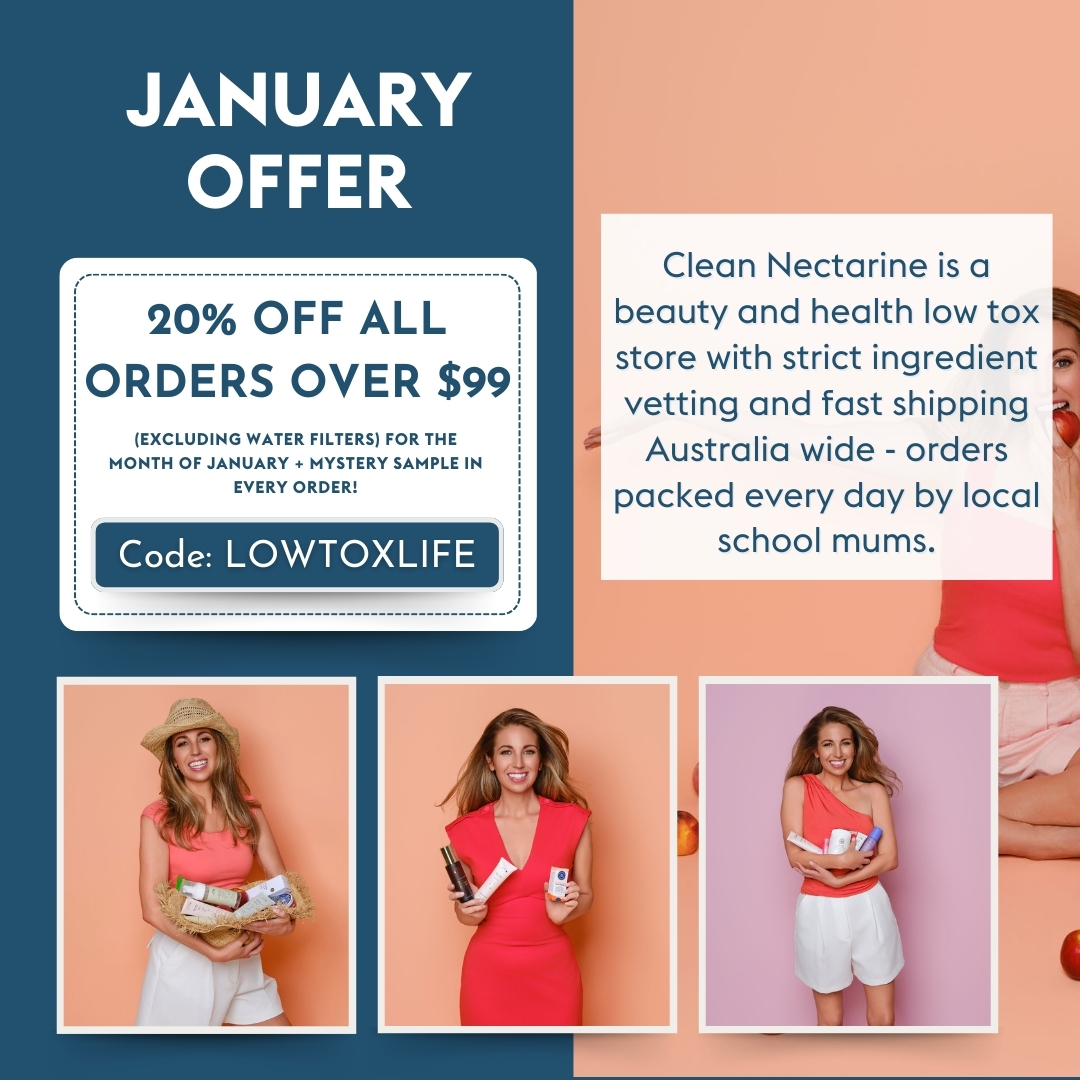
What to say about the good news that my good friend Irene Falcone is back on her terms with a brand new and beautiful low tox store – Clean Nectarine. Clean Nectarine is a beauty and health low tox store with strict ingredient vetting and fast shipping Australia wide – orders packed every day by local school mums. When Irene built Nourished Life to be the huge business it was it was no longer doable on her own. She thought selling it to a big company would be the answer but then had to watch them ruin all her hard work of 10 years and her legendary status as an amazing customer service focused business.
I just love and admire so much her resolve to start all over again on her terms and in a way that will work for her AND her customers.
And to celebrate it? Irene is giving us (Aussies) 20% off store wide with the code Low Tox Life
- This is excluding filters (you still have 12% off those on Waterscofilters website though remember till mid-September with code Low Tox Life)
So many things to love on the site – some of my favourite low tox businesses like Weleda, Mukti, 100% Pure (omg the apple enzyme products – helloooo fresh, vibrant skin!) and the Hurraw tinted lip balms. The only things I wear on my lips that don’t dry them out. I also love the 100% pure make up – the eyeshadows a fun yet natural and make me feel like I’m still wearing my skin, not covering it.
Enjoy taking a look around and making the most of the 20% off this month!
Instagram Link: https://www.instagram.com/cleannectarine/
Facebook Link: https://www.facebook.com/talkingclean
Website: https://cleannectarine.com.au/
***
Title show track, by LIOR.
Love the podcast music? You will hear excerpts from Lior’s track “Caught Up” – go check it out on iTunes or Spotify if you want to hear the whole song or album, Scattered Reflections. Co-written with Cameron Deyell, it’s a great song and I love the reflective energy of it – perfect for the show, right? Enjoy. Lior is always touring, so do check out his website. It is wonderful to hear him sing live, trust me.
Low Tox Club – The place to bring your low tox life to life.
Want to join a community of like minds and enjoy all the perks of being in the Low Tox Life inner circle such as an online membership platform, 50% off all our Low Tox courses, an awesome chat group, my monthly Q&A, and special guest star interviews for just $49AUD ($29USD/28EUR/23pounds) per YEAR? We have created a special place and set of resources to help you achieve your goals and it’s a wonderful place to be – MORE DETAILS AND REGISTRATION HERE.
***
If you would love reading like me or you just simply want to go through the full transcript, you can check below.
[Alexx Stuart] (0:00 – 9:22)If you want to feel hopeful about the food system we can build from today and into the future, today is the show for you. Hello and welcome to the LOTOX Life podcast. I am Alexx, your host, founder of the LOTOX movement, and today is show 417.
And I wanted to expand on the brilliant show that we did with Tammy Jonas, who has a PhD in agroecology, is a smallholder farmer herself, and has been a long time advocate and activist working with government at every level, both here in Australia and abroad, on better justice in the food system, in terms of accessibility, in terms of cultural appropriateness, in terms of uniting all eaters around ecologically sound food. So you could believe, subscribe to, have a preference for, have an allergy, whatever you prefer to eat, we can all unite and build a better food system together.
You will absolutely know this if you’ve read my second book, LOTOX Life Food, which you can grab anytime, or that comes free when you join the LOTOX club for 2025, a special offer. And I’ve got the details for that in the show notes. But there is just so much we can be hopeful for.
And I remember when I started the LOTOX movement, it was born for me out of a personal discovery of how much crap was in the packets of food I was eating. And I remember being excited when big companies like Campbell’s would announce that they were going GMO ingredient free, or when Hershey’s stopped using GMO sugar beet for sugar, or when M&M’s announced a couple of years ago that they were taking petroleum-based colours out of their colours. I remember I used to get really excited about those changes.
And in a way, they’re still positive, because when big, big companies affect change, of course the whole planet and the people eating feel those ripple effects. But what I get really excited about now is less red tape for smallholder farmers, more access for a wider range of people to not have to shop or depend on predominantly on big supermarkets that answer to shareholders, and a much more equitable, accessible, nutritious food system for all. That’s what pushes my buttons these days.
Not one additive in a 20-ingredient ultra-processed food is being changed to organic or non-petroleum. Yay. No.
Gluten-free cheesy pasta is still crap for our health. So I really have felt that personal transition towards simpler food, really well-grown food being more accessible to everyone. And that is why you see these types of shows, and not me on Instagram doing the safest gluten-free chip that you can buy.
Just to give you some context as to why you don’t see that kind of content from me. And there’s a place for that as well. We still need the safer party food if you’ve got to buy party food, or if you have to choose something for the carnival so your kid fits in.
I get all of that, and I’m really passionate about that as well. But if we’re really going to make a change, we’ve got to get to a place where we stop looking at people who are giving their kids a carrot in the park, like I used to, as if we were aliens, and congratulating us as the other option there, which I used to get as well. Oh, isn’t he good?
Or aren’t you good? It’s food, right? And so that’s what we really need to remember, the big picture goal that we’re working on here.
So with that in mind, I have found a fabulous, acclaimed author, social justice journalist, grew up as a farm girl, a wonderful woman from Florida, Stephanie Anderson, who actually is a professor in creative nonfiction. But she has written two books now, so One Size Fits None, brilliant book. And I’ve also read her new one, From the Ground Up, where she’s telling stories of women revolutionizing the regenerative agriculture space.
And we hear some of those stories and examples in today’s chat. But I really wanted to also unpack how the subject of food is nonpartisan. And often, farmers get stuck in the middle.
And you can be very aware of climate change and how it’s impacting farms. But you can also be very aware that a lot of government red tape can get in your way. And so I often feel like farmers are stuck between political divides.
And yet that also presents an opportunity for us to unite with our farmers where we overlap, which is everyone deserving access and fair priced food, fair priced for the farmer selling it, as well as fair priced for the eaters, enjoying it and nourishing ourselves. And so it is a very multi perspective topic. And we can come together no matter what our politics over food to discuss some of the real challenges that everybody faces.
So that is really some of the stuff we explore today. And I know a lot of low toxics are passionate. And I know we have a lot of people who vote in different ways on different sides.
But you know me, I’m always here for the overlaps and always here to make sure we hold everybody to the same standards for people and planet health always, when we’re talking about elected officials. So I hope you enjoy today’s show. I’ll hook into it in a little minute.
Of course, I need to share some fantastic partner offers. The wonderful clean nectarine is back. Irene launched clean nectarine at the start of 2024.
After having initially founded nourished life back in 2012. She moved away from that business had a non compete phase. And then of course, once she waited that out, she had seen some of the greenwashing that had crept up in the beauty space, and really wanted to put together a very strict, very high performance collection of brands from all price ranges across both supporting local business here in Australia and overseas.
And your offer this month is 20% off with the code low tox life any orders over $99. And it’s it’s just a great collection. It’s building every day as she grows school moms lovingly packing your orders, and a super tight eye on ingredient lists, even sometimes not allowing certain products from certain ranges in but others.
So if you shop clean nectarine, you know for sure it’s low tox. And, and I hope you enjoy making some beauty swaps. If you’re running out of a few things, or if you’ve had a couple of things on your wish list, go check it out clean nectarine.com.au and that’s available for New Zealand and Australia. And then of course, for our Aussies, we are definitely hitting the humid season now big time February is the I always joke about it like is it menopause or is it February here in Sydney and up the East Coast. So you have 10% off the already often discounted prices on ausclimate.com.au for their dehumidifier range, which I swear to you and many of you now know it is a life changer to have good dehumidification in place for when it’s raining, or when you hit a humid season, or when something springs a leak and you can thoroughly dry out the area when life happens. So valuable as an investment.
And then of course, their Winix air purifiers, air circulators and heating range, which keep that one in mind for the next couple of months because the Ausclimate offer is right through 2025. And I didn’t mention that the clean nectarine offer is through February 15. So enjoy those partner offers.
We are so appreciative of their support and the ability to also lift their voices and businesses as great makers and ranges of products. Now it’s time for this week’s show. Enjoy.
Hello, Stephanie, how you doing?
[Stephanie Anderson] (9:23 – 9:25)I am well. How are you Alex? [Alexx Stuart] (9:25 – 9:35)
I’m very well. And I am so excited about this subject. I love that back to back shows are featuring female farming voices. [Stephanie Anderson] (9:35 – 11:08)
Thank you. Yeah. So I decided to write from the ground up because of the it started with the pandemic really.
And I’m sure things in Australia weren’t going as well either. But we here in the U.S., we experienced such a food system collapse during that time. The big, sprawling, nationalized, globalized food system in which we operate just really failed.
We saw all the weaknesses in a top down approach. We saw the kind of command and control of having a really big food corporations model that controlled the supply. And so that really worried me.
I was thinking ahead to like, well, what about when we have a climate change related emergency or another pandemic or just any other shock to the system that we can’t foresee? And I thought, like, are these the images that we’re going to keep seeing for the next few decades or can we change it? And so I wanted to see, since I had looked at it before my first book, were there people that were really taking that that particular issue seriously?
And when I went out and searched, I kept finding women using that holistic perspective, using that kind of whole system approach where things like everything that’s happening on the land affects nutrition, affects distribution, affects our rural communities and our urban communities and just affects all these other things and the consumer’s ability to get the food at the end of that. So that was why I decided to write it. And I also thought that women just deserve to get the credit that they were earning out there when they were in these positions trying to move the needle forward.
[Alexx Stuart] (11:09 – 12:13)Absolutely. And I wanted to ask about the food system a little bit more before we dug into some of those individual stories, because a lot of people were really, you know, crappy about having to be limited by like one thing of beef or, you know, then seeing whole shelves, you know, here, it was all the memes about the toilet paper and there being no toilet paper on the shelves. But for me, far more worrying was the fact that whole foods were just off supermarket shelves.
And a lot of people don’t realise why, because if you look at how much food exists in the world, there’s plenty, even through a pandemic. But the way the food system is structured, that’s actually what the problem is. Can you step us through that so that we understand a little better?
Like, how does that happen every time there’s a big hurricane or a blizzard, like we get cleaned out? Why, when there’s so much food?
[Stephanie Anderson] (12:14 – 13:20)It’s a tangled web, to be sure. But it really starts with this fact that we have such a concentrated food supply. It is concentrated in the hands of, you know, first big farms, really big, very specialised farms that maybe grow a lot of one thing.
And when that, you know, that is sort of, you know, very, very controlled, tightly controlled. And then they’re selling then that same supply into the corporate food supply system that is also very tightly controlled. And then which is sort of pushing from one location, all these products out to the rest of the country, rest of the world.
And so that’s a system that’s pretty fragile. It can get, you know, if that’s one supplier is, for example, experiencing like a COVID related output problem, like we saw here in the US, for example, COVID outbreaks, horrible outbreaks, affecting our meat supply, people working in our slaughterhouses, our meat supply. And so if that’s concentrated into major, like factories, food processing facilities, that are suddenly not off, off the grid.
[Alexx Stuart] (13:21 – 13:33)Yes, and then COVID sweeps through, you know, wipes a few people out, you know, God forbid they die of it. But like, even if you’re just down with virus for a couple of weeks, that, you know, it can hit you really hard. [Stephanie Anderson] (13:34 – 14:08)
Yeah. And like, like, you know, eggs, things like eggs that are time sensitive. Milk was a big one here, vegetables that were time sensitive, all of a sudden, when that demand dried up, the farmers and the food suppliers just had nowhere to put it.
So it just got dumped. In many cases, they couldn’t, like reorient that system to get it where it needed to be places like food banks, places like, I mean, our emergency shelters, or people just who had suddenly lost their jobs and needed were suddenly food insecure. So like, that was a big problem as well.
And our broken localized and regional food chains, people were like, yeah, let’s talk about that.
[Alexx Stuart] (14:08 – 14:12)Because a lot of people say, why aren’t we all just trying to buy local more, but that’s not always easy. [Stephanie Anderson] (14:13 – 14:57)
Oh, it’s not. And, you know, here we have an issue where our local suppliers, though, they’re doing really great work out there, and they’re growing, but people are not always attuned to where to go to find them. And it’s sort of how to get how to access that food in an emergency.
And so people were looking around saying, where’s my local beef supplier? Where’s my local produce supplier? And they had a lot of I was proud of how people went to work to find that.
And so I just, I just feel like that was another issue that we don’t have as robust of a local system as we could, and we should, so that we can turn to people like that. And we don’t have to go through those big delays or collapses of the distribution chain, we can we can go next door sometimes.
[Alexx Stuart] (14:57 – 16:41)Yeah. And Stephanie, can you help us understand? Because one of the problems with the disappearance of smallholder farmers, well, actually, two is the aging farmer.
So the average age, we have that crisis, we then have the issue of so much red tape in small farms, even with vegetables now, as well as with meat products. And then, you know, maybe you’re a great farmer, but you don’t, you’re not a great marketer. And you don’t have social media.
You know, I see my lovely beef ladies at the markets. And I keep telling them, you know, I’ve got quite a few followers, like, why don’t we get you on Instagram, and I can post and you can maybe start doing some direct box selling. And they’re like, oh, that’s all a bit much for me.
And so we have quite a few issues. And then you add on top of that, that sometimes they end up feeling so pressured, and it’s all so hard. And then a big guy comes and offers you like just some piddly sum to just buy it all up.
And you think, you know what, does that mean the hard work is over, and I can just rest? Like I could see why farmers would get to the point where that would then finally become the only possible solution. So I love the romance of local, but I feel like there are quite a few steps that we need to examine to help smallholder local farms thrive.
What did you see? And what have you seen over the years to give a bit of hope that that can actually be revived and have smallholders thriving?
[Stephanie Anderson] (16:42 – 18:23)Yeah, that’s a great, great question. So you’re right. Farmers are aging out, which is scary in the sense that it can leave land to sort of get developed or to get into the hands of bigger and bigger farms.
But it also is an opportunity for young people to come back and to return. And as we build better bridges between young landowners or young potential landowners in need or renters or operators of any kind, and the people who have the land, that’s really great. And so I saw this in action in North Carolina, the state of North Carolina, with a mother-daughter duo.
And they have been able to combine, you know, the knowledge that their mother, the mother Carrie has, you know, many, many decades being involved with the farm, with a relative newcomer, her daughter Erin, who’s in her 20s, and who is also a talented farmer in her own right. But she also has that social media knowledge, she has that marketing, she’s able to tell the story of the farm in a really unique way. So I think bringing in the next generation can help solve some of that issue for farmers and marketing.
And I realize it is a challenge, especially, you know, in places may not have good internet or all those types of issues. But it’s also any small business kind of faces that issue. So it’s, you know, the more we can bring in people to help and support, especially on the farm, the better.
So that was one example of a really great, hopeful way that a small, you know, relatively here in the US, a small farm was able to kind of go over that, you know, solve that challenge and, you know, jump over that hurdle of how do I reach consumers? How do I stay current? How do I tell the farm story?
[Alexx Stuart] (18:23 – 18:41)Mm, I love that. What do we do as regular people who aren’t farmers to start actually being more proactive, in your opinion? I mean, you can obviously speak from the American perspective, but it’s the same here, for sure. [Stephanie Anderson] (18:42 – 20:23)
I mean, you know, it can be challenging sometimes, and I get it as well. But as much as we can in our schedules and given our financial situations, to try to seek those producers out and be able to find them. So your farmer’s market is the obvious way, but there’s a lot of ways that producers are moving even past the farmer’s market to do like the community supported agriculture, the CSA, where you’re able to buy shares of beef or shares of vegetables, or whatever the farm happens to be producing.
So participating in something like that, and also taking advantage of where in your local community, maybe a smaller regional, you know, because regional is also very good, you know, these producers who are a small label are producing, growing for a small label and then buying that, you know, food produced under that label to support them. So I’m thinking of when you go into your big box store, look for something like that, that’s grown somewhere in your region, you know, within a 500 mile radius or something like that, or that’s sourced from small farmers. And often that story is either on the packaging or available to you in other ways.
I also think that, you know, the way that we vote, the way that we know where we choose to put that political energy can also be a good way to support our farmers. I mean, voting with your, you know, your purchasing is great. And that’s like, sort of one thing you can do today to solve that problem.
But thinking about how you’re able to, you know, promote that in your daily life, and through the way that you’re able to, you know, extend your political will to whatever possible. So there’s all kinds of ways, you know, being a voice, being a consumer, and, you know, helping the next generation see that. And of course, women, of course, are really adept at that.
[Alexx Stuart] (20:24 – 21:32)Absolutely. And I think also about recognizing every level of government’s important. A lot of people just come out to play once every three or four years, depending on the country and leadership cycle.
And I just really think the real change happens at much lower levels of government, who are given seats at the table in the bigger government structures. But what I find interesting with farming is, especially if you’re a regenerative farmer, you’re clued into climate change, and you actually believe it’s real, and that things are happening that are man influenced, then you have this issue where you benefit from having smaller government. So let’s say with you guys, it’d be Republican governments.
But then you also benefit from governments that don’t say drill, baby drill. And so what do you do there? Do you then, is the focus really to just look at your local representatives and to just focus on the people who are supporting healthier food systems in that space?
[Stephanie Anderson] (21:33 – 21:35)Oh, I mean, I love that point that you just made. [Alexx Stuart] (21:35 – 21:45)
It’s really tricky because I feel like farmers are caught in the middle of the two negatives and the two positives of those two left and right differences. [Stephanie Anderson] (21:46 – 22:02)
Yeah. Oh, I know. And so I think one way to help address some of that divide, I guess, or that kind of perceived divide maybe between, is to focus on the many things that we have in common.
And just be careful how we talk about it.
[Alexx Stuart] (22:03 – 22:20)I think sometimes… 100%. That’s what I’m really trying to do.
I’m like so done with polarization, everybody picking a camp and then just going, well, it doesn’t matter about those issues because I’ve got my one issue covered. So I’m just going to turn a blind eye. And we need to actually just be on team human.
[Stephanie Anderson] (22:21 – 23:42)Yes. Yeah. I think that, you know, there might be farmers, there are data, at least in the US shows that there are farmers there who are acknowledging the climate is changing, or at least the conditions.
Maybe they don’t want to call it that, but conditions are changing. So thinking about how language influences our conversations and can also bring us closer together on what we do agree on because, you know, farmers, they definitely feel at risk and that’s always a huge thing on the farm. And it has been before we’re starting to see all these climate consequences that we’re seeing.
So talking them through the lens of risk and being like, now our risk level is changing. How can we reduce that? Some practices and different management and stewardship styles could help us reduce that risk and maybe less dependence on, you know, inputs that can change in price and become really expensive and are going to become harder to get as our oil resources draw down.
So like, I don’t know, things that can kind of… How we phrase things matters. And so trying to find the most neutral language can, I think, help.
But to go back to your point about local. Yeah, absolutely. Like local and sort of like state or like mid-tier government has a lot of influence and people, I encourage people to, like you said, be aware of that and participate in that, you know?
[Alexx Stuart] (23:42 – 24:45)Absolutely. I was following, I can’t remember his name, but he’s just got a book out recently, a young Republican farmer. But he’s now saying the whole like deportation thing is just going to kill farms.
Like, you know, like, and I just love seeing these multi-perspective thinkers who are able to actually step out of politics identities and say, well, you know, yes, I can believe in a more conservative style of government for me, for that person. But I can also see that this would be economically ridiculous if this actually happened. And it actually takes us all reading more than just headlines and following more than just influences on socials to get our political understanding of issues and to go much deeper and wider.
And I think when we do that, we can then accept different perspectives and debate more effectively to get real solutions happening for farmers everywhere.
[Stephanie Anderson] (24:45 – 25:32)Oh, yeah. Well, and it’s like we get food is so urgent, you know, I mean, yeah, that is something like that. We don’t really have the ability.
I don’t know that we don’t have this the to, you know, kind of let politics get in the way of our of our stable food supply and nutritious food supply that doesn’t make our kids sick, that doesn’t, you know, harm our environment to the point where we can’t produce food anymore. Like it’s such a like bipartisan common issue that once politics gets too much into it can I mean, it’s just the risk level is intolerable just when it comes to making sure that are the next generation is well taken care of. But also we can just make sure everybody has that food that they need.
So I know I would what you said really resonates with me.
[Alexx Stuart] (25:32 – 26:01)Yeah, I’ve been thinking about it a lot. And I think, you know, if you are then a thinker about those things, we then have a duty to just keep conversations flowing and and neutral and multifaceted instead of just, you know, ignoring whole sides of arguments, because it’s I think COVID made us too scared of any other argument on both sides. And, and I’m just trying to be less scared. [Stephanie Anderson] (26:02 – 26:48)
Yeah. I say this. That’s one reason I you know, when I was writing from the ground up, I was always and once I switched on to for that matter, I was always imagining an audience that came from a different, you know, maybe political perspective than I do.
And, you know, specifically farmers, and even more specifically, my people in my family that, you know, are probably going to disagree with some of the claims in the book, but, you know, that I would never want to alienate or whenever I want to, like, cut out of the conversation. So I try as much as with my writing to inhabit that space whenever possible. And, you know, sort of make it, you know, try to be persuasive through storytelling, but also not judgmental through, you know, language or tone or any of those things are chosen.
[Alexx Stuart] (26:48 – 27:02)That definitely comes through. You did a beautiful job. I think anyone would read that and feel where those farmers stories were coming from and feel what the implications are for all of us if we don’t join team human when it comes to the food system. [Stephanie Anderson] (27:03 – 27:03)
Yeah. [Alexx Stuart] (27:03 – 27:04)
Yeah. [Stephanie Anderson] (27:04 – 27:04)
Yeah. [Alexx Stuart] (27:05 – 27:17)
So let’s talk about some of the women that you highlight in this book. Yes. Who would you like to start with?
Like, I’m just gonna throw that over to you. There’s such powerful stories.
[Stephanie Anderson] (27:18 – 29:07)Yeah. Oh, thank you. I, I, just so I can sort of talk about someone that I haven’t talked about in some of these appearances before.
So yeah. So there’s a company in California, they’re called veritable vegetable and they’re run by three women who have basically been with this company since the seventies and yeah. And they’re incredible.
So they’ve been doing this work for a long time and they run the company now, you know, they’re, they’re the three people in charge of the owners of the company. And it’s like women, you know, it’s women owned, it’s primarily a women, a female for workforce. And it just sort of has evolved that way organically over the years.
And they really do a great job of prioritizing the farmers that they work with, long-term relationships, fair and economically responsible relationships that are not just sort of a extractive, you know, can we get what’s the lowest price we can pay our producers? And they just have a great like social and ecological consciousness with the company and it’s profitable. It is not just some sort of altruistic supported by outside money and doesn’t, doesn’t, you know, doesn’t make money.
It’s a business and it has been a business for many years. And it is profitable and it does it in a way that the profits are not, you know, sort of all going to the CEOs are all going to, you know, sort of shareholder, you know, lining the pockets of shareholders type of thing. It is responsibly, you know, it’s used, their profits are useless.
Everyone gets their living wage, their farmers get a fair price and they’re able to reduce their carbon footprint at the same time. And so I thought that their story was really inspiring because it’s, to me, it’s really convincing about how this holistic mindset can stand the test of time. And it can work in our, you know, very capitalist society here.
[Alexx Stuart] (29:08 – 30:33)A hundred percent. And it actually made me think a lot of the Bronner family with their soaps and how they, they have the cap of the five. I think executives can only earn five times per hour, what the lowest paid full-time worker earns per hour.
And so they cap that. And so they then have this fantastic cash to use in the community for different projects, even like creative projects. It doesn’t even have to be activism all the time.
It can be setting up an outdoor cinema for the summer and just making the community better. And I think, imagine if businesses beyond the kind of like social responsibility department that kind of ticks a few boxes to look like we’re doing good things on, you know, XYZ cancer day or this, you know, sustainability day where we all bring our own reusables to the office. Like that seems to be often quite tokenistic, but if you build a system that is literally geared to then have a committee that decides what community projects do we want to invest in to make our communities stronger, safer, better, more fun.
Like imagine if every company was wired like that. I love that story of those women and it’s, it’s possible. We actually just have to start knowing who they are and then supporting the ones who are doing it a great way.
[Stephanie Anderson] (30:34 – 30:39)Yeah, no, a hundred percent. I love that one. So thanks for asking. [Alexx Stuart] (30:39 – 31:25)
Oh no, so good. And so what about a regenerative example where someone has had to transition land? Like you mentioned expensive fluxing prices of chemical inputs.
I think that’s something that’s not that farmers are often not stepped through. And because you’re just so used to doing it for so long and because it’s so hard and such long hours, you don’t have much time to work on your business. You’re already like you’re in it 70 hours a week.
So it’s very easy to understand why people would just continue doing it the way they’ve always done it. But then if you just had enough time to step back, right, it’s only a generation and a half or so that has been doing it that way.
[Stephanie Anderson] (31:27 – 33:13)Oh yeah. I love, I love this question too. So in one of the chapters I highlighted a woman named Susan Jaster.
She is working within the research community and also just like the, what we call here in the United States, the extension service, which is basically like a land grant university program offers programming to help farmers in many different ways. But she’s really used that her job and her role in there to help farmers transition and just provide advice for, especially when transitioning from more industrial methods to more regenerative. So she helped a family that had been farming in Missouri, row crop farming, corn and soybeans, genetically modified, full on chemical production here, no rotations, all monoculture.
And they’d been doing that for three generations now. And so the generation on the farm currently was a young man named Josh. And he was farming alongside with his grandfather.
Unfortunately, his father passed away in a farm accident, but well, another consequence of industrial. But so anyways, he, Josh was farming with his grandparents and his grandfather was getting quite elderly. And so Josh was doing a lot of the work and he found it, you know, pretty, not very intellectually stimulating, but worse was that he kept getting sick.
He kept getting, having these reactions. He couldn’t figure out what’s going on. And he, his doctor finally diagnosed it as a agrochemical allergy.
He couldn’t be out in the fields. He couldn’t be near those agrochemicals. So they faced a choice, keep farming and do it grandpa’s way or do it the grandson’s way.
And by the way, he’d been trying to work in regenerative practices. Grandpa was giving him quite a hard time about it and not really allowing this to happen.
[Alexx Stuart] (33:14 – 33:15)This is really common. Yeah. [Stephanie Anderson] (33:15 – 34:48)
It is so common. So in that case, it forced the decision. But even better was that as Josh let some land go and leased it out, was able to reduce the operating acres, add more diversity, add things like livestock, no tillage, cover crops, a lot of rotation, all these types of things.
And he was also able to bring on his sister, Jordan, who had always been pretty excluded from the farm work and was now able to be brought in. It helped diversify the operation. And now both families are able to be on the farm.
And yeah, that power was able to give the family more stability, also bring in two sets of minds, two sets of eyes to look at things and able to regenerate their land, bring their soils back, make more money per acre. And just, yeah, they’ve had a really nice, successful transition over the years. And so that’s one story that I think gives me hope, particularly these days are younger people in their late thirties, early forties, which is for a farmer these days, relatively young.
And they’re able to have a future on the land and also be able to make money, support their families and fulfill the ecological goals that they have for that space. So, yeah.
[Alexx Stuart] (34:48 – 37:14)And that’s the thing, like the food system, as we know it now with so few people controlling it and so much monocropping and so much focus on profit as the metric for success beyond all other metrics. It’s finite because the soil will eventually be destroyed and very, very hard to recover that landscape. And so while we still have some soil, this is the time.
And we hear just transitioning energy sectors, for example, and giving mining communities time to transition into a new economy with energy. And there’s, I’m in two minds about that whole transition myself. I think there are some, I mean, it’s just, we swap what we’re mining and then it’s still finite.
So what are we doing here? So there’s still a lot of debate there, but the words just transition for me, it feels like we need just transitions across multiple sectors if we’re going to do life on earth better. And why would we not start incentivizing farmers to transition and support them?
And instead of, what do you call it? Subsidies for monocrops. What about subsidies for farmers who are putting their hands up to transition to more ecological ways of doing things?
I know in your country, things like Citizens United make that very hard because of the lobby structure and the influence of corporations on government. And we are often a bit of an America light in that regard as well. But I think we as consumers, as eaters, don’t realize we are uniquely placed to play a very major role in this just transition.
Even if it’s just two or three items that we swap out, if that’s all the budget allows right now, to just start somewhere with that relocalization and supporting regenerative that makes a huge difference to farmers feeling like it’s worth it as well as they see some sales coming through.
[Stephanie Anderson] (37:15 – 38:53)Yeah. And that’s where that kind of one size fits none approach, I think applies to because we need diversity within what we eat, what we’re shopping. It’s probably good to have diversity there as well, like we would want on the land.
And so we’ll get, not everything can come locally. So the things that we do buy that are sourced maybe from larger companies or from different places outside our region, if they were also produced in a regenerative fashion, imagine the impact of that. One woman I interviewed in the book was talking about how up till now, big food has been kind of a negative force in the food system.
But if we’re able to transition that and have our regeneratively sourced wheat and our granola bars that we buy or regeneratively sourced barley and the beer that we drink, whatever it is, imagine the impact if the big PepsiCo and the big general mills are able to have their farmers meet those standards, that will do them wonders as well with the government support, like hand in hand, we have to have the support so that those farmers can go at scale so that we can still have that kind of transition as well in that bigger space paired with the transition in the regional space and the local space. So I agree. I mean, farmers will do the things that make economical sense to them as well as what makes ecological sense.
But we’ve used the carrot of industrial production through things like subsidies for so long, there is no reason we can’t use that lever to transition the opposite direction.
[Alexx Stuart] (38:53 – 40:17)Mm hmm. For sure. Now, let’s talk about how most families shop in supermarkets and and then most of those shopping trolleys currently have processed foods.
And as you discovered, like through different communities and speaking with different farmers, what are some of the unique ways that you’ve seen some shifts, some more direct to farm selling as you started to? I mean, I know we’ve talked about social media and marketing, and I think that’s a key one. Are there any stories of hope there?
Because I think sometimes people just think, well, if I don’t go to the supermarket, what am I going to like 10 different places? Is that it? And then, you know, do people have time?
There’s so many pressures it feels like these days. And you speak about it beautifully at the start of that book, how COVID era, regardless of what you think of what that era meant or did, it definitely made everyone a bit more scared for the future and a bit more present minded. Like, let me just get through today.
And I feel like we’re still hung over from that. And that’s one of the things that affects being able to have the brain space to diversify places we get food from.
[Stephanie Anderson] (40:18 – 41:47)Right. I know it can be challenging, of course. And so it might take a little bit more research and a little more legwork to, you know, then simply just going into the supermarket to get everything you want, you know, kind of in one shopping trip.
That’s why what’s fun about like a CSA to me is that like you get a wide variety of things in most cases, you know, and there’s multi-farm CSAs. Like that’s how the model has sort of shifted here, responding to that consumer concern about, OK, I have to go here to get this thing and here to get that. You can now have the option to have what we call multi-farm CSA that brings in, you know, in one box, you’ll get products from all kinds of farms.
So you can get your fruits, your vegetables, your meat, your eggs, like your dairy, like all different things, whatever you want to sign up for, you know, or maybe some local or regionally produced pantry goods as well. You can kind of supplement that through a CSA that offers multiple things. And that’s one person I highlight in the book who’s doing that in New York, able to source everything from within 500 miles of the city from various farms and food makers.
So you can get everything from your pasta sauce to your eggs through your subscription with that person. So there are people out there that are trying to meet that need and realize that consumers don’t have as much. We’re all pressed for time.
So to try to make it easier while still honoring that regenerative commitment.
[Alexx Stuart] (41:49 – 42:20)One of the things I remember you talking about in the book is how the regenerative farming space is more welcoming. Can you unpack that a little bit? Because I think that’s a really, like, that is definitely what I feel when I started going to farmers markets and speaking to farmers and people who were passionate about, you know, leaving the land in a better way than they found it.
It feels like it’s attracting almost people who yearn for a better future then.
[Stephanie Anderson] (42:22 – 43:44)Yeah, I think one reason that regenerative tends to be more welcoming is that you kind of have to step outside of the industrial space. And so we all have that in common when we start to get into that movement. And there’s also a really strong network here in the US.
And I hope the same is true in Australia of like regenerative training on farms. So that’s where this generation of producers is, is getting that, that some of that knowledge that they may not have. And so it’s bringing together producers that are maybe grew up in cities, grew up with different backgrounds than the typical kind of white European ancestry farmer that, you know, might be having some of that experience or getting their experience from that.
And so I think that that kind of experience of going to farms, doing training together, kind of growing up in the movement. And when you think of, you know, the regenerative principles of diversity, and, you know, sort of health and working with nature, rather than against it, I think that naturally lends itself to people who are going to be more open minded and are going to be more willing to be in communication in community with one another, not and I don’t want to say that to the exclusion of anyone, you know, at all. But, you know, the industrial mindset does tend to be kind of command and control and that can leak over into the way operations are run or the way relationships can be handled in sometimes.
[Alexx Stuart] (43:45 – 43:51)Yeah, we’re like fighting to get what we need rather than collaborating to get what we need. [Stephanie Anderson] (43:52 – 44:37)
Yes. Like that’s one very frustrating thing for me about the industrial movement is that the get bigger, get out command forces you to be in competition with all of your neighbors and your fellow farmers. So where it becomes us versus them.
And when, you know, when they go out of business, it’s good for you because you can acquire their land and, you know, and sort of and when everyone’s growing the same thing, you’re competing on yields, but then it also higher yields will also drive down prices. So, you know, when you’re competing to grow the same type of corn or the same type of wheat, then that gets to be oversupply and then that hurts everyone. So like that kind of competitive mindset rather than a collective we’re in this together mindset.
I think it’s just been the detriment to our rural communities. A hundred percent of each other.
[Alexx Stuart] (44:37 – 46:32)Yeah. I think that I can’t remember his name right now, but the wonderful filmmaker who passed away recently, who did the supersize me documentaries and the follow-up, the sequel, where he went under the hood of the chicken and egg industry. And as you kind of see exactly what you just described, how farmers end up getting pitted against each other to try and undercut on pricing and completely disregard animal health to do so.
It was, it was such a fantastic, plain, tragic exploration of that system, but really helped show why we need something different. That’s not good for anyone. If you hate your neighbor because they got the sale to the big guy, then you didn’t.
And, you know, and then you, you hate your life because you’re always sick because you don’t even realize why the agricultural chemicals are getting you. And, and like, let’s not forget that you might not consciously think that it’s playing on you, that the animals you’re caring for are unwell. And there’s another dead one.
Like you might, it just might become so normal that you don’t even realize that somewhere deep down, it’s really hurting your soul to, to live in that environment and see that at work every day. And I think you don’t meet too many regenerative farmers with thriving businesses who, who have these sadnesses or emotional cutoff kind of vibes. The way you often see in larger industrial spaces, it’s like, you can’t afford to connect to nature because if you did, you’d almost fall apart at the reality of the situation.
[Stephanie Anderson] (46:34 – 47:09)Yeah. Wow. That’s, it’s absolutely true.
That resonates because, and I think that’s why a lot of young people who maybe have grown up on farms or the opportunity to farm, don’t really want to do it. I mean, it’s, it’s, it can be a bit depressing. It can be a bit monotonous.
It can be, you kind of, yeah, you have to shut off that emotional side of yourself, especially if you’re working with, with livestock in some cases. So yeah, I mean, regenerative does offer a more vibrant existence. I think something that kind of honors the, not only the land, but also kind of you as a human being and your family and.
[Alexx Stuart] (47:10 – 47:14)And you’re smart and your ability to read the land becomes so important. [Stephanie Anderson] (47:15 – 47:49)
Oh yeah. One farmer I interviewed for my last book, he says, we have too many D students on the farm, you know, students who are not using their brains, right. Or I didn’t think, you know, I mean, he meant what he meant by that was just, we have, we’re not challenging our farmers to be their full selves and to kind of engage and think dynamically and think holistically.
And you know, we just kind of have more, you know, we’re telling them, we just want you to focus on profits. We just want you to focus on yields. We want you to narrow your perspective instead of broadening it.
[Alexx Stuart] (47:50 – 48:31)Yeah. There’s a striking parallel as you talk there about with medicine and poor doctors who are like stuck between a rock and a hard place. You’ve got a short amount of time and they have to literally wait until things get bad to be able to prescribe things to fix them.
Anything subclinical is like, well, let’s just wait and see where this goes, even though someone could be in pain or sick. And it’s like, we have, we, we live in crisis and repair mode instead of nurture and, and prevent. And I think regenerative does nurture and prevent bad things from happening.
[Stephanie Anderson] (48:31 – 48:32)Yeah. [Alexx Stuart] (48:32 – 48:33)
Yeah. [Stephanie Anderson] (48:33 – 49:24)
No, it’s such a great point. It kind of reminds me of one of the women I interviewed in the book, Kelsey Scott, she said something I’m going to paraphrase here. Like when we see something that we don’t like, or a response in the environment that we don’t like, we have to sort of sit back and say, well, why did mother nature give me that?
Like that plant there, like, what was I doing to, you know, there’s no such thing as a weed. It’s just the way your management response. Yeah.
So like, you know, thinking about it that way and changing your mindset I think is, is a really powerful, powerful thing, you know, and, and recognizing that some like maybe what could be chaos in the industrial model is okay. Like it’s going to have some, it can have also unintended, but welcome benefits that we may not be able to see if we just eliminate it right away.
[Alexx Stuart] (49:25 – 50:34)Yeah. And I want to finish by asking you about a sense of can do like a lot of people, I feel like we’ve almost gone backwards with many people now struggling on grocery prices. So there’s this whole new challenge of trying to get cut through and get people to order direct from farms because if you’re a farmer who’s just transitioning, like that’s quite an expensive exercise to make those changes before you sometimes see the benefits financially.
And so it can be really expensive from even direct to consumer, you know, sending boxes out. And so I just kind of wanted to ask you, are you seeing anything hopeful happening there? Creative ways, people are finding ways to still access regeneratively produced foods by coming together as communities.
Cause a lot of people say, oh yeah, you know, regenerative is fine, but like, that’s for privileged people right now. I’m still like, should I buy the blueberries from the supermarket or not?
[Stephanie Anderson] (50:36 – 52:19)Right. Yeah. I know that has been, you know, I think probably a setback for the regenerative movement or even, you know, any kind of alternative to the big food model is that, you know, the prices were already higher in some cases, although they were coming down and coming in parity.
But so I would say, you know, just remember that transition takes time, like just so that, you know, and setbacks are going to be normal. Like, or there might be periods of your life where you’re not able to, you know, purchase the things that you, that you want in the moment or not as much of what you want in the moment. And that, you know, if there’s a gap, it can, you know, can be addressed later on when, when the situation changes.
So like, don’t be too hard on yourself, basically, if you’re finding that something that you want to buy is out of, out of reach at the moment, and don’t feel guilty about that. That, you know, that’s the economic realities that, that we’re in. And also, you know, I see regenerative producers, you know, are able to, because they’re able to set their own prices, they’re also able to set prices that are going to be as fair as possible.
So we did see a lot of price gouging, you know, here in the US where, you know, the corporate sort of profits were outpacing what they needed to cover inflation. Like that was clear. So we, when we have farmers who are going to have to look you in the eye and ask you to pay this, they’re going to charge you what’s fair so that they can have a living wage, but not that’s going to, you know, be exorbitant.
And again, do that whole corporate greed thing. So I think that’s a sign of hope that when we have people, real people involved in the system, there’s going to be a better balance between price and what’s, you know, the real cost of food.
[Alexx Stuart] (52:20 – 54:50)Yeah, absolutely. And, and I think if you shop at markets and things, there’s no harm in offering to buy double and get a dollar off or, you know, something like if something that’s high rotation in your family, I don’t know, a farmer that wouldn’t find that a reasonable exchange, plus they just get to sell more to one person. So then the profit is made that the economy is made that way, if you like.
I do that with eggs all the time and everyone’s always fine with it. It’s not, I’m not saying like, can I have like two eight, $8 egg dozens for like $10 or nothing ridiculous, but just like times by two minus a dollar. And if it’s over 15 bucks, no one’s ever said no.
So to actually just have like light chats about like, is it flexible? Could it be a dollar off if I got double? And I think we forget because we’re so used to just going through cash registers at supermarkets where it’s all fixed and you would never say that to like your Walgreens or Woolworths, but to a farmer who’s just there and they’ve driven in their truck and they’re like, yeah, that’s a sweet deal.
No problems. To be a bit more community chat minded around pricing. They can always say no too.
It’s not like you’re trying to pressure people. Um, but yeah, I find that, um, that usually works because they get to empty their truck if, um, if they do a few more of those over a course of a day. Um, yeah.
So, and then learning to cook, I think I just want to add that in. If you can cook, you are way more resourceful and the price of your meals comes down. People who have to follow recipe books and buy all the ingredients and they follow everything step-by-step that’s the most expensive way and most stressful in my opinion, way to cook.
Um, and like being able to just rustle things up with a couple of things you’ve got at a market and a couple of pantry items, bring it all together with a slow cook. Um, you usually can produce delicious things that don’t have to be, um, ridiculously expensive per person as well. I think I noticed, um, I noticed whenever I’m able to really save cash is the weeks where I go, let’s just, let’s just cook from what we actually have and be a bit more resourceful instead of always buying new stuff.
And that way I can actually make more of my spend regenerative sources.
[Stephanie Anderson] (54:51 – 55:26)Yeah. Yeah. And when you do that, you know, you’re controlling the nutrition, which is such a great thing because what, uh, the only thing going up faster, I think that, I mean, it’s just a hyperbole, but the only thing going up faster than food prices is healthcare.
So, you know, thinking about how that nutrition can save you money down the line, you know, through better health, better nutrition. Um, I, I just try to think about that too. Um, and, and how can I feed my body in a way that will help me not have to be in that kind of medical complex later on as much as possible.
[Alexx Stuart] (55:26 – 55:56)So I hope that to nurture and prevent it works across everything at Stephanie. It’s been so lovely chatting with you. I really, your book was so beautiful and you are an amazing writer.
I might just say like, I honestly felt like in times I was getting lost in a novel rather than a nonfiction with the way you described landscapes and things. It was really lovely. So thank you for your work and for elevating the voice of female farmers in from the ground up.
[Stephanie Anderson] (55:57 – 56:00)Thank you for having me. It’s been delightful. Thank you. [Alexx Stuart] (56:00 – 58:56)
I hope you loved today’s show as much as I loved bringing it to you. I want to remind you that if you are someone who craves a low-tox community that is judgment-free, full of empowerment, has health professionals and building health professionals that can support you as well as me in there answering questions multiple times a week, I want to invite you to join the low-tox club for the price of less than a cup of coffee a month. You have an annual membership for $49 Australian.
So it’s about $30 US or Euro that allows you to have a member masterclass every single month with a health professional or global expert from the podcast, where we have them to ourselves for an hour to ask questions and deep dive further. You have the beautiful supportive chat group. You have Q and A’s with me, me answering questions.
We read books and talk about them and a whole bunch more. You can head to lowtoxlife.com, hit the explore tab and join the club is the very first option on that list. Of course, we have over 10 evergreen courses that you can jump into anytime, whether it’s navigating everyday low-tox swaps with our go low-tox signature course, whether you have kids and you’re wanting to know how to best support them with our low-tox kids course, whether you’re planning a family and looking at a healthy low-tox preconception journey, reducing inflammation, especially the chronic kind without inflammation ninja course, many, many other courses. You can again, head to lowtoxlife.com, hit the courses tab and you’ll see all of the options, which includes a business course, my low-tox method program. A lot of people don’t know, but I was doing a lot before starting low-tox life in 2009. And I was a business consultant across hospitality, health, retail and cosmetics. I have been in business consulting for a very long time.
So I absolutely adore helping people move into the low-tox space or develop their low-tox businesses. So that’s a way I can support you. And then of course, there’s our wonderful social media communities at lowtoxlife on Instagram.
And of course the website with over 250 gluten-free recipes, blogs, downloadable PDFs to help you navigate wanting to get rid of synthetic fragrances in your school or office. I could go on. So head to lowtoxlife.com, see what takes your interest or fancy. And thank you so much for being a part of our podcast community. I love, love, love reading your reviews. I appreciate every follow and subscribe.
And I want to just remind you to finish off that if there’s anything you heard that you found interesting from medical or scientific perspective, it is intended as education only, please always chat to a health professional who knows you and your situation best. I’ll see you next week. Bye.
